World Class Textile Producer with Impeccable Quality

World Class Textile Producer with Impeccable Quality

Key Sourcing Takeaways
GSM is one of the most quoted numbers in apparel sourcing — and one of the most misread. Brands that specify only a fabric name on their bill of materials routinely receive bulk shipments with garment weights that are lighter, heavier, or inconsistent compared to their approved sample. The issue is rarely dishonesty; it is usually a specification gap that the factory fills with whatever material is available at the moment of production.
This guide is written for brand buyers and product developers who place garment orders — not for fabric technicians. It explains what GSM actually controls in a finished garment, how to include it correctly in your tech pack, what to expect from each major clothing category, and how to verify fabric weight before accepting a bulk shipment.
GSM stands for grams per square metre — the mass of one square metre of fabric cut from the roll before any garment construction takes place. It is the international standard for expressing fabric weight, and it appears in mill specifications, bulk fabric purchase orders, and finished-garment tech packs alike.
In garment production, GSM influences four practical outcomes:
What GSM does not tell you: Weight alone cannot tell you whether a fabric is durable, warm, breathable, or good for printing. A 320 GSM cotton fleece can pill heavily after ten washes while a 200 GSM polyester interlock remains structurally intact for years. GSM is one input into fabric selection — not the only one.
The most common reason brands receive garments with the wrong feel or weight is a vague bill of materials (BOM). Writing "cotton jersey" without a GSM value gives the factory full discretion to use any material that fits the general description — and their selection is usually driven by what is available in the dye lot they are running, not by your product goals.
A production-ready fabric entry in a tech pack should include at minimum:
Specifying GSM as a range (rather than an exact figure) is intentional. Fabric mills produce to weight tolerances of approximately ±5–10%, and finished garments undergo wet processes that can alter weight by a similar margin. Defining an acceptable range — for example, 220–240 GSM — tells the factory what you will and will not accept at quality inspection, without creating a standard that no real fabric can reliably meet.
Example of a weak spec: "French terry, approx 300g"
Example of a production-ready spec: "85% cotton / 15% polyester French terry, 300–320 GSM, brushed interior, pre-shrunk"
If you are in early development and not yet certain of the exact weight, indicate a reference point and ask for factory guidance during the sampling stage. A note such as "mid-weight French terry, target 300–320 GSM — open to factory recommendation on construction" gives the factory a clear anchor while preserving flexibility.
For brands building their first tech pack, working through the full specification format — including GSM, construction, and finishing — is covered in detail in our guide on tech packs for clothing manufacturers.
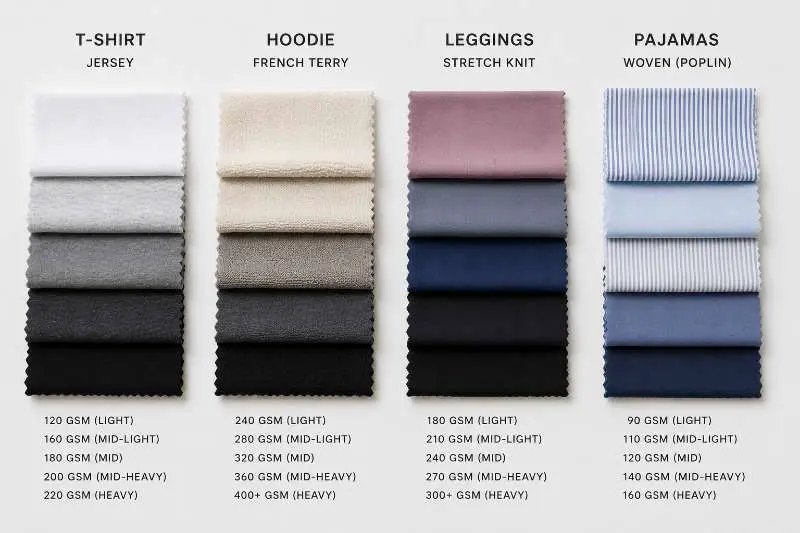
Different garment categories operate in distinct GSM bands, and the logic behind each band is specific to how the garment is worn, constructed, and tested by the end customer. The table below provides directional GSM ranges by category. All specific values should be confirmed with your production partner during the sampling stage.
| Garment Category | Typical GSM Range | What GSM Affects in This Category | Key Consideration |
|---|---|---|---|
| T-Shirts (knit jersey) | 140–220 GSM | Opacity in light colours; print adhesion; shrinkage after wash; drape against the body | Lower-GSM garments in light colours need opacity testing at sampling — a white T-shirt that photographs well at 160 GSM may be unacceptable at 140 GSM |
| Hoodies & Sweatshirts (fleece / French terry) | 280–450 GSM | Structure and silhouette retention; seam bulk at hood and cuffs; weight perception as quality signal in streetwear positioning | French terry and fleece of the same GSM behave differently — French terry has a looped interior (lighter feel), fleece has a brushed interior (heavier feel); specify construction alongside weight |
| Leggings & Activewear (stretch knit) | 180–300 GSM | Opacity under stretch (squat-proof performance); four-way stretch recovery; compression level | Stretch fabrics are measured at rest — a 200 GSM nylon-spandex blend will feel significantly lighter in wear than 200 GSM cotton jersey; do not compare across fabric types by weight alone |
| Pajamas & Loungewear (woven / knit) | 120–220 GSM | Softness on skin contact; breathability for sleep use; seasonal positioning (lighter for warm markets, heavier for cold-weather markets) | Woven pajama fabrics (poplin, flannel, satin) and knit pajama fabrics (jersey, waffle) should not share the same GSM benchmarks — woven fabrics at the same weight feel fundamentally different |
| Polo Shirts (piqué / interlock) | 180–260 GSM | Surface texture and structure retention after repeated wash; embroidery base stability | Piqué construction at the same GSM feels lighter and more textured than interlock — both are common for polo shirts, and the right choice depends on end-use (sport vs. corporate uniform) |
Table note: All GSM ranges above are directional references. Confirm target weight with your production partner and lock the specification in the tech pack before sampling begins.
A question that comes up regularly in product development is why two garments at the same listed GSM feel completely different. The answer is construction and fibre type.
Consider a 220 GSM cotton single jersey versus a 220 GSM nylon-spandex four-way stretch fabric. The cotton jersey will feel noticeably heavier, less elastic, and more opaque. The nylon blend will feel lighter in hand, significantly more stretchy, and may be nearly transparent under tension. Same weight; completely different garment performance.
This is why GSM should always appear in your tech pack alongside — not instead of — the fabric construction type. The combination of fibre content, knit or weave structure, and GSM is what determines how a garment will actually perform in use and in production.
Even with a well-written tech pack, GSM can shift between an approved sample and bulk production. The most common causes are:
Before accepting a bulk shipment, brands can take the following steps to verify that fabric weight falls within the approved specification:
At Runtang, GSM specification and verification are built into the sampling workflow from the first proto stage. Brands that lock fabric weight — including the acceptable variance range — at sample approval experience significantly fewer disputes at bulk delivery. If you are unsure how to structure your QC process around fabric specifications, our production team can advise during the development stage.
GSM is not only a technical specification — it is a positioning decision. The weight of the fabric in a finished garment communicates quality, seasonality, and price-point to the end customer before they look at a label or a price tag.
Lower-GSM garments in most categories are typically positioned as accessible, warm-weather, or entry-level products. They have lower material cost, which can translate into a lower retail price or higher margin depending on the brand's model. The trade-off is that lightweight garments require careful opacity management — particularly in light colours — and may communicate a less premium feel to customers in markets where weight is associated with quality.
Mid-weight fabrics represent the highest volume of bulk orders across most garment categories. They balance material cost, wearability across seasons, and customer quality perception in a way that works for a wide range of brand price points. For new brands placing their first significant bulk orders, mid-weight specifications are generally the most practical starting point — they are well-understood by factories, easier to source consistently, and tend to produce samples that convert quickly to approved bulk.
Higher-GSM garments — particularly in the hoodie and sweatshirt category — carry a strong premium signal in streetwear and lifestyle markets. A brand positioning product in this segment typically specifies construction and weight explicitly as part of its marketing narrative ("420 GSM" as a product feature, for example). The production implications are real: heavier fabrics require more careful seam engineering, longer dye cycles, and higher freight weight, all of which affect total landed cost.
For brands considering heavyweight garments, confirming all construction-specific parameters — including seam type, stitch density, and zipper or hardware load-bearing capacity — alongside the GSM is critical before sampling begins.
Ultimately, the right GSM for your garment line is not a single number — it is the intersection of your target customer's quality expectations, the retail price point you are building toward, and the production reality of what a factory can deliver consistently at bulk. The development stage, and specifically the sampling conversation with your OEM clothing manufacturer, is the right time to work through that alignment.
For category-specific sourcing decisions, compare fabric weight against the garment program you are developing: custom T-shirt programs, hoodie bulk production, activewear leggings, or custom pajama sets.
At minimum, include fibre content and percentage, fabric construction type (e.g., single jersey, French terry, piqué), and GSM as a range rather than a single number. Adding the finishing treatment — such as pre-washed or brushed — gives the factory the full picture. Avoid writing just a fabric name without a weight, as this allows factories to substitute any material that broadly fits the description.
Yes, it can. Wet processing — dyeing, enzyme washing, and finishing — can alter fabric weight from the pre-production measurement. This is why specifying a GSM range (rather than a single figure) with an agreed tolerance is important. Request the factory's GSM test report for the bulk fabric, not just the grey goods, to confirm the finished weight falls within your approved specification.
Warm-weather markets generally favour lower-GSM fabrics within each category — lighter jersey for T-shirts, lighter woven or jersey constructions for loungewear, and mid-weight performance fabrics for activewear. The specific range depends on the garment type and construction. Discuss target GSM with your production partner in the context of the end market climate, and request fabric swatches in multiple weights before committing a range to your tech pack.
Changing GSM after a sample has been approved typically requires a new fabric sample and at minimum a counter sample for approval — it is not a minor adjustment. A GSM change affects fabric cost, cut pattern efficiency, and potentially seam and stitch specifications. If you anticipate wanting to compare weights, request two sample versions in the first proto round rather than revising after approval.
Fabric weight is one of the first decisions that shapes everything downstream — from how your garment feels to how consistently it delivers across bulk runs. If you have a target GSM in mind, or if you are still working out what the right weight is for your product, share your tech pack or a brief description of the garment and we will advise during the sampling stage.
Not sure where to start? Drop us a message and we will walk through fabric selection with you before you commit to a sample.
 Customization & Craft Guide
Embroidery vs Print for Custom Apparel: Durability, Cost and Bulk Quality Compared
READ MORE Leggings Related
What Makes Leggings Squat-Proof? A Fabric and Construction Guide for Brands
READ MORE T-shirts Related
T-Shirt Sourcing Guide: Single Jersey, Interlock and Slub Jersey for Brand Buyers
READ MORE Garment Material Insights
Nylon vs Polyester Activewear: A Fabric Decision Guide for Apparel Brands
READ MORE Pajamas Related
How to Quickly Lay Out the Christmas Pajama Market
READ MORE