World Class Textile Producer with Impeccable Quality
World Class Textile Producer with Impeccable Quality

Key Sourcing Takeaways
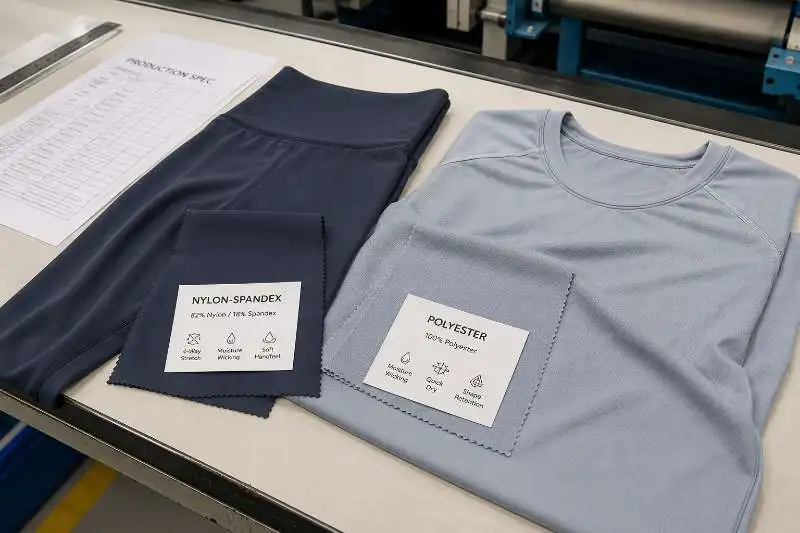
Every activewear brand faces the same early decision: nylon or polyester? Get it right and your sampling round runs smoothly. Get it wrong and you're back to a second sample, an unplanned cost, and a delayed launch window. The fabric choice affects not just how the garment feels — it determines your print options, your cost structure, and what your factory can realistically deliver at bulk.
This guide covers what apparel brands and buyers need to know from a production standpoint, so the right spec goes into your tech pack before the first sample is cut.
Both nylon and polyester are petroleum-derived synthetics, and both dominate activewear production globally. The similarities stop there. From the moment fabric is knitted to the moment a garment is washed for the tenth time, these two materials behave differently — in ways that matter for brands placing bulk orders.
The table below summarises the key production-relevant differences. The sections that follow explain what each one means for your sourcing decisions.
| Property | Nylon | Polyester | Brand Implication |
|---|---|---|---|
| Hand-feel | Smooth, silky — premium feel against skin | Slightly coarser; softened by enzyme/silicon finish | See section below |
| Moisture behaviour | Slightly hygroscopic; comfortable for low-moderate intensity | Hydrophobic; faster dry; better for high-sweat use | See section below |
| Stretch recovery | Superior — returns to shape reliably after washing | Good — holds cut silhouette; less elastic over time | See section below |
| Abrasion resistance | Higher — suits leggings, sports bras, compression wear | Sufficient for jerseys, team wear, standard gym tops | See section below |
| Sublimation printing | Not compatible — solid colours or applied branding only | Best suited for dye-sublimation printing | See section below |
| Typical cost | Higher cost than comparable polyester blends | Lower entry cost; wide mill availability in China | See section below |
| Sustainable option | Recycled nylon (Econyl) — limited mill availability | Recycled polyester (rPET) — documentation may be available | See section below |
Use this table as a starting framework. The right column — Brand Implication — is expanded in the product-type decision guide below.
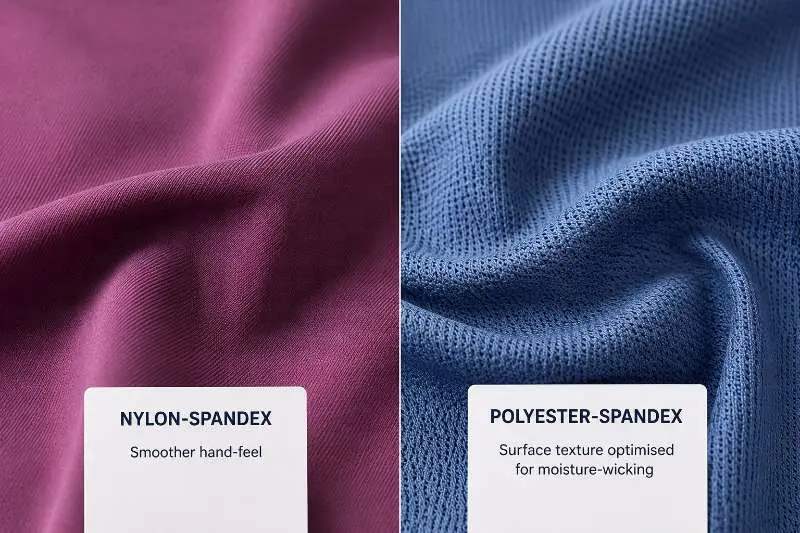
The answer is almost always product-driven. Rather than picking a "better" fabric in the abstract, the cleaner approach is to match the fabric to the garment's primary performance requirement.
| Product Type | Recommended Fabric | Why |
|---|---|---|
| Leggings (gym/yoga/ high-waisted) | Nylon | Superior stretch recovery; retains second-skin fit after repeated wear and washing |
| Sports bras & crop tops | Nylon | Softness and elasticity are primary purchase drivers |
| Seamless leggings & bodywear | Nylon or nylon-blend | Check mill availability; seamless knitting uses different yarn counts |
| Team jerseys & training tops | Polyester | Shape retention; moisture-wicking under high-intensity use; easier sublimation |
| All-over print activewear | Polyester | Best for polyester-based sublimation printing |
| Outdoor / UV-exposed garments | Polyester | Better UV resistance than untreated nylon |
| Premium lifestyle sets | Nylon or blend | Position at a higher price point; hand-feel is the key differentiator |
The table reflects general production guidance for brands developing gym leggings production styles. Specific blend ratios — such as the spandex percentage needed to pass opacity checks for leggings — depend on knit construction and GSM, and should be confirmed with your factory during the sampling stage. For brands developing yoga-focused leggings, comfort, recovery, and opacity should be evaluated together during sampling.
One category worth flagging separately:
Seamless leggings. Seamless knitting uses a fundamentally different production process from cut-and-sew, and yarn specifications differ accordingly. If your product line includes seamless styles, confirm fabric availability with your factory before locking in your spec — see our seamless leggings manufacturing page for more on the process.
This is the decision point most brands miss until they're already in sampling. Dye-sublimation printing is primarily designed for polyester fabrics and achieves the most reliable colour transfer on polyester-based materials. The dye-sublimation process requires the dye to bond chemically with polyester fibres. It will not transfer correctly onto nylon or any natural fibre.
The practical consequence is direct: if your activewear design relies on all-over printing, complex colour patterns, or gradient backgrounds across the full garment, you need a polyester base. Nylon is not an option for those styles, regardless of other performance preferences.
For nylon garments, branding and decoration are applied through:
For your product line, the print decision and the fabric decision need to happen in the same conversation. If you're developing a style range that mixes sublimation-printed tops with plain leggings, you may end up specifying polyester for the tops and nylon for the leggings — which is a common approach for brands that want to offer both performance prints and premium basics.
Choosing the right fabric is only half the work. The other half is making sure that choice is written into your tech pack precisely enough that the factory cannot interpret it differently — because they will default to whatever they have in stock if your spec is ambiguous.
When working with an OEM production partner, fabric specifications should be finalized before sample development starts. From a factory intake perspective, these are the fields that must be confirmed in your tech pack before sampling begins:
State the fabric as a percentage breakdown: for example, nylon/spandex at a specific ratio, or polyester/spandex at a specific ratio. Do not write "nylon blend" or "performance polyester" — these are not actionable specs. The spandex percentage is particularly important for leggings: higher spandex content increases compression and stretch recovery, but also raises fabric cost. The right ratio for your product depends on the intended use and price point — confirm this with your factory during the fabric development stage.
GSM determines the fabric's weight, opacity, and structural behaviour in production. For leggings, a heavier GSM generally improves opacity and reduces the risk of sheerness under stretch. For sports tops and jerseys, a lighter GSM improves breathability and reduces bulk. Specify a target GSM range in your tech pack, and request a GSM test result at the fabric inspection stage.
Different knit structures (single jersey, interlock, double-knit) produce different surface textures, weight distributions, and stretch directions — even at the same fibre composition and GSM. If you have a reference fabric or benchmark garment, provide it. If you are developing a new spec from scratch, ask the factory to provide swatch options at the agreed fibre composition and GSM range before the first sample is cut.
Depending on your product type and target market, you may need the factory to confirm specific performance benchmarks before bulk approval. Common checks for activewear include:
Brands working with an OEM production partner should request fabric swatches and performance test references before committing to sample development. Locking the fabric spec before sampling is one of the most effective ways to reduce the number of revision rounds — and the most common reason brands go through multiple sample rounds is an underspecified fabric brief.
For brands with sustainability commitments or buyers requiring environmental documentation, recycled polyester (rPET) is the most accessible option in the activewear category. Made from post-consumer PET bottles or post-industrial polyester waste, rPET performs comparably to virgin polyester in most activewear applications and is available from multiple mills in China that may offer Global Recycled Standard (GRS) documentation, subject to certification scope and supply-chain verification.
From a brand buyer's perspective, the key checkpoint is the chain-of-custody documentation. Receiving a certificate that says "GRS certified" from a supplier is not the same as confirming that the specific fabric used in your order is covered by that certification — the scope of the certificate must include the material type and production site. For guidance on how to verify recycled material claims against GRS documentation, Textile Exchange publishes the GRS standard reference, including what the certification scope should cover.
Recycled nylon (commercially known under trade names such as Econyl) is available but has a smaller mill base and typically involves longer lead times. If recycled nylon is a requirement for your line, flag this at the inquiry stage — availability varies by factory and order volume.
Yes, and many activewear brands do. A common approach is to use nylon-spandex panels in high-contact areas (seat, inner thigh, waistband) for durability and comfort, with polyester-spandex panels in the front or back body where sublimation printing is applied. This adds complexity to the tech pack and may affect MOQ requirements — confirm panel-by-panel specifications with your factory before sampling.
Neither shrinks significantly when produced correctly, but both are sensitive to heat settings during dyeing and finishing. Incorrect heat during processing can cause dimensional instability in either fabric. The risk is higher with nylon if the factory's dyeing process is not calibrated for polyamide fabrics — which is why confirming a factory's experience with your chosen fibre type matters before placing a bulk order.
This depends on the GSM, knit construction, and the specific opacity standard you are testing against — there is no single universal percentage. Brands typically work with their factory to confirm opacity at the fabric development stage, using a specified lighting condition and stretch level. Opacity is influenced by fabric weight, knit construction, colour, and stretch level, so laboratory testing and sample evaluation are more reliable than relying on a single spandex percentage.
Developing an activewear collection starts with the right fabric specification. Whether you're comparing nylon and polyester for leggings, sports bras, or training apparel, early fabric decisions can reduce sampling revisions and improve bulk consistency. Share your tech pack or product brief with our team and we'll help evaluate suitable fabric options, print compatibility, and production requirements before sampling begins.
 Hoodies Related
How to Find a Hoodie Manufacturer for Your Clothing Brand
READ MORE Leotard Related
Custom Dance Costumes OEM: How Studios and Brands Order in Bulk from China
READ MORE Top Clothing Manufacturer Recommend
Top 8 Clothing Manufacturers Around the World
READ MORE Leggings Related
How to Start an Activewear Brand: From Design to OEM Production
READ MORE T-shirts Related
How to Find a T-Shirt Manufacturer for Your Apparel Brand
READ MORE