World Class Textile Producer with Impeccable Quality

World Class Textile Producer with Impeccable Quality

Key Sourcing Takeaways
The question of embroidery versus print comes up in almost every custom apparel development conversation — and the answer is rarely the same twice. The right method depends on your garment construction, the complexity of your artwork, your target order volume, and how the finished product will be used by end customers.
What most comparison guides leave out is the factory side: how each method affects your production file requirements, sampling lead time, and batch consistency once you move from samples to bulk. This guide covers both perspectives — so your brand can make a confident decision before artwork is submitted.
At the production level, embroidery and printing are structurally different processes — not just aesthetically different outcomes.
Embroidery stitches thread directly into the fabric using a multi-head machine. Before production begins, your artwork must be converted into a digitization file — a stitch-by-stitch instruction set that tells the machine how to move, how dense to stitch, and which thread colors to use. This file is a one-time setup cost, but it is artwork-specific: changing the logo size or complexity requires a new digitization.
Print methods apply ink (or heat-transferred film) to the garment surface. The artwork file format varies by method — screen printing requires color-separated film positives; DTG and DTF accept standard high-resolution raster files. Setup costs and lead times differ accordingly.
For brands placing bulk orders, the practical implications are:
Confirming the decoration method before sampling matters because it determines what artwork files your factory needs, which directly affects how quickly sampling can begin.
"Print" is not a single method. Brands ordering custom apparel typically encounter four distinct printing techniques, each with different production requirements and performance profiles.
| Method | Best For | Setup Cost | Bulk Cost/Unit | Design Limit |
|---|---|---|---|---|
| Screen Print | Large runs, bold graphics, tees & hoodies | Medium (per color) | Low (scales well) | Limited color gradients; max ~6–8 colors typically |
| DTG (Direct-to-Garment) | Photo-quality artwork, short runs | Low (no screens) | High (does not scale) | Full color, photographic |
| DTF (Direct-to-Film) | Hard fabrics, nylon, small-batch multi-garment | Low | Medium | Full color; transfer can peel on stretch fabrics |
| Heat Transfer / Sublimation | All-over prints, performance fabric | Low–Medium | Medium | Requires 100% polyester for full sublimation |
Table note: Cost descriptors (Low / Medium / High) reflect relative positioning within typical OEM bulk production scenarios. Specific unit pricing depends on order volume, number of colors, and garment weight — confirm with your factory at the RFQ stage.
For most brands ordering hoodies and t-shirts in medium to large quantities, screen printing is often the most cost-efficient option for large graphic designs.
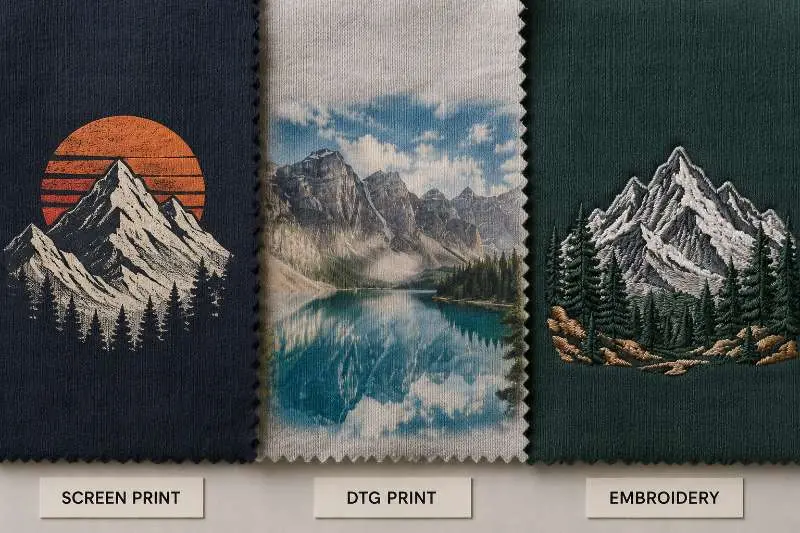
Decoration durability is not just about the method — it is about how the method interacts with the specific fabric construction and how the garment will be used. Here is how the main methods compare across the product categories most relevant to bulk apparel orders.
| Garment Type | Embroidery | Screen Print | DTG / DTF |
|---|---|---|---|
| Heavyweight hoodie (300–420 gsm fleece) | Excellent — thread anchors well in thick pile; logo retains shape after repeated washing | Good — plastisol or water-based ink bonds well; avoid high-heat drying | Fair — DTG ink absorption can vary on loopback fleece; pre-treatment required |
| Polo shirt (piqué or interlock knit) | Preferred — structured fabric holds stitching cleanly; standard for corporate and brand polo programs | Acceptable for chest graphics; chest logo areas on piqué may show ink unevenness on texture | Not typical; piqué surface texture can affect DTG adhesion |
| T-shirt (160–220 gsm jersey) | Limited — embroidery adds weight and stiffness to light jersey; works for small left-chest logos only | Excellent — smooth jersey surface is ideal for screen print; consistent results at high volume | Good (DTG) — suitable for full-color artwork; wash durability improves with quality pre-treatment |
| Leggings / stretch activewear | Not recommended — embroidery is incompatible with high-stretch four-way fabric | Possible with stretch-compatible inks, but coverage consistency can vary on spandex blends | Sublimation preferred for all-over patterns; DTF can work for small logos on lower-stretch panels |
Table note: GSM ranges are directional. Fabric weight interacts with construction (knit structure, yarn type) — confirm decoration compatibility during the sampling stage before committing to bulk.
A common sourcing mistake is selecting a decoration method based on aesthetics alone, then discovering during sampling that the ink or thread does not perform as expected on the chosen fabric. Sharing your fabric specification alongside your artwork file when briefing a factory helps avoid this mismatch.
Polo shirts occupy a specific position in the embroidery vs print decision: they are the one garment category where embroidery is the dominant choice across virtually all brand applications — from corporate uniforms to premium retail.
The reason is structural. Piqué and interlock knit constructions — the two fabrics most commonly used for custom polo shirts — have a textured surface that interacts differently with ink than smooth jersey does. On piqué in particular, screen printing ink has to bridge across the raised knit texture, which can create a slightly uneven appearance at close inspection, especially on lighter-colored base fabrics.
Embroidery, by contrast, stitches through the fabric rather than sitting on top of it. The result is a raised, clean logo edge that holds its definition regardless of the fabric's surface texture.
Practical considerations for polo embroidery at bulk order stage:
For brands considering screen print on polo shirts — typically for a larger back graphic or full-color artwork that embroidery cannot reproduce — water-based inks on interlock fabric (smoother surface than piqué) tend to give cleaner results. Confirm garment fabric type before committing to the print method.
Rather than a binary choice, most brand apparel programs end up using both methods across their product range — embroidery for structured garments and brand signature pieces, print for casual and promotional lines. The decision matrix below organizes the key variables.
| If your order looks like this… | Garment | Recommended Method | Why |
|---|---|---|---|
| Simple logo, 1–4 colors, 100–300 pcs | Polo, heavyweight hoodie, jacket | Embroidery | Premium finish; holds up to repeated washing; digitization cost is manageable at this volume |
| Complex graphic, 4+ colors, 200+ pcs | T-shirt, casual hoodie, sweatshirt | Screen Print | Cost-per-unit drops significantly at scale; handles large artwork and color gradients better than embroidery |
| Photo-quality or full-color artwork, 50–150 pcs | T-shirt, tote, lightweight casual | DTG | No screen setup fees; full-color reproduction; suitable for shorter test runs |
| All-over pattern, performance or polyester fabric | Leggings, sportswear, swimwear | Sublimation / DTF | Only methods compatible with stretch and synthetic fabrics at full coverage |
| Mixed logo sizes across multiple SKUs | Polo + tee + hoodie line | Embroidery (polo) + Screen Print (tee/hoodie) | Match method to garment type; combining both is standard practice for multi-product brand programs |
Table note: Order quantity thresholds above are directional references. Actual cost crossover points depend on color count, artwork complexity, and factory-specific setup fees — get a comparative quote for both methods when in doubt.
Beyond decoration selection itself, brands should also evaluate supplier quality-control processes and supply-chain management practices. The AAFA Supply Chain Resources provide useful guidance when assessing long-term manufacturing partners.
One additional consideration: brands scaling from a test run to a full production run should confirm that their chosen factory can handle both methods in-house. Splitting decoration across two vendors adds coordination complexity and can introduce color matching inconsistencies between embroidery thread and screen-print ink for the same brand mark.
For a broader look at how print method selection fits into the overall OEM customization process, the garment print methods comparison guide covers screen print, DTG, heat transfer, and sublimation across all major garment categories.
Yes — combining methods on a single garment is possible and sometimes used for premium positioning (for example, an embroidered chest logo with a screen-printed back graphic on a hoodie). It does add production steps and cost, so confirm whether your factory handles both in-house to avoid cross-vendor coordination issues.
For embroidery, your factory will convert your vector artwork (AI, EPS, or high-resolution PDF) into a digitization file — this is done by the factory and typically carries a one-time fee. For screen printing, color-separated vector files are preferred. For DTG and DTF, high-resolution PNG or TIFF files with transparent backgrounds work best. Always confirm file requirements with your factory before the brief stage.
Not all. Embroidery performs best on stable, non-stretch fabrics — piqué polo, fleece hoodie, denim, canvas. It is generally not recommended for high-stretch activewear or very lightweight jersey (below roughly 150 gsm) where the embroidery frame tension can distort the fabric. Your factory should flag fabric incompatibility during the sampling review.
The crossover point depends on color count and design complexity, but as a directional reference, screen printing typically becomes more economical than DTG at quantities above approximately 100–150 units per design for a 1–2 color artwork. Multi-color designs break even at higher quantities. Request a comparative quote from your factory for both methods when your order is in the 80–200 unit range.
For embroidery, request Pantone-referenced thread matching during sampling and approve the thread color card before bulk production begins. For screen printing, Pantone spot colors can be matched, though process printing (CMYK) introduces more color variability. Approving a physical strike-off sample for both methods is the most reliable way to lock in color before bulk.
Not sure which decoration method fits your next product line? Share your artwork file and target garment — our team reviews your design and advises on the most suitable method for your order volume before sampling begins.
Browse our custom hoodie production and graphic t-shirt manufacturing pages to see decoration options by product, or contact us directly to discuss your project.
 Hoodies Related
How to Choose the Right Blank Hoodies Manufacturer for Your Brand
READ MORE Top Clothing Manufacturer Recommend
Top 8 Hoodie Manufacturers in China
READ MORE Pajamas Related
How Social Media Is Driving Christmas Pajama Sales
READ MORE Customization & Craft Guide
Garment Print Methods Compared: Screen Print, DTG, Heat Transfer and Sublimation
READ MORE Customization & Craft Guide
Lab Dip and Bulk Color Approval for Custom Apparel Orders: A Brand Buyer’s Guide
READ MORE