World Class Textile Producer with Impeccable Quality
World Class Textile Producer with Impeccable Quality

Key Sourcing Takeaways
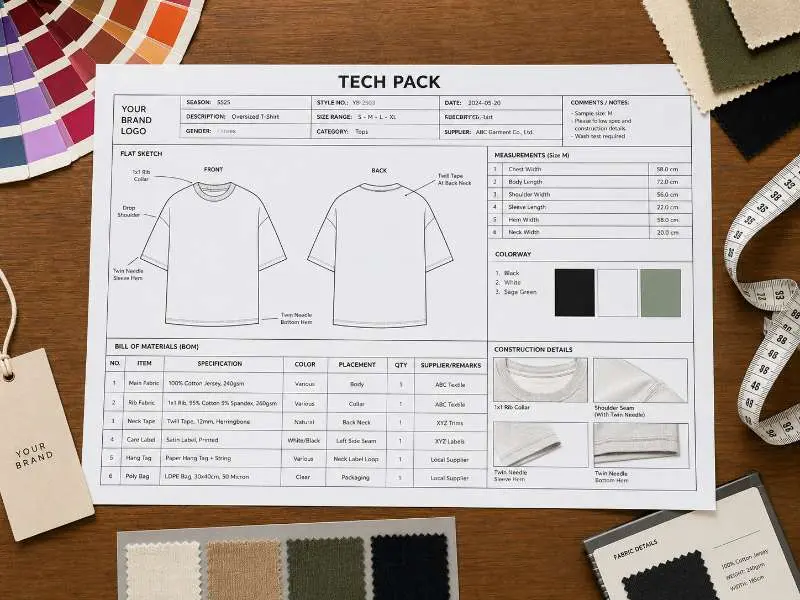
When a garment factory receives a new order inquiry, the first thing the production team asks for is a tech pack. Not a mood board. Not a reference photo. A tech pack. The reason is straightforward: without one, the factory cannot give you an accurate quote, cannot open the correct pattern, and cannot source the right materials. Any gap in your specifications becomes a judgment call — made by the factory, without your input.
The result is predictable. The first sample comes back with the wrong fabric weight, a different seam finish than you expected, or a zipper placed slightly off from your sketch. Then comes another sample round — and another. Each round adds time and cost before bulk production has even begun.
This guide explains what a clothing tech pack needs to include and, equally important, how to submit it so your factory can actually use it. The perspective here is the factory floor: what each section is used for, and what happens when it is missing or vague.
A tech pack — short for technical package — is the set of documents that translates your design into production instructions. It covers every measurable, visual, and material decision about your garment, recorded in a format the factory can hand directly to its pattern maker, fabric buyer, and sewing team.
From the factory's side, the tech pack is used at three distinct stages:
One common point of confusion: a spec sheet and a tech pack are not the same thing. A spec sheet typically covers measurements only. A tech pack is a broader document that includes sketches, materials, colorways, construction notes, and packaging instructions. For OEM production — especially where the brand and factory are in different countries — a full tech pack is expected before any sampling work begins.
The practical implication: anything not documented in your tech pack is open to interpretation. Experienced factories fill those gaps efficiently, but they fill them based on what is standard for their production line — not necessarily what your brand needs.
The following table outlines the main sections of a clothing tech pack, how the factory uses each one, and what typically happens when that section is missing or incomplete.
| Tech Pack Section | How the Factory Uses It | What Happens When It's Missing |
|---|---|---|
| Technical Flat Sketches (front, back, detail views) | Pattern maker references seam placement, pocket position, topstitching, zipper location, and hardware callouts | Factory defaults to its standard block pattern — version fit and construction details may differ from your design |
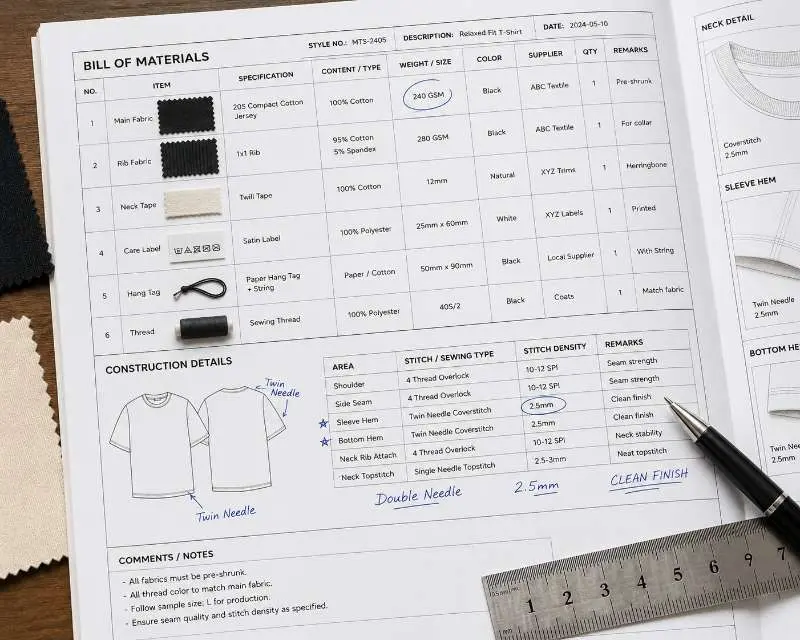
| Bill of Materials (BOM) | Fabric buyer sources main fabric, lining, thread, zippers, buttons, labels, and all trims; costing team builds the FOB quote | Factory substitutes available stock or sources the cheapest option that fits the description — fabric hand, weight, and trims may all be off |
| Measurement Spec (POM) | Pattern maker cuts and grades the first sample; QC team measures against it at each stage | Factory grades from its own block or applies its default grading rules — sizes across the range may not match your expected fit |
| Colorways with Pantone References | Dye lab matches color; print team aligns colorway to artwork files | "Navy" or "forest green" is interpreted by the factory — color drift across bulk production is harder to dispute without a reference code |
| Construction Notes (stitch type, seam finish, hem, interlining) | Sewing team references these for every garment in the run; determines labor cost | Factory uses its standard stitch and finish methods — seam allowances, edge finishing, and interior construction may differ from your expectation |
| Label and Packaging Spec | Private label production, hang tags, poly bag configuration, carton marks, and barcode requirements | Packaging is discussed during or after sampling, which compresses the timeline and can delay shipment |
Each section of a tech pack maps to a specific decision on the production floor. Gaps in any column shift that decision to the factory.
A note on the BOM specifically: it is the section factories check first when evaluating a new order. An incomplete BOM — one that lists fabric type but not composition, weight, or finish — means the factory cannot give you a reliable quote. They will either come back with questions (adding days to your timeline) or they will estimate high to cover the unknowns. Neither outcome is efficient.
Most first-sample problems trace back to one of three recurring gaps. Understanding them from the factory's perspective makes it easier to see why the details matter.
A BOM that reads "100% cotton fleece" gives the factory enough to source something — but not enough to source the right thing. Without GSM, yarn count, finish (brushed or unbrushed), and shrinkage treatment, the factory will use what is available from its regular suppliers. The sample may feel lighter than expected, pill earlier, or shrink differently in wash. By the time the problem is identified, at least one sample round has been spent on the wrong base fabric.
For brands ordering custom hoodies, gym leggings, or other structured OEM garments, fabric specification is directly tied to product positioning. The difference between a lighter fleece and a heavier fleece is not just weight — it affects silhouette, drape, and how the garment holds its shape after repeated wear and wash. Specifying GSM, composition, and construction type in the BOM prevents this category of error before sampling begins.
Providing measurements for a single size and expecting the factory to grade the rest is one of the most common assumptions in a first tech pack. Factories will grade from a single set of measurements — but they will apply their own grading increments, which are based on their standard blocks. Those increments may not match your target sizing for different markets. A brand selling into US, European, and Australian markets simultaneously is likely to need different grading rules for each.
The fix is to document a full size range with per-size measurements and explicit grade increments between sizes. This is covered in more depth in our guide to size chart and grading for OEM production, but the starting point is the same: every size your brand intends to produce should be represented in the tech pack before the first sample is requested.
"Stitch as appropriate" or "standard finish" are not specifications — they are instructions to the factory to make a judgment call. Construction details that are frequently left vague include: stitch type at the hem, seam allowance width at side seams, whether the neckband is sewn flat or folded, and how the waistband is attached on leggings and joggers.
Each of these affects how the finished garment looks, fits, and holds up in production. A coverstitch hem and a single-needle hem have different appearances and different costs. A folded-and-topstitched neckband sits differently than a bound neckband. If the construction method is not specified, the factory will use what is fastest on their line — which is usually not wrong, but may not be what your brand expects.
The content of your tech pack determines whether the factory can sample correctly. The format and process of submission determine whether they sample against the right version of it.
Send the official version of your tech pack as a locked PDF. This prevents accidental edits and ensures the factory is working from a static document. Keep your working file (whether that is a spreadsheet, PLM file, or Illustrator document) separate and internal. When you make changes, export a new PDF with an updated version number and resubmit — do not send the editable source file to the factory.
Every page of your tech pack should carry a style name, style number, version number, and date. A version log on the cover page that records what changed between versions takes less than five minutes to maintain and prevents one of the most common sources of production error: the factory building a sample against a version you revised three days ago.
When a revision is made mid-sampling — for example, a change to the hem finish after the first sample review — send the updated tech pack with a clear note flagging which sections changed. Do not assume the factory will compare versions and identify the difference themselves.
Factories can begin early-stage development conversations without a full tech pack. A reference garment with annotated measurements, a clear sketch with fabric direction, and a brief written description of construction intent can get the conversation started. At Runtang, we work with brands at different stages of development — if you have a concept but no formal tech pack, our team can advise on what specifications are needed before sampling begins and flag what is likely to cause misalignment if left undefined.
That said: before requesting a costed sample or confirming a bulk order, a complete tech pack is required. The more complete the documentation at the start, the fewer rounds of sampling — and the faster your product reaches production. Brands should also understand how the garment sampling process connects to tech pack review, sample revisions, approval checkpoints, and bulk production readiness.
For brands planning U.S. market entry, the Federal Trade Commission provides guidance on textile product labeling requirements, including fiber content, country of origin, manufacturer identification, and care labeling considerations: Threading Your Way Through the Labeling Requirements Under the Textile and Wool Acts.
Yes — especially at an early development stage. A reference sample, annotated sketch, or even a rough description of the garment can start a conversation about feasibility, fabric direction, and rough costing. However, before a factory can produce a costed sample or commit to a production schedule, they will need a complete tech pack. Starting the conversation early gives you time to develop the documentation before sampling begins.
Send a locked PDF for the official version submitted to the factory. PDFs preserve formatting across devices and prevent unintentional edits. Include a version number and date on every page. If you are also sending artwork files (for print placement or label design), package these separately as high-resolution files referenced clearly in the tech pack.
As detailed as possible. For the main fabric, include: fiber composition, GSM or weight range, weave or knit construction, finish (e.g., brushed, preshrunk), and any required testing standards. For trims, specify material, size, color (with a reference code), and placement. The more complete the BOM at the first sample stage, the more accurately the factory can source and quote — and the less likely the sample will come back in the wrong material.
Ready to move from concept to sample? Share your tech pack — or a sketch and fabric direction — and our production team will review it and let you know what is needed before we begin. Runtang works with brands at every stage of development, from first collection to ongoing bulk production, with MOQ from 100 pieces per style.
Get in touch with our production team →Explore our OEM clothing manufacturing services to understand how Runtang supports brands from tech pack review through to bulk delivery.
 T-shirts Related
Cotton vs Polyester T-Shirt: Which Fabric Works Better for Bulk Brand Orders
READ MORE Leggings Related
A Must-Read for Professional Sportswear Brands: How to Customize the Best Fleece Lined Leggings
READ MORE Top Clothing Manufacturer Recommend
10 Best Clothing Manufacturers in China(2025)
READ MORE T-shirts Related
How to Choose High-Quality Comfort Colors T-Shirts
READ MORE Sourcing & Supplier Guide
Garment Sampling Process: What Apparel Brands Should Manage at Each Stage
READ MORE