World Class Textile Producer with Impeccable Quality

World Class Textile Producer with Impeccable Quality

Key Sourcing Takeaways
Most brands assume the garment sampling process is something the factory manages on its own. Send the tech pack, wait for samples, give feedback, repeat. In practice, every stage of sampling has a brand-side responsibility — what you submit, how precisely you give feedback, and how quickly you approve or reject each stage directly determines how many rounds you go through and whether your bulk production starts on time.
This guide walks through the four core sampling stages in OEM production — Proto, Fit, PP, and TOP — and explains what brand buyers need to prepare, check, and approve at each point. It also covers the most common buyer-side mistakes that add weeks to a development timeline before bulk production even begins.
The garment sampling process is a staged validation system. Each stage checks different things, and each requires a formal sign-off before the next can begin. For OEM production — where the factory is building to your spec rather than a pre-existing template — the stakes at each stage are higher because nothing exists until your documentation makes it exist.
The four core stages most brands move through are:
Not every brand uses all four. Smaller orders with simpler garments sometimes move from a development sample directly to PP. The right sequence depends on the complexity of the garment, your existing relationship with the factory, and how much risk you're willing to carry. For new factory relationships or technically complex products, running all four stages reduces the chance of a costly bulk correction.
At Runtang, most first-time brand orders start with a proto or development sample before moving into fit and PP stages. This front-loads the review work and may reduce avoidable revision rounds. Brands that skip straight to fit samples without resolving construction questions early tend to spend more time overall — not less. Once production starts, connecting with a dedicated OEM production team early makes a practical difference in how smoothly the development phase runs.
The proto (or development) sample is the first physical version of a garment. Its purpose is to check whether the silhouette, construction logic, and overall design concept work in three dimensions. It is not a quality benchmark — fabric substitutions and approximate trims are normal at this stage.
What the factory needs from you before making a proto:
What to review when the proto arrives:
What not to do at proto stage: do not send minor finish corrections or colorway comments. Proto is for structure, not details. Sending a long list of mixed-priority feedback forces the factory to interpret what actually needs to change before fit sampling can begin — that ambiguity typically adds a round.
These two stages are where most brands lose time — either by conflating what each stage is for, or by approving one without fully checking the right things. Fit sample and PP sample serve different purposes and lock in different aspects of the product.
| Fit Sample | PP Sample (Pre-Production) | |
|---|---|---|
| Primary purpose | Confirm sizing, fit, and construction accuracy | Final approval before bulk fabric and materials are cut |
| Fabric used | Similar weight/hand; may not be final production fabric | Must use approved bulk production fabric and trims |
| What gets locked | Pattern, seam construction, sizing across the range | Everything: color, fabric, trims, labels, packaging, print placement |
| Brand review focus | Measurements against spec, construction quality, fit on body/form | Match to approved fit sample; all trim and label details; print/embroidery accuracy |
| What happens after approval | Pattern grading begins for full size range | Bulk production begins; PP sample becomes the sealed reference standard |
The table above summarizes the functional difference between the two stages. Treating them as interchangeable is the most common cause of unexpected quality gaps at bulk delivery.
Fit sample review checklist. When the fit sample arrives, measure it against your tech pack spec sheet for the base size. Check every point of measure — chest, waist, hip, sleeve length, body length, and any garment-specific measurements. Also check construction: are seams straight, consistent, and correctly finished? Does the garment sit correctly on a dress form or fit model? Any measurement outside the agreed tolerance range should be flagged and returned for correction; the exact tolerance should be confirmed by garment type, fabric, and factory standard.
PP sample review checklist. PP is the final gate. Once you approve it, the factory treats it as the sealed production standard — every bulk unit will be compared against this sample. Check: Does the fabric match the approved swatch? Is the colorway correct under both daylight and indoor lighting? Are all trims (zippers, buttons, drawcords, elastic) the correct specification? Are labels, wash care instructions, and size labels in the right position with the correct content? Is print or embroidery placement aligned with your tech pack spec? If any of these differ from what was agreed, return the PP with specific written corrections before bulk begins.
The number of sampling rounds a brand goes through is not fixed — it is largely determined by the quality of feedback at each stage. A factory can only act on what it receives in writing. Vague or verbal-only feedback produces another round of interpretation, not a corrected sample.
The most common buyer-side causes of additional sampling rounds:
Practical approach: at each stage, provide feedback in a structured format — photograph the garment with annotated callouts for each point, reference the specific measurement or construction note from the tech pack, and clearly mark each comment as 'must correct before proceeding' or 'preferred but not blocking.' This format gives the factory an unambiguous instruction set and reduces the chance of a misinterpretation round.
Brands that lock their fabric and colorway choices before proto stage, submit a complete tech pack, and provide structured written feedback at each stage usually give the factory fewer variables to reinterpret during fit and PP review. The upfront investment in documentation pays back in development speed.
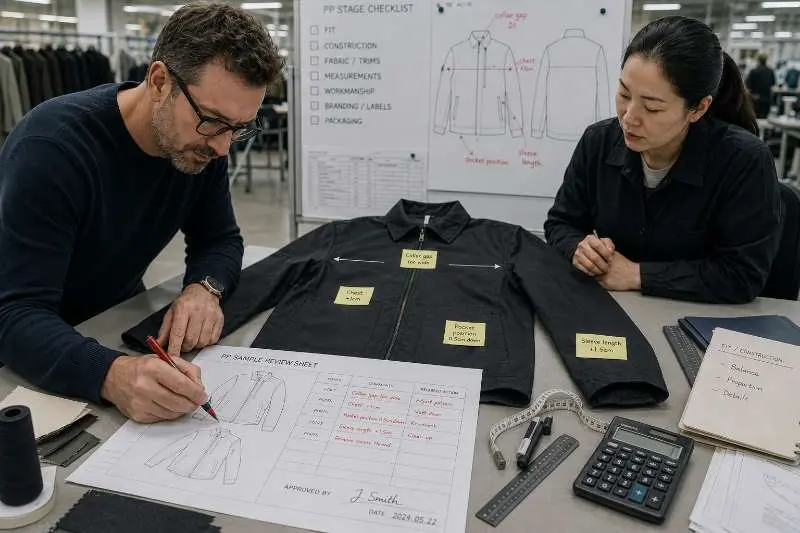
Approving the PP sample authorizes the factory to begin bulk production. It does not mean the sampling process is finished. Once production is underway, a TOP (Top of Production) sample is pulled from the actual production run — not made specially — and sent to the brand for review.
What a TOP sample checks:
If the TOP sample passes review, it becomes the shipment standard. If there are discrepancies, the brand can flag them before the full bulk run is completed rather than discovering issues at the receiving dock.
One practical note on timeline: brands often plan their launch date from their PO date. The more accurate planning anchor is the PP approval date — bulk production cannot start until PP is approved, and bulk lead time runs from that point. Brands that treat the PP approval as part of their planning calendar rather than an administrative step end up with more accurate inventory arrival dates. For a broader view of how each stage maps to a production calendar, the guide on garment production lead time covers how to build a realistic timeline from sampling through to shipment.
Once TOP is approved and bulk production is complete, a pre-shipment quality inspection is the final check before goods leave the factory. That stage is separate from sampling but directly connected — the PP sample serves as the inspection reference standard. Brands planning their first OEM order should also review what a pre-shipment apparel quality inspection covers to understand how the sampling and inspection stages link together.
A fit sample uses similar-weight fabric and is reviewed for sizing, construction, and proportion. A PP (pre-production) sample uses the actual approved bulk fabric and trims and is the final approval before production begins. Once the PP is approved and sealed, it becomes the reference standard for every unit in the bulk run.
Sampling rounds vary by garment complexity, fabric choice, and how complete the initial tech pack is. A straightforward style with clear measurements, construction notes, and approved fabric direction may move through fewer rounds, while complex garments or designs still being revised during sampling usually need more review. The most controllable factor is the quality of the tech pack and written feedback at the start.
It depends on the garment and the relationship with the factory. For simple reorders or products with minimal construction complexity, moving from a detailed tech pack directly to fit sampling is feasible. For new styles with unusual construction, skipping proto often results in fit sample corrections that would have been faster to catch at proto stage. If time is the concern, a faster path is a thorough tech pack — not fewer sample stages.
At minimum: a tech pack or detailed sketch covering silhouette, key measurements for the base size, seam and construction notes, and fabric direction. A reference sample or brand-approved swatch helps significantly. The more specific the input, the closer the first sample will be to the target — and the fewer rounds required to reach approval.
Managing the garment sampling process well is one of the most direct ways a brand can shorten its development cycle and protect its production timeline. If you have a design ready — or a tech pack you want to review with a factory — share it with our team and we can walk through sampling requirements specific to your product.
Share your tech pack, sketch, or reference sample, and our team will outline the sampling stages and preparation steps before your first OEM order.
 Polo Shirts Related
The Ultimate Guide to “What Is a Polo Shirt”: Explore the Charm of the Polo Shirt
READ MORE T-shirts Related
Custom Graphic T-Shirts Manufacturer Guide: Screen Printing, DTG, and Heat Transfer for Bulk Orders
READ MORE Private Label & Brand Building
Private Label Clothing OEM Setup: A Stage-by-Stage Production Guide for Brand Buyers
READ MORE Hoodies Related
Why Are Camo Hoodie a Must-Have for Outdoor Enthusiasts
READ MORE Customization & Craft Guide
Size Grading for OEM Clothing: What Brands Need to Prepare Before Bulk Production
READ MORE