World Class Textile Producer with Impeccable Quality

World Class Textile Producer with Impeccable Quality

Key Sourcing Takeaways
Fabric selection is one of the earliest decisions in the T-shirt development process — and one of the most consequential. Pick the wrong fiber, and your chosen printing method underperforms, your bulk order shrinks unevenly, or your compliance labels need correcting before the product clears customs. This guide lays out how cotton and polyester behave differently inside a factory production cycle, so your brand can make the right call before sampling begins.
When you’re ordering a single piece, fiber is largely a comfort preference. When you’re placing a bulk run of custom T-shirts, fiber choice becomes a production specification that affects every downstream step: how the fabric takes dye, how consistently color lands across a 500-piece run, which printing methods are viable, and whether your finished product meets regulatory labeling requirements in your target market.
From a factory standpoint, cotton and polyester are not interchangeable blanks. They require different dyeing chemistries, different pre-treatment steps before printing, and different finishing processes. Switching fiber mid-development — say, from 100% cotton to a 65/35 poly-cotton blend after sampling — can change the hand feel, the print outcome, and the dye consistency of the entire order. That is a resampling scenario, not a minor adjustment.
The brands that navigate this smoothly are the ones that lock fiber composition in the tech pack before the first sample is cut, not after it comes back from the factory.
GSM — grams per square meter — is the standard way to specify T-shirt weight, and the typical GSM range differs meaningfully between cotton and polyester constructions.
| Fiber Type | Typical GSM Range | Common Construction | Best Suited For |
|---|---|---|---|
| 100% Cotton | Lightweight to midweight | Single jersey, interlock, slub | Lifestyle basics, vintage, streetwear |
| 100% Polyester | Lightweight performance range | Bird-eye, pique, interlock | Activewear, performance, uniforms |
| CVC (Cotton-rich blend) | Midweight cotton-rich range | Single jersey, French terry | Premium basics, heather colorways |
| 50/50 Poly-Cotton | Lightweight budget range | Single jersey | Event merchandise, budget corporate |
GSM descriptions are directional only; exact weight should be confirmed by yarn count, construction, and sample testing before bulk approval.
Beyond weight, construction matters. Cotton single jersey is the most common structure for basic T-shirts — breathable and with good drape, though it stretches more in one direction than the other. Polyester interlock is denser and recovers its shape better after stretching, which is why performance-oriented brands tend to prefer it for active categories. At a comparable GSM, cotton will feel heavier and denser than polyester because the natural fiber traps more air in the weave — a distinction worth communicating to buyers who use GSM as a quality signal in product descriptions.
This is the area where the cotton-vs-polyester decision has the most direct production impact, particularly for brands with strong graphic or colorway requirements.
Dyeing: Cotton accepts reactive dyes, which bond chemically with the fiber to produce deep, saturated, wash-stable color. Polyester uses disperse dyes under heat and pressure — a different process entirely. If you specify a Pantone color and switch fiber mid-development, the dye recipe changes. The color output will not match your original sample even if the same Pantone reference is used.
For brands ordering across multiple colorways, cotton is generally more forgiving for achieving consistent, rich color at scale. Polyester can achieve vibrant results, but color consistency across a large run depends on tighter process control at the dyeing stage.
Printing compatibility: This is where the fiber decision becomes non-negotiable.
| Print Method | 100% Cotton | 100% Polyester | Poly-Cotton Blend | Key Consideration |
|---|---|---|---|---|
| Screen printing | Excellent | Limited | Good (≥50% cotton) | Ink adhesion drops on high-poly fabric |
| DTG (Direct-to-Garment) | Excellent | Not recommended | Usually performs best on high-cotton fabric; confirm with printer and pretreatment | Ink bonds to cotton fiber, not synthetic |
| Sublimation | Not compatible | Best on 100% polyester; ≥65% polyester may work depending on print target | Faded result on cotton portion | Dye only bonds with synthetic fibers |
| Heat transfer | Good | Good | Good | Works on most fibers; wash durability varies |
| Embroidery | Excellent | Good (heavier gsm) | Good | Heavier fabric holds stabilizer better |
Print compatibility is determined by fiber content. Confirm your decoration method before finalizing fabric composition to avoid resampling at the bulk stage.
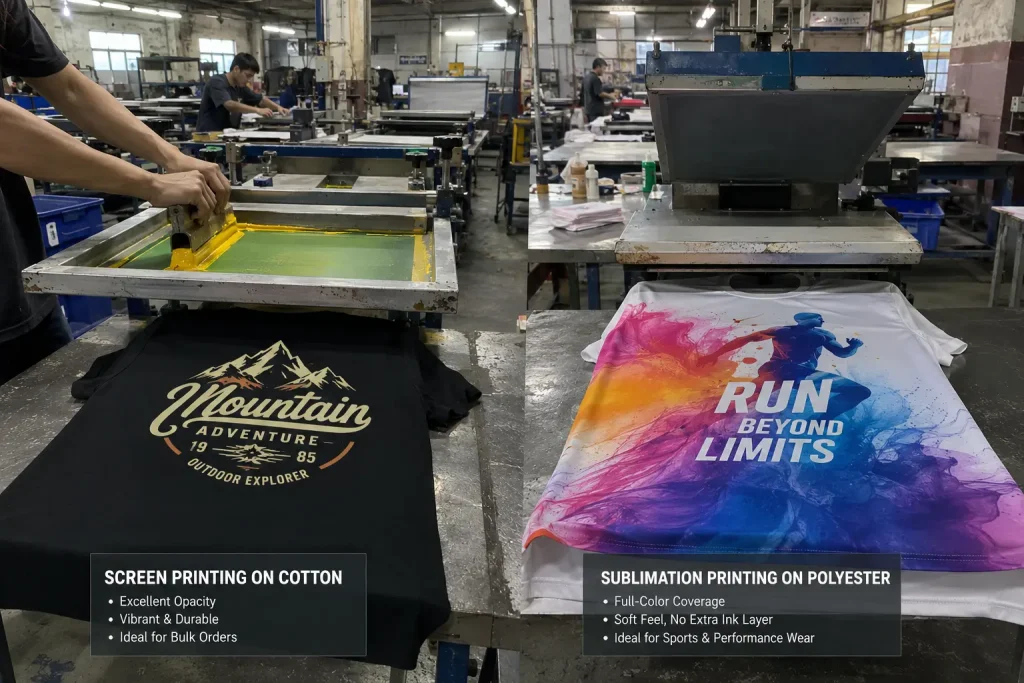
A common mistake at the development stage is specifying a fabric and a print method without checking compatibility. DTG printing on a 60% polyester shirt delivers washed-out, patchy results because the ink cannot absorb into synthetic fibers. Sublimation on a 50/50 blend produces a faded, vintage-look print — intentional for some aesthetics, a defect for others. Establish the print method first, then confirm fiber composition. That is the correct sequence for T-shirt development.
Cotton shrinks. This is the most common quality complaint in cotton T-shirt bulk orders, and it is almost always a preventable production step, not an inherent material flaw.
Untreated cotton fabric may shrink by several percentage points in the first wash cycle, depending on yarn count, knitting structure, finishing, and washing conditions. For a brand selling in standard international sizes, that shrinkage can push a finished large into a medium on the customer end. The standard production solution is pre-shrinking (also called pre-washing or sanforizing) — the fabric is washed and dried before cutting. When ordering from an OEM factory, ask during sampling whether pre-shrink treatment is included in the standard bulk spec or quoted separately. This affects both unit cost and lead time.
Polyester is dimensionally stable. It does not absorb water the way cotton does, which means minimal shrinkage risk across a production run. For brands that need precise size consistency across a large bulk order — uniforms, corporate programs, sports teams — polyester’s dimensional stability is a meaningful operational advantage.
Practical checklist for your sampling stage:
Lead times are broadly comparable between cotton and polyester production at the bulk stage. The difference appears at fabric preparation: cotton orders involving special washes (enzyme wash, garment dye, acid wash) require additional pre-cutting time, typically adding days to the pre-production schedule depending on the finishing effect and batch size.
The right fiber depends on your brand positioning, end-use category, and decoration method. Here is a practical framework by brand type:
| Brand Type | Recommended Fiber | Why | Print Method Fit |
|---|---|---|---|
| Lifestyle / Basics | 100% Cotton or CVC | Natural hand feel, color depth, broad appeal | Screen print, DTG, embroidery |
| Performance / Activewear | 100% Polyester or ≥65% poly | Moisture-wicking, shape retention, lightweight | Sublimation, heat transfer |
| Vintage / Streetwear | 100% Cotton (heavier gsm) | Washed effects, color fade authenticity, weight | Screen print, garment dye |
| Eco / Sustainable | Organic cotton (GOTS-ready) | Natural fiber, reduced chemical processing | Screen print, DTG, embroidery |
| Corporate / Uniforms | 50/50 or 65/35 poly-cotton | Cost efficiency, durability, wrinkle resistance | Screen print, embroidery |
Your specific collection goals, target price point, and decoration method should all factor into the final fiber decision. The sampling stage is the right time to test and confirm before committing to bulk.
A note on FTC labeling compliance: U.S. law requires garments sold in the American market to carry an accurate fiber content label listing each fiber by its generic name and percentage of total weight. This applies to blends — a 60/40 cotton-polyester shirt must be labeled as such, not listed as “cotton-rich” or left unspecified. Working with an OEM factory experienced in U.S. export orders means this labeling requirement will typically be built into the production process, but it is worth confirming at the tech pack stage. For details, see the FTC’s textile labeling guidance.
On organic cotton: Runtang offers GOTS-compatible organic cotton fabric as an available option for brands with sustainability requirements. GOTS-ready means the fabric is sourced through certified organic supply chains; the pathway to a GOTS-certified finished product involves additional steps, which we can advise on during development.
For brands that want more depth on how fabric structure — jersey, interlock, and slub constructions — behaves differently in OEM production, our T-shirt fabric structure guide covers those decisions in detail.
Yes, but they need to be treated as two separate SKUs with separate tech packs and separate sampling rounds. Dyeing, printing pre-treatment, and size specifications differ between fibers, so they cannot be produced interchangeably on the same line. Runtang’s MOQ of 100 pieces per style per color applies to each separately.
Sublimation dye bonds only with synthetic fibers. To achieve vibrant, accurate color reproduction, the fabric should be at least 65% polyester — with 100% polyester delivering the sharpest results. Lower polyester content produces a washed-out, heathered appearance, which can be intentional but should be confirmed at the sample stage before bulk approval.
Fiber choice does not affect Runtang’s standard MOQ of 100 pieces per style per color. On cost: polyester fabric typically has a lower raw material cost than combed cotton at comparable GSM, which can be reflected in the unit price at bulk volumes. The exact cost difference depends on the specific construction, finishing treatment, and order quantity. Request a quote with your fiber specification for accurate pricing.
State fiber composition as a percentage breakdown by weight (e.g., 60% cotton / 40% polyester) in your tech pack. For blends with more than two fibers, list fiber names and percentages by weight in descending order. Under FTC guidance, fibers under 5% are generally listed as “other fiber,” with exceptions for wool, recycled wool, or fibers with functional significance.
Ready to lock in your fabric spec? Whether you’re developing a cotton basics line or a polyester performance collection, share your tech pack or a rough brief and we’ll advise on the right fiber and construction for your production run. Browse our custom t-shirt manufacturing options or contact our team to request a factory-direct quote. MOQ from 100 pieces per style.
 Top Clothing Manufacturer Recommend
Top 8 Hoodie Manufacturers in China
READ MORE Leggings Related
How Brands Create Leggings Like Lululemon: The Fabric and Construction Behind the Feel
READ MORE T-shirts Related
T-Shirt Sourcing Guide: Single Jersey, Interlock and Slub Jersey for Brand Buyers
READ MORE Leotard Related
Custom Leotards: Construction Choices Brands Should Confirm Before Bulk Production
READ MORE Top Clothing Manufacturer Recommend
10 Best Clothing Manufacturers in China(2025)
READ MORE