World Class Textile Producer with Impeccable Quality
World Class Textile Producer with Impeccable Quality

Key Sourcing Takeaways
Most apparel brands approach t-shirt sourcing by asking two questions: how much and how fast. Those matter — but they come second. Before price and lead time, the decisions that shape your entire production run are about style type, fabric structure, and the development path your order will follow.
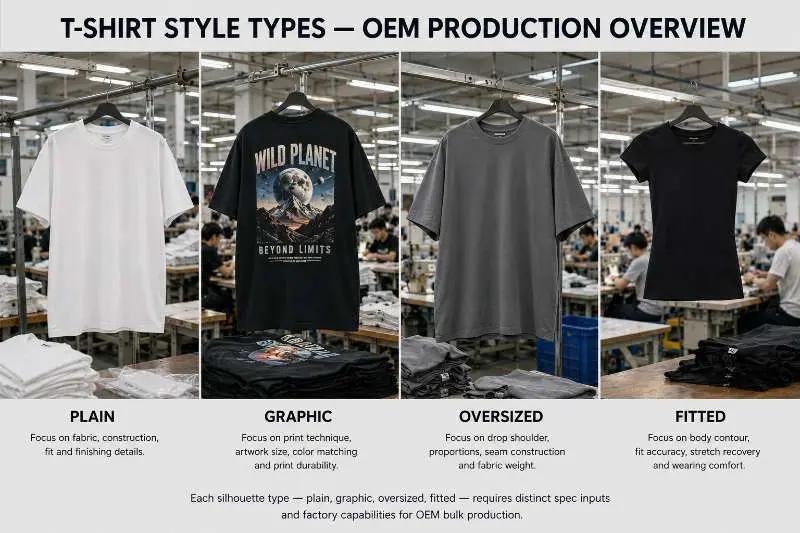
A plain blank tee ordered in bulk, a graphic streetwear piece, and an oversized drop-shoulder silhouette each require different factory capabilities, different sampling stages, and different technical conversations. Getting clear on which category you're sourcing — before contacting any factory — is what makes the difference between a smooth first order and a costly revision cycle.
Finding the right production partner starts with being specific about what you need. Two brands sourcing 'custom t-shirts' can have almost nothing in common if one needs blank cut-and-sew basics and the other needs full-color sublimation graphics on a structured silhouette.
OEM (Original Equipment Manufacturing) means you bring the design — tech pack, fabric spec, fit requirements — and the factory executes. ODM (Original Design Manufacturing) means the factory offers ready-developed styles that you can adopt and brand. For most apparel brands building a distinct product line, OEM is the standard path. If you're early-stage and don't yet have tech packs, look for factories that offer development support from sketch or reference sample.
Test-and-learn brands prioritize low MOQ and fast sampling cycles. Brands scaling into retail need consistent bulk quality and stable lead times. The factory attributes you evaluate — and the questions you ask — should reflect where your brand actually is, not where you plan to be in two years.
T-shirts look simple from the outside. The sourcing requirements aren't. Each style type has its own factory capability requirements, and mixing them up in an RFQ typically results in slower responses and less accurate quotes.
| Style Type | Key Factory Requirement | Primary Spec to Confirm |
|---|---|---|
| Plain / blank | Fabric consistency across batches; pre-shrink treatment | GSM, fiber composition, wash shrinkage tolerance |
| Graphic tee | In-house or vetted print facility; color matching | Print method, placement tolerance, Pantone reference |
| Oversized/drop-shoulder | Pattern grading for relaxed fits; fabric drape management | Shoulder width, body length, hem finish type |
| Fitted tee | Stretch management; consistent stitch tension | Elastane %, recovery direction, side seam shaping |
Use this breakdown as a starting checklist when writing your RFQ — specify which style type(s) you're developing so the factory can flag relevant capability gaps early.
Plain blank tees in bulk suit brands testing a core essential. For private-label blank programs, the custom t-shirt production page covers fabric options, MOQ structure, and bulk order support in detail.
For graphic styles, print method selection is a pre-sampling decision, not an afterthought. The custom graphic t-shirts page outlines available print methods and bulk consistency benchmarks.
Fabric selection is where many brands make their most expensive mistake: they choose based on how a sample feels in hand, without considering how that fabric will perform across hundreds or thousands of units — through washing, printing, and repeated wear.
Single jersey is the standard construction for most T-shirts — it has a distinct face and back, is lighter, and tends to roll at cut edges before finishing. Interlock is a double-knit structure: thicker, more stable, and less prone to curl. For brands ordering plain or lightly decorated tees, the choice between jersey and interlock affects both the final drape and how the fabric accepts screen print or DTG.
Fabric weight affects hand-feel, opacity, and perceived quality — all of which connect directly to how your brand is positioned. Lighter constructions may suit warm-weather basics and layering styles, while heavier constructions are often used for premium or oversized positioning. Exact GSM ranges should be confirmed against fiber blend, knit density, and the approved sample before bulk production.
For a detailed breakdown of fabric structures and how jersey, interlock, and slub compare for bulk orders, see the guide on t-shirt fabric for bulk orders.
Print method selection is a pre-sampling decision — not something to finalize after you've already requested a sample. The method you choose affects cost structure, color range, minimum viable quantity, and how the finished garment holds up over time.
| Method | Best For | Bulk Consideration |
|---|---|---|
| Screen print | Simple designs, 1–6 colors, large runs | Cost per piece drops significantly at higher volumes; setup cost fixed per color |
| DTG (Direct to Garment) | Complex, photo-quality artwork; small runs | Higher per-piece cost; best on 100% cotton; consistency harder to maintain at scale |
| Heat transfer | Specialty finishes; small-batch or reorder flexibility | Durability varies by substrate and application temperature; confirm wash-fastness specs |
| Sublimation | All-over prints; polyester-dominant fabrics | Requires light-colored base; not suitable for pure cotton |
For many graphic streetwear and lifestyle tees, screen print is often the more cost-efficient method once the order quantity justifies setup costs. DTG suits brands needing small-batch flexibility or highly detailed artwork. Confirm print placement tolerances and Pantone matching process with any factory before approving samples.
For a deeper comparison of print methods across product types, see the guide on graphic t-shirt print methods for OEM.
Two of the most common misconceptions in t-shirt sourcing: that MOQ is a negotiation starting point, and that delays come from the factory side. Both deserve a clearer picture.
MOQ is typically calculated per style per color — not per total order. Ordering three colorways of the same style means three separate MOQ runs. The logic behind this is production efficiency: each color requires a separate fabric dye batch and, where applicable, a separate print setup. At Runtang, MOQ starts at 100 pieces per style per color, which supports test-and-learn brands without requiring full inventory commitment.
The most common causes of extended sampling timelines aren't factory capacity — they're buyer-side: incomplete tech packs submitted at the start, color approvals that require multiple revision rounds, or fit comments that arrive after construction has already begun. Brands that submit a clear tech pack, a confirmed color standard, and a single consolidated round of fit comments typically move through sampling faster than those who iterate without a fixed reference.
For a full breakdown of MOQ structures across product types, see the article on clothing MOQ for OEM brands.
Vetting a t-shirt manufacturer is less about checking boxes and more about testing whether the factory can handle the specific requirements of your order. Here's what to assess.
| Evaluation Area | What to Look For |
|---|---|
| Fabric capability | Does the factory have in-house knitting or dye facilities, or do they source externally? Vertical integration typically means tighter batch-to-batch consistency. |
| Sampling support | Can they work from a tech pack? From a reference sample? From a sketch? Understand the input they need before you send anything. |
| MOQ flexibility | Does the stated MOQ apply per style per color, or per total order? Clarify this before negotiating. |
| Print capability | Is print done in-house or subcontracted? Ask to see samples of the method you need — not a portfolio of different methods. |
| Branding services | For private label: can they handle custom woven labels, hangtags, and polybag spec? Confirm the packaging timeline aligns with your shipping window. |
| Quality documentation | What QC reports do they provide before shipment? AQL inspection level, fabric test results, and measurement specs are all standard requests. |
Evaluating a factory on these dimensions before sampling — rather than after — reduces the chance of discovering capability gaps midway through development.
Runtang Textile operates a vertically integrated production setup: in-house knitting, dyeing, and garment manufacturing under one supply chain. With over 15 years of export experience to European and North American brands, and MOQ starting at 100 pieces per style per color, the factory supports both test-stage brands and established labels scaling into larger runs.
For brands reviewing chemical compliance before placing an order, the American Apparel & Footwear Association Restricted Substances List provides a reference framework for restricted substances in finished apparel and footwear products.
MOQ is typically calculated per style per color. At Runtang, the starting MOQ is 100 pieces per style per color — so a single style ordered in three colors would require 100 pieces minimum per color. This structure applies across plain, graphic, and oversized styles.
Yes — sampling is a standard stage before bulk production, not an optional add-on. Most factories offer proto samples (from tech pack or reference), fit samples, and pre-production samples. The number of rounds depends on how complete your tech pack is at submission.
Common options include 100% cotton jersey, cotton-polyester blends, and stretch blends with elastane. Fiber choice affects GSM range, print performance, and wash behavior. Organic cotton, recycled polyester, and other lower-impact options may be available depending on the selected fabric route — confirm material claims and documentation requirements at the RFQ stage.
The factories that deliver on quality and timeline are the ones that receive clear, complete information upfront. If you have a tech pack, a style reference, or even a rough sketch of what you're developing, share it — and use it to open a real conversation about fabric, MOQ, and sampling.
Send your design brief or style reference to the t-shirt manufacturing team, and we'll walk you through fabric options, MOQ structure, and sampling from there.
 Leggings Related
How Brands Create Leggings Like Lululemon: The Fabric and Construction Behind the Feel
READ MORE Leggings Related
A Must-Read for Professional Sportswear Brands: How to Customize the Best Fleece Lined Leggings
READ MORE T-shirts Related
How to Choose High-Quality Comfort Colors T-Shirts
READ MORE T-shirts Related
How to Find a T-Shirt Manufacturer for Your Apparel Brand
READ MORE Top Clothing Manufacturer Recommend
Top 8 Pajama Manufacturers in China
READ MORE