World Class Textile Producer with Impeccable Quality

World Class Textile Producer with Impeccable Quality

Key Sourcing Takeaways
Choosing between single jersey, interlock and slub jersey is not only a fabric-selection exercise. The decision changes how the factory spreads and cuts the fabric, stabilises seams, develops decoration samples and checks bulk consistency. This guide focuses on the garment-production controls a brand buyer should lock before sampling: construction, target GSM, approved surface standard, dimensional-change tolerance, decoration method and reorder matching. Slub is treated here as a yarn effect—usually used in slub single jersey—not as a third knit structure parallel to single jersey and interlock.
When developing custom t-shirts, brands should not specify the fabric only as “100% cotton” or “jersey.” Those descriptions leave several production variables undefined. Before sampling, record the following items separately:
Recording these fields separates knit construction from yarn effect and gives the factory measurable approval points. It also prevents slub single jersey from being treated as a third construction parallel to single jersey and interlock.
Single jersey is produced on one needle bed and shows knit stitches on the face and purl loops on the reverse. Its unbalanced structure creates edge curl and may increase spirality risk compared with balanced double knits, although actual behaviour also depends on yarn twist, loop length, machine settings and finishing.
For bulk sourcing, do not use a generic 3–5% shrinkage assumption. Request dimensional-change results in both length and width on the exact fabric, using the wash method stated in the product specification. When post-wash tolerances are tight, confirm whether relaxation drying, compaction or another agreed finishing process is included.
Its relatively smooth face generally supports screen printing and DTG, but fibre content, pretreatment and surface finish still influence the result. Approve a print strike-off on the intended bulk fabric rather than selecting the construction from the print-method name alone.
Interlock is a double-knit structure produced on two needle beds, creating similar knit faces on both sides. Its balanced construction usually gives lower edge curl and better lay-flat behaviour than single jersey, but “near-zero spirality” should not be promised without test results from the actual fabric.
Interlock is worth evaluating when the product brief requires greater opacity, more body, improved shape retention or a denser base for embroidery. Embroidery still requires backing and stitch density suited to the fabric, while DTG and screen-print performance still depends on fibre content, pretreatment and finishing.
Do not estimate the interlock premium from construction alone. Request the quotation against the confirmed GSM, yarn count, fibre composition, machine gauge, finish and order volume. Interlock often costs more within a comparable garment programme, but a fixed percentage cannot be applied reliably across different specifications.
Slub is a yarn characteristic rather than a separate knit construction. Use “slub single jersey” unless another base structure has been confirmed. The intentionally thick-and-thin yarn creates visible surface variation that can support vintage, pigment-dyed or garment-washed T-shirt programmes.
The textured surface does not automatically make slub unsuitable for detailed printing. It may reduce edge sharpness or solid-ink uniformity, so the brand should approve a print strike-off on the intended fabric before bulk production.
Bulk control requires separate standards for colour and texture. Use a shade band for acceptable colour variation and an approved reference swatch for slub intensity, spacing and overall surface character. Stable replenishment is possible when yarn source, knitting settings, finishing method and visual tolerance are recorded and retained.
Slub yarn also does not inherently prove higher or less predictable shrinkage. Dimensional change must be tested on the actual construction, fibre composition and finish used for the order.
The right construction depends on where the brand is in its production cycle and what the product is meant to do. The table below summarises the key production variables across all three fabric options:
| Option | Best When | Buyer Must Specify | Approval Test | Main Bulk Risk |
|---|---|---|---|---|
| Single jersey | Print-led basics and relaxed T-shirts | Construction, yarn, GSM, finish, dimensional-change and spirality tolerances | Wash test and print strike-off | Edge curl and side-seam twist |
| Interlock | Greater opacity, body or embroidery support is required | GSM, gauge, composition, finish and recovery requirement | Wash, lay-flat and embroidery test | Heavier hand, yield and quote variation |
| Slub single jersey | Visible texture is part of the design brief | Approved yarn effect, reference surface, lot tolerance and finish | Shade band, texture swatch and print strike-off | Visual variation between lots |
Before approving any of the three options, lock five items with the factory:
For additional guidance on cotton fabric processing and dimensional control, refer to the Cotton Incorporated Technical Bulletins.
These approval controls should also be carried through the wider t-shirt manufacturing process, from fabric inspection and cutting to sewing, decoration and final bulk inspection.
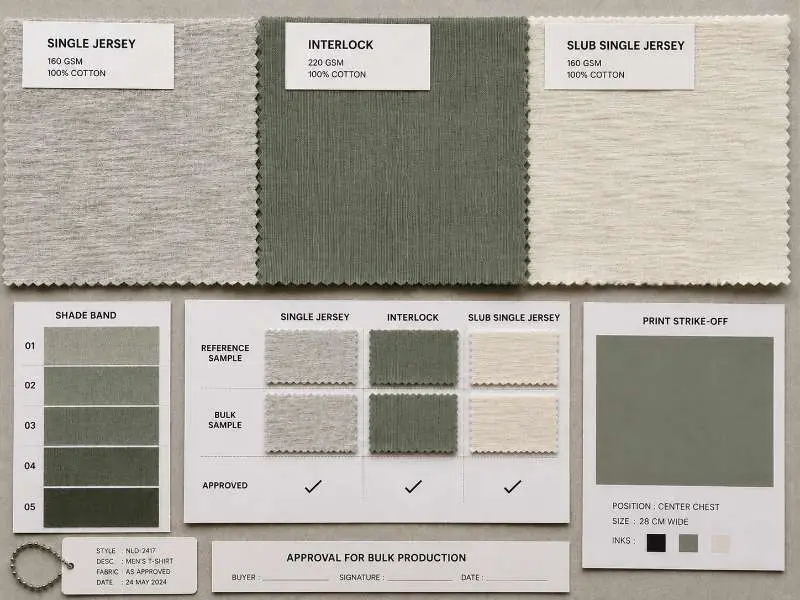
Single jersey is produced on one needle bed, with knit stitches on the face and purl loops on the reverse. Interlock is produced on two needle beds and has similar knit faces on both sides. Interlock usually has lower edge curl and better lay-flat stability, but dimensional change and spirality still need to be tested on the actual fabric.
Single jersey is the most common base because its face is generally smooth and widely available. Interlock can also print well. Slub single jersey may soften fine edges or affect solid coverage, so all three options should be approved through a print strike-off on the intended bulk fabric.
Not necessarily. Slub yarn does not by itself prove higher shrinkage. Dimensional change depends on loop geometry, fibre composition, wet processing and finishing. Test length and width change on the actual fabric using the wash method stated in the product specification.
Yes, but treat each construction as a separate fabric approval. Confirm its MOQ, colour lot, testing requirements and production schedule before issuing the purchase order. Whether the styles can run together depends on the factory’s fabric and sewing plan.
Choosing the wrong knit construction or yarn specification at the start of production creates compounding problems — shrinkage surprises after the first wash, print inconsistencies across a run, or extra sampling rounds that push back your timeline. Getting the fabric specification right before sampling is the most cost-effective step in the t-shirt sourcing process.
We work with brands across different sourcing stages — from first collections testing single jersey basics to established labels moving into premium interlock styles or vintage-wash slub programmes. Share your product brief or tech pack and we will confirm fabric structure options, GSM range and MOQ from 100 pieces per style and colour.
Not sure which construction fits your product? Send us a description of the tee you are building — we will advise before you commit to sampling.
 Leggings Related
How to Start an Activewear Brand: From Design to OEM Production
READ MORE Leotard Related
Custom Leotards: Construction Choices Brands Should Confirm Before Bulk Production
READ MORE Top Clothing Manufacturer Recommend
Top 8 Polo Shirt Manufacturers in China
READ MORE Polo Shirts Related
Types of Polo Shirt Fabric: Piqué, Interlock and Jersey Compared for Bulk Orders
READ MORE T-shirts Related
How to Choose High-Quality Comfort Colors T-Shirts
READ MORE