World Class Textile Producer with Impeccable Quality

World Class Textile Producer with Impeccable Quality

Key Sourcing Takeaways
When activewear brands brief a leggings development project, “squat-proof” appears in almost every design brief. But what that term means on the factory floor is rarely spelled out—and the gap between expectation and bulk output is where most opacity failures happen.
Squat-proof performance isn't a single fabric property. It's the result of several intersecting decisions: knit construction, elastane grade, fabric density, and GSM. Understanding how these variables interact—before sampling begins—gives brands a far better chance of approving the first sample rather than the fifth.
This guide breaks down the manufacturing parameters behind squat-proof leggings and gives brand buyers a practical framework for specifying and verifying opacity through the sampling and bulk production stages.
From a consumer standpoint, squat-proof means the leggings don't become transparent when the wearer bends or squats. From a manufacturing standpoint, that outcome is determined at the fabric development stage—not at the QC stage.
Three fabric parameters drive opacity under stretch:
The key insight for brand buyers: GSM is the most commonly referenced number in leggings sourcing conversations, but it is the least reliable single indicator of squat-proof performance. Density and elastane quality matter more.
Most performance leggings used for commercial activewear programs are developed around three common construction approaches: interlock knit, single-jersey knit, and seamless knit structures.
| Construction | Opacity Under Stretch | Best Suited For |
|---|---|---|
| Interlock knit | High — two fabric layers looped together maintain structure when stretched | High-performance gym leggings, squat-focused activewear |
| Single-jersey | Lower — single-layer construction thins noticeably under dynamic stretch | Light yoga, low-impact sessions, lifestyle/athleisure positioning |
| Seamless knit | Variable — depends on yarn denier and gauge; can achieve high opacity with correct spec | Premium activewear, seamless collections where chafe-free construction is a priority |
Interlock is generally the safer choice for brands that need repeatable squat-proof results at bulk scale. Seamless constructions can reach the same opacity standard, but require more precise yarn and gauge specification at the fabric development stage.
For brands ordering gym or yoga leggings, the construction type should be specified in the tech pack alongside fabric composition. See gym leggings production for an overview of what Runtang produces across this category.
Brands evaluating recycled nylon or recycled polyester leggings programs can also review the standards published by Textile Exchange.
Elastane percentage is the number most commonly cited in leggings fabric specs—but percentage alone is an incomplete instruction to a factory. The quality of the elastane yarn matters as much as the quantity.
High-tenacity elastane (sometimes referred to in the industry as high-power elastane) maintains its recovery force under repeated stretch cycles. When integrated into a tightly knit base, high-tenacity elastane can often achieve better opacity and recovery than standard-grade elastane, even at similar stretch ratios. The exact percentage depends on the fabric construction, yarn selection, and intended level of compression.
| Elastane Type | Stretch Recovery | Opacity Result Under Stretch |
|---|---|---|
| High-tenacity elastane | Strong — maintains knit structure through repeated cycles | Consistent opacity at lower % ratios |
| Standard-grade elastane | Moderate — recovers but loses tension over time | May thin under deep stretch; requires higher % to compensate |
Specific elastane percentages and precise denier values depend on the base yarn, fabric construction, and intended end-use—and should be confirmed with the factory during fabric development. Directional guidance here is intentional: exact numbers vary by mill and should be validated through sample testing rather than taken as universal benchmarks.
How nylon and polyester behave differently as base yarns in this context is covered in the nylon vs polyester for activewear guide—a useful reference when making the base yarn decision before fabric development begins.
Tech pack note: Rather than specifying only "squat-proof" as a design requirement, brands can strengthen the brief by referencing: (1) a physical fabric standard sample submitted alongside the tech pack, (2) the intended construction type (interlock/seamless), and (3) an opacity pass/fail criterion—for example, "fabric must remain opaque to solid-colour underlayers at 90° squat depth under standard indoor lighting." This gives the factory a verifiable target rather than a subjective label.
Once a pre-production sample arrives, opacity should be tested before any further development decisions are made. Three practical methods work consistently for brand buyers evaluating leggings samples:
At the bulk production stage, brands can formalise the opacity requirement in the purchase order or quality agreement by specifying the reference sample number and stating that any deviation visible to the naked eye under the same test conditions constitutes a non-conformance.
Understanding the cost structure behind leggings fabric development—why premium elastane and tighter knit constructions cost more at the fabric stage—is covered in the leggings manufacturing cost breakdown, which walks through how material decisions affect unit cost and brand positioning.
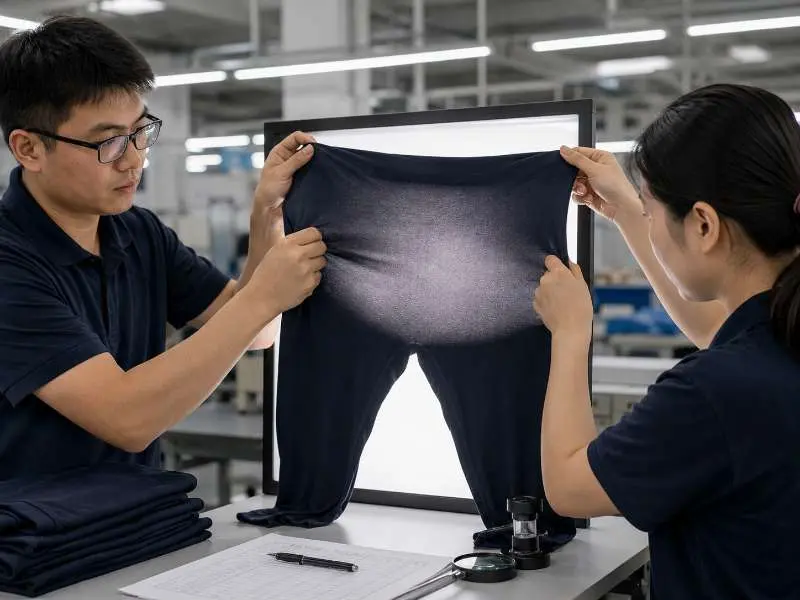
In practice, the brands that experience the fewest opacity failures at bulk are those that treat squat-proof as a specified, measurable standard rather than an assumed outcome. From the factory side, the most common development issues arise when:
A straightforward way to close these gaps: include a physical reference swatch in the tech pack submission, specify the construction type explicitly, and conduct the light test on every sample regardless of colour.
For brands evaluating which factory to partner with for activewear development, the custom activewear OEM sourcing guide covers the capability questions worth asking before committing to a sampling relationship.
Runtang produces gym leggings and yoga leggings for activewear brands across European and North American markets, working from tech packs or sketch-level briefs. MOQ starts from 100 pieces per style per colour.
Not reliably. GSM measures fabric weight, which correlates loosely with thickness but not directly with opacity under stretch. A dense interlock fabric can outperform a heavier single-jersey fabric in squat-proof performance because knit structure often has a greater impact on opacity than fabric weight alone.
The most reliable approach is to combine three elements: (1) a physical reference fabric swatch submitted with the tech pack as the opacity standard, (2) an explicit construction call-out (e.g., interlock knit), and (3) a written test condition (e.g., "fabric must remain fully opaque to solid-colour underlayers at squat depth under standard indoor lighting"). This gives the factory a verifiable target rather than a subjective description.
Yes, but it requires more precise specification. Seamless constructions depend on yarn denier and gauge settings to achieve opacity, and the variables are less standardised across mills than interlock knit fabrics. Brands developing seamless leggings should expect more specification work at the fabric stage and allocate additional sampling rounds to confirm opacity consistency across colourways.
Share your tech pack, target market, or performance requirements with the Runtang team. We can help evaluate fabric construction, opacity expectations, and sampling options before bulk production begins. MOQ starts from 100 pieces per style per colour.
 Top Clothing Manufacturer Recommend
10 Best Clothing Manufacturers in China(2025)
READ MORE Top Clothing Manufacturer Recommend
Top 8 Clothing Manufacturers Around the World
READ MORE T-shirts Related
The Charm of T-shirts Factory Custom Printing: A Good Helper for Brands
READ MORE Polo Shirts Related
Types of Polo Shirt Fabric: Piqué, Interlock and Jersey Compared for Bulk Orders
READ MORE Pajamas Related
How to Quickly Lay Out the Christmas Pajama Market
READ MORE