World Class Textile Producer with Impeccable Quality
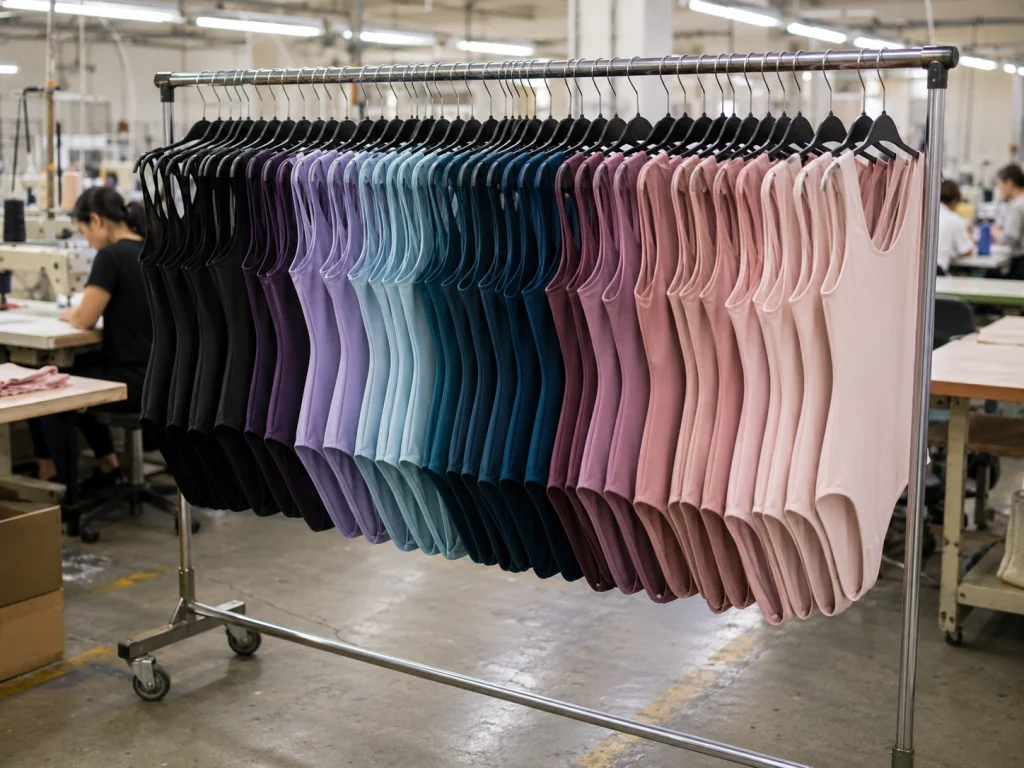
World Class Textile Producer with Impeccable Quality

Key Sourcing Takeaways
Whether you are outfitting a dance school's class uniforms or developing a private label recital collection, the program type decides the style mix, color count, order structure, and factory brief. A uniform program needs a small, repeatable set of styles that can be reordered cleanly season after season, while a performance line uses style and finish variety to build a recognizable brand. This guide focuses on how to structure a bulk dance leotards order before sampling; for a style-by-style breakdown, use the leotard styles guide as a separate reference.
The first question to settle is not which cut looks best — it's what the order has to do. A studio uniform program and a private label performance line have different success criteria, and that difference should drive your style and color decisions before you ever request a sample.
A uniform program is judged on consistency. Teachers and examiners need to see posture, alignment and technique clearly, which is why class leotards stay close-fitting and visually clean. Just as important, the order has to re-stock predictably: a dancer who joins mid-year, or a level that grows, needs to match what's already in the room. That favors a narrow style set — often one base cut per level — in a small, fixed color palette.
A private label performance or recital line is judged on differentiation. Here, style variety, neckline and back details, and decorative finishes are what make a collection feel like a brand rather than a generic stock item. The buying logic flips: instead of locking down one repeatable style, you are deliberately building a range. Cuts like camisole, tank, short and long sleeve, and skirted styles each carry a different look, and choosing among them is a branding decision, not a fit-only one.
Across both scenarios, the underlying garment is the same category of product — a fitted one-piece built for movement — but the sourcing approach is not. Getting this framing right up front is what keeps a bulk order from turning into a restocking headache or a collection that reads as undifferentiated.
For a uniform program, the goal is a style mix that is broad enough to serve different levels but narrow enough to re-order without surprises. The most common approach is to anchor each level on a single base cut, then layer in a second style only where a real need exists — added coverage for younger dancers, or a performance style for recital season.
| Program stage | Style-mix direction | Sourcing note |
|---|---|---|
| Beginner/younger levels | One supportive base cut with wider straps for security during movement | Keep to a single color to simplify restocks as new students join |
| Technique/classical levels | A clean, minimal cut that keeps lines visible for alignment checks | Standardize on one cut per level so examiners see a consistent look |
| Cooler studios/winter terms | Add a sleeved option as a seasonal layer on top of the base cut | Treat it as a second SKU, not a replacement, to keep the core uniform intact |
| Recital/performance season | Introduce one performance style separate from the class uniform | Order as its own run; do not fold it into the standing uniform SKU |
In short, a workable uniform program usually means one anchored base cut per level, with seasonal or performance styles added as separate SKUs rather than swapped in — this keeps re-orders matching and avoids a fragmented set of cuts that's hard to restock. Whether your studio leans toward a camisole, tank or sleeved base is a fit-and-policy call best confirmed against your dress code, but the structural rule holds regardless of which cut you anchor on.
A private label line works on the opposite principle. Instead of standardizing, you are using a style range to build a recognizable look. Mixing camisole, tank, sleeved and skirted cuts across a collection gives a recital lineup visual variety and lets a brand stake out its own aesthetic rather than reselling a generic stock leotard.
The practical decisions here are about which cuts carry your brand's look and how many you can realistically support across sizes and colors. A tight, focused range of two to three signature styles is usually easier to produce consistently and market clearly than a sprawling set that dilutes both. Backline details — open backs, cross-backs, higher necklines — are part of how a performance style reads, and they are where a private label line earns its differentiation from off-the-shelf options.
For a sourcing plan, keep the first private label range focused: two or three signature styles, a clear color story, and a size run that can be sampled and graded consistently. If you need a deeper style-by-style comparison, refer to the leotard styles guide. If the collection depends on prints, rhinestones, appliqué, or stage-specific decoration, those choices belong in the custom dance costumes guide because they affect a different part of the production brief.
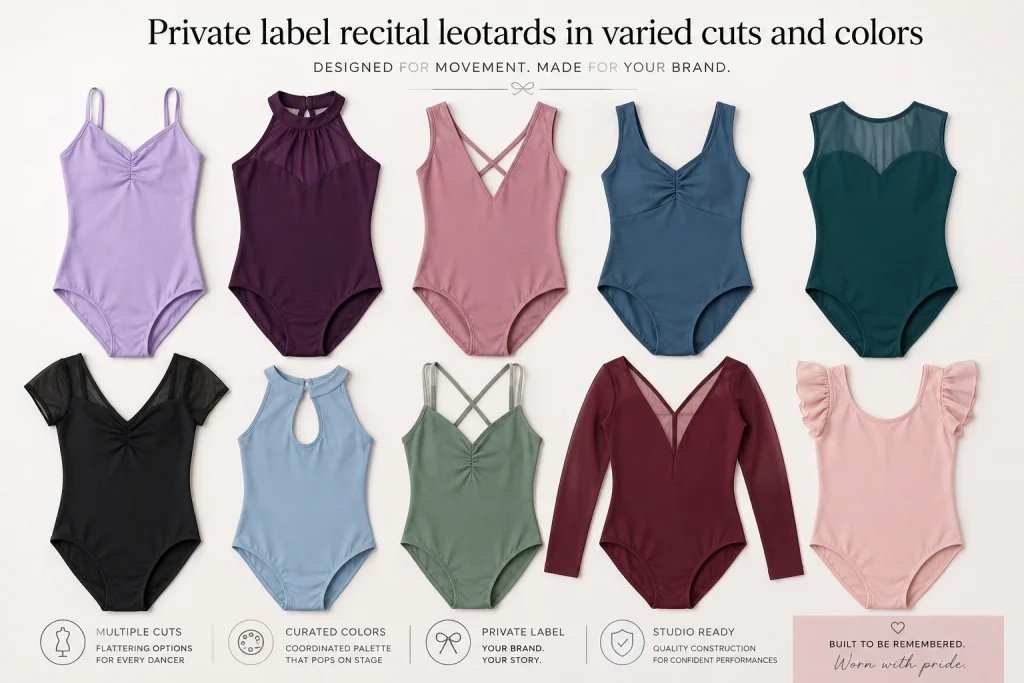
Both scenarios often end in the same place: a single purchase order that spans several styles, colors and a full-size run. Mixed orders are normal in dancewear, but a few things are worth pinning down with your manufacturer before bulk production begins, because they affect both cost and timeline.
Working these out early is the difference between a clean bulk run and mid-production rework. A manufacturer set up for end-to-end OEM clothing production can usually walk you through how a mixed order is structured before you commit, which is the moment to resolve these questions rather than after sampling.
Once the style structure is set, three production basics shape the rest of a dance leotard's program: fabric, branding, and order minimums. None of them needs to be over-engineered, but each has a decision point worth understanding.
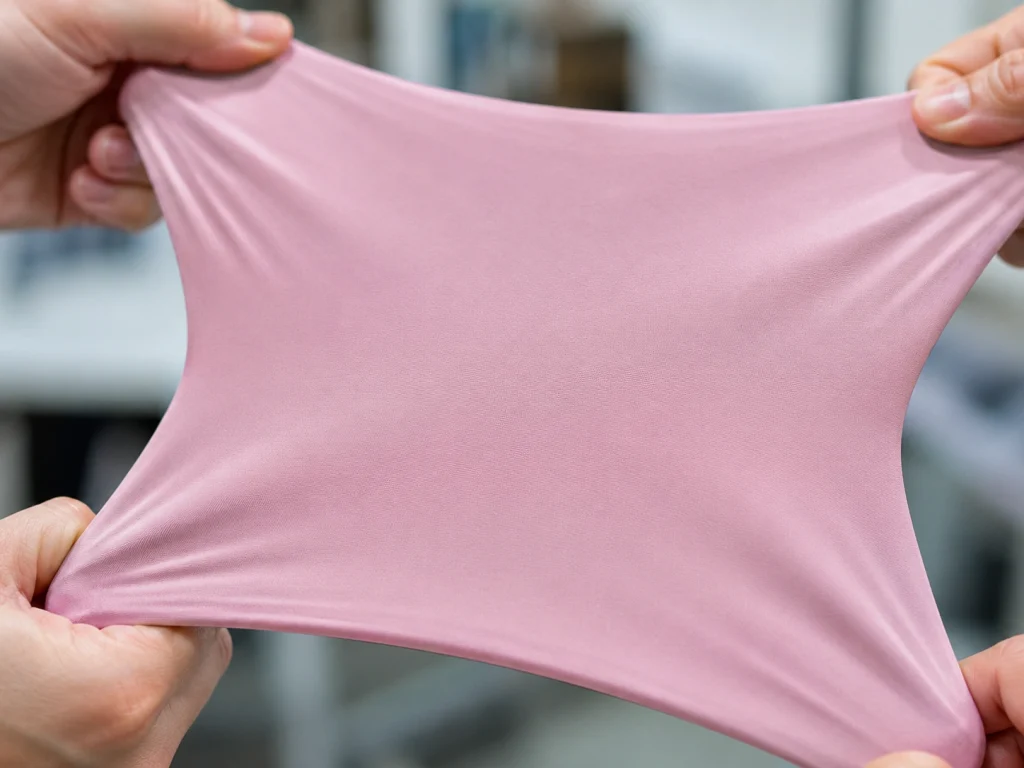
Fabric is what makes a leotard move with the dancer. Most are built on an elastane blend — commonly nylon-spandex or polyester-spandex — chosen for four-way stretch and the recovery that lets the garment hold shape through repeated wear and washing. The blend you specify affects hand feel, matte versus sheen finish, and how the fabric behaves over a season of use. The trade-offs between nylon and polyester blends in fitted activewear are worth understanding before you lock a spec; our guide to nylon versus polyester in activewear covers how each behaves, and a dedicated leotard fabric guide goes deeper on cotton and spandex blends specific to this category. Exact weight ranges and recovery figures depend on the fabric selected and are best confirmed against a sample. For brands prioritizing recycled or certified fibers, Textile Exchange standards are a useful reference point for recycled, organic, and content-claim documentation.
Customization for a private label program is mostly about branding the garment as yours: woven labels, printed care and size tags, and custom packaging are the standard pieces that turn a produced leotard into a private label product. These are distinct from decorative finishes on the garment surface — prints, rhinestones, applied logos — which are a performance-design decision covered separately in the custom dance costumes guide. For the construction-level customization choices specific to leotards, such as gusset and lining options, a dedicated custom leotards guide goes into that detail.
On minimums, low order quantities are what make a first private label run or a single-studio uniform order feasible without overstock risk. For Runtang leotard orders, the standard MOQ is 100 pcs per style per color, which supports small test runs as well as full programs. For a mixed dance leotards order, confirm how that minimum applies to each style-color line before finalizing the purchase order.
Runtang's standard minimum for leotard orders is 100 pieces per style per color, which keeps small studio programs and first private label runs viable. For a mixed dance leotards order, confirm how that minimum applies to each style-color line before finalizing the purchase order.
Yes. Mixed orders are standard in dancewear. The points to confirm are how the style-and-color split is counted against minimums and how many distinct styles need their own pre-production sample, since each style typically needs a separate fit sign-off.
Yes. Private label work includes woven brand labels, custom care and size tags, and packaging, so a produced leotard ships as your own branded product. Surface decoration such as prints or rhinestones is handled as a separate design step.
Sampling time depends on how many distinct styles are in the order, since each style usually needs its own approved sample before bulk. A realistic window should be confirmed after the style list, fabric direction, size range, and branding details are fixed.
Planning a studio uniform program or developing a private label dance line? Share your style list or a rough brief, and our team will walk you through how to structure the order. Start with our leotard production team — send your idea and we'll get back to you shortly.
 Hoodies Related
The Most Popular Different Types of Hoodies and Their Specialties
READ MORE T-shirts Related
How to Choose the Right T-shirt Garment Manufacturers to Create High-Quality Clothing
READ MORE Private Label & Brand Building
How to Start a T-Shirt Business: From Design to OEM Production
READ MORE Customization & Craft Guide
Garment Print Methods Compared: Screen Print, DTG, Heat Transfer and Sublimation
READ MORE Pajamas Related
Winter Night Essentials for the Family: A Guide to Choosing Comfortable Family Christmas Pajamas
READ MORE