World Class Textile Producer with Impeccable Quality

World Class Textile Producer with Impeccable Quality

Key Sourcing Takeaways
Most guides on how to start a t-shirt business focus on print-on-demand platforms and Etsy storefronts. If that's your model, this article isn't for you. This guide is written for brand founders who want to build something with real product identity — a line of t-shirts with a defined fabric, a consistent fit, and a label that's yours. That means going through OEM manufacturing, which has a different set of decisions, timelines, and trade-offs than POD. Here's what that path actually looks like.
Before reaching out to any factory, the most important step in knowing how to start a t-shirt business is being clear about your production model. There are two fundamentally different paths. If you are still comparing factory options, this separate guide on how to find a t-shirt manufacturer can help you screen production partners before sending an RFQ.
The first is print-on-demand: a third-party service prints and ships each order as it comes in. Startup cost is low, but so is your control over fabric weight, fit, and quality consistency. Margins are also thinner at low volumes, and you have no ownership of the product itself — just the design on top.
The second is OEM (Original Equipment Manufacturing): you work directly with a factory to produce branded garments in bulk, to your specifications. You choose the fabric, define the fit, and own the finished product. This path requires more upfront planning — a tech pack, a sampling round, and a minimum order commitment — but it's the route that scales into a real brand.
This article covers the OEM path. If you want to produce a defined style with controlled fabric, fit, labels, and packaging, OEM production is the right framework. The starting quantity does not need to be oversized — Runtang’s standard MOQ starts from 100 pieces per style per color, which gives early-stage brands room to test before scaling.
Factories field inquiries for many different t-shirt types. Going in without a clear product brief slows everything down. Before your first email to a production partner, you should have a basic product plan that covers at least: the silhouettes you want to produce, the target markets for each style, and any design treatments you're planning. You can also review our T-shirt manufacturer page to see which custom T-shirt categories are already supported for OEM production.
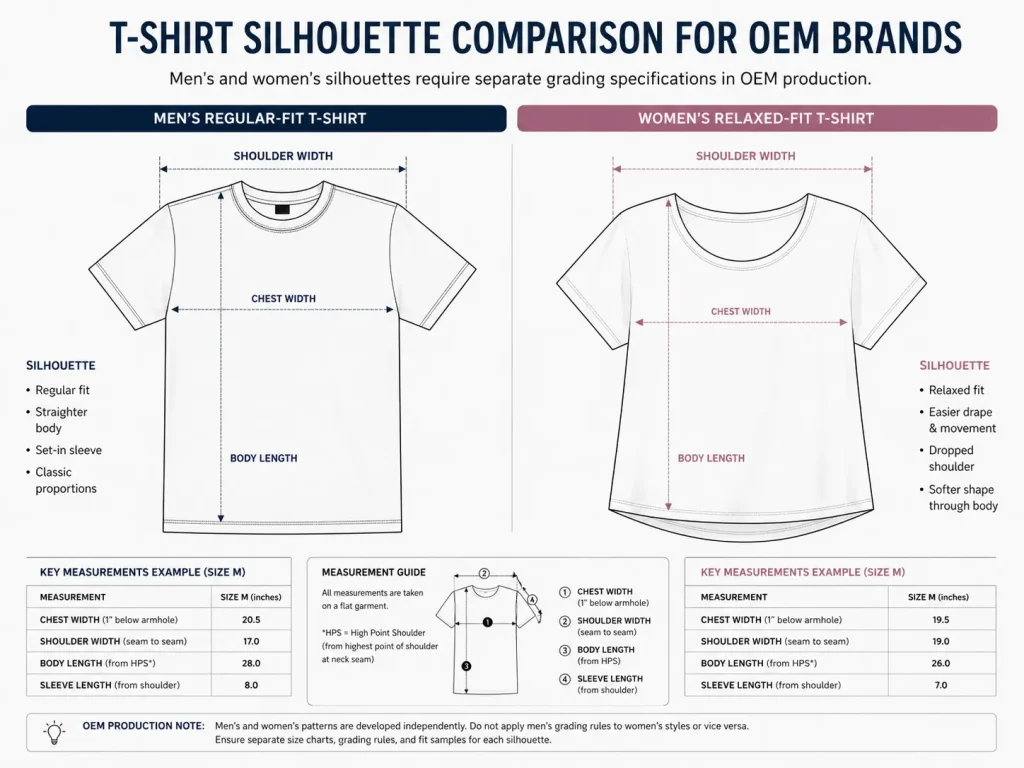
At the product planning stage, it helps to separate your line by silhouette category. The most common ones for a T-shirt brand are:
Men's and women's styles involve meaningfully different spec decisions, not just different sizes. Men's tees typically require attention to chest-to-shoulder ratio, body length from HPS (High Point Shoulder), and collar diameter. Women's styles require grading across a different measurement range, and are more sensitive to fabric drape — a lightweight jersey that works well for a men's slim-fit reads differently when cut for a women's relaxed silhouette.
If you're planning both men's and women's styles in your first bulk run, treat them as separate tech packs. Mixing silhouette specifications into a single document is a common source of sampling errors and increases your revision rounds.
Fabric choice is the single most consequential decision in a bulk t-shirt order. Get it wrong in sampling and you'll spend additional rounds correcting shrinkage, print adhesion, or hand-feel — all of which add time and cost before you've seen a single finished unit.
The two main variables in t-shirt fabric are fiber composition and knit structure.
Fiber composition determines how the fabric feels, how it responds to washing, and how well it holds color and print:
| Fiber | Bulk Characteristics | Best For |
|---|---|---|
| 100% Cotton | Good breathability, higher shrinkage risk without pre-shrink treatment, prints well with water-based inks | Classic brand aesthetics, everyday wear positioning, screen print graphic styles |
| Cotton/Polyester Blend | Reduced shrinkage vs. 100% cotton, improved durability, slightly synthetic hand-feel | Volume basics, activewear crossover styles, budget-sensitive orders |
| 100% Polyester | Excellent moisture management, lower static softness, sublimation-printable | Performance and gym tees, full-coverage sublimation graphics |
| Organic Cotton | GOTS-compatible options available; similar hand-feel to conventional cotton, supply chain documentation required | Eco-positioned brands, EU and US retail channels with sustainability requirements |
Table: Fiber options and their practical implications for bulk t-shirt production. Specific GSM ranges vary by style — confirm during sampling.
Knit structure is the second variable, and it's one of the most brand buyers underestimate:
Fabric GSM — the weight measurement — affects how the garment drapes, how it handles bulk washing, and what print methods are appropriate. Specific GSM recommendations depend on your end use and target positioning; confirm the right range for your style during your first sampling conversation with the factory.
One thing to lock in before sampling: whether you want a pre-shrunk (compacted) finish or not. For 100% cotton styles, skipping compacting or pre-shrink treatment may increase visible shrinkage risk after washing, which can lead to returns or fit complaints. Confirm whether this finish is needed during sampling, because it can affect both unit cost and approval criteria.
Understanding how to start a t-shirt business through OEM production means understanding the sequence of decisions that run between concept and finished garment. Each stage has a handoff between the brand and the factory — and the quality of what you send in determines the quality of what you get back.
The timeline across all stages depends on factory capacity, sample complexity, and your own approval speed. Specific lead times vary — plan for the sampling stages to take at least as long as production itself, especially on a first order with a new factory.
Once you understand the OEM production path, the next question is what you actually need to commit to in order to get started. MOQ — minimum order quantity — is the threshold at which a factory will take your order. For a broader clothing MOQ breakdown across styles, colors, and fabrics, see our guide for apparel brands.
Runtang's standard MOQ is 100 pieces per style per color. This means a basic two-style, two-color line (for example, a plain tee and a graphic tee in black and white) would require 400 pieces minimum across the run. This is a meaningful but manageable first order for a brand at launch stage, and it allows you to test market response before committing to larger volumes.
Several factors influence unit cost in a t-shirt bulk order:
| Cost Factor | How It Affects Price |
|---|---|
| Order quantity | Higher volume reduces cost per unit, primarily through fabric economy and setup amortization |
| Fabric selection | Organic cotton and interlock knit cost more than standard cotton jersey. Slub yarn adds a premium. |
| Color count | Each additional colorway adds dyeing cost and a separate MOQ threshold |
| Print method and placement | Screen printing is most cost-efficient at volume; DTG suits low-quantity or complex artwork; placement complexity (e.g. all-over print vs. chest logo) adds cost |
| Label and packaging | Custom woven labels, hangtags, and polybag printing each carry setup costs; these costs amortize at volume |
Table: Key cost drivers in a custom t-shirt bulk order. Unit pricing depends on your specific combination of these factors — request a factory-direct quote for your exact spec.
For your first order, one practical approach is to run a plain style alongside a graphic style. Plain tees have a simpler production path (no print setup cost), which helps you establish the quality baseline quickly. Graphic styles introduce print variables that are easier to manage once you've already approved the base garment construction.
To get an accurate cost picture early, send the factory a preliminary brief — even before a full tech pack is ready — that covers: style count, fabric preference, colorway count, print type and color count, and target quantity. Most factories will provide a ballpark quote from this information, which you can use to validate your retail pricing model before committing to sampling fees.
Building a private label t-shirt brand means more than putting your logo on a garment. It means building a brand experience that the buyer encounters from the moment they open the packaging. In OEM production, this is entirely configurable — and it's one of the clearest advantages of the OEM path over buying wholesale blanks.
The key branding components you'll need to specify for your factory are:
One thing brand founders often underestimate: label and packaging setup timelines. Woven label production can add a separate artwork approval and production step. If you are planning a fixed launch date, label and packaging development should run in parallel with garment sampling, not after sample approval.
If you're not ready to invest in full private label packaging on a first test run, many factories can produce the garments with a basic label setup, and you can transition to full branded packaging on the second order once you've validated demand.
The standard MOQ is 100 pieces per style per color. If you're launching multiple styles in multiple colorways, each style-color combination counts as a separate MOQ. Contact the production team to discuss your specific product mix.
A complete tech pack is the ideal input, but not every brand has one at first inquiry. If you're working from sketches or reference samples, a factory can help develop the technical specification during the sampling stage. You will need to have a clear view of your fabric choice, size range, and any print or trim requirements before sampling begins.
The available range covers 100% cotton, cotton/polyester blends, 100% polyester, modal, and organic cotton (GOTS-compatible options). The right choice depends on your brand positioning, target price point, and intended use — gym wear, fashion basics, and premium casualwear each point toward different fabric specs. Share your use case with the production team for a recommendation.
Sampling timelines depend on the complexity of the style and how quickly feedback is returned on each round. A straightforward plain tee with no print typically moves through fewer rounds than a graphic style with multi-placement print. Specific lead times vary — build at least two to three sample rounds into your launch calendar to allow time for feedback and approval without rushing your timeline.
Ready to move from concept to production? Share your product brief or tech pack with our team — MOQ from 100 pieces per style, direct factory pricing, and support from sampling through bulk delivery. Start with our T-shirt manufacturer page or get in touch directly.
 Top Clothing Manufacturer Recommend
Top 8 Polo Shirt Manufacturers in China
READ MORE Private Label & Brand Building
How to Start a T-Shirt Business: From Design to OEM Production
READ MORE Leotard Related
Custom Dance Costumes OEM: How Studios and Brands Order in Bulk from China
READ MORE Leotard Related
Unitard vs Leotard: Why the Construction Differs and What Brands Should Specify
READ MORE Garment Material Insights
Corduroy Fabric Characteristics and Application
READ MORE