World Class Textile Producer with Impeccable Quality

World Class Textile Producer with Impeccable Quality

Key Sourcing Takeaways
Brands ordering oversized T-shirts wholesale often run into the same production gap: samples look right, but the bulk run fits differently. The problem usually is not a quality control failure — it is an underspecified measurement brief. Drop shoulder position, fabric weight, body length proportion, and wash treatment all interact in ways that change how the garment reads on the body. Getting the spec right before production begins saves sampling rounds and prevents costly rework after bulk delivery.
This guide covers the structural and fabric decisions that matter most when sourcing oversized T-shirts at scale, and what to include in your tech pack so your OEM factory can produce them consistently.
An oversized T-shirt is not simply a standard tee scaled up. The structural difference lies in how the garment block is built: specifically where the shoulder seam sits, how wide the body is relative to its length, and how the sleeve is attached. Ordering a larger size of a regular-fit tee produces a different garment with a different silhouette — one that often reads as ill-fitting rather than intentionally relaxed.
The defining feature of most oversized T-shirts sold at wholesale is the drop shoulder construction. In a conventional set-in sleeve, the seam lands at or very close to the natural shoulder point — roughly where the shoulder ends and the arm begins. In a drop shoulder version, that seam is deliberately shifted down the arm, anywhere from 2 cm to 6 cm depending on the desired aesthetic. This shift widens the shoulder, softens the armscye, and gives the garment a boxy, relaxed profile.
For a factory to produce this correctly, the tech pack needs to state the drop distance explicitly — not just indicate an oversized intent. Two suppliers interpreting "drop shoulder" without a measurement can produce meaningfully different results.
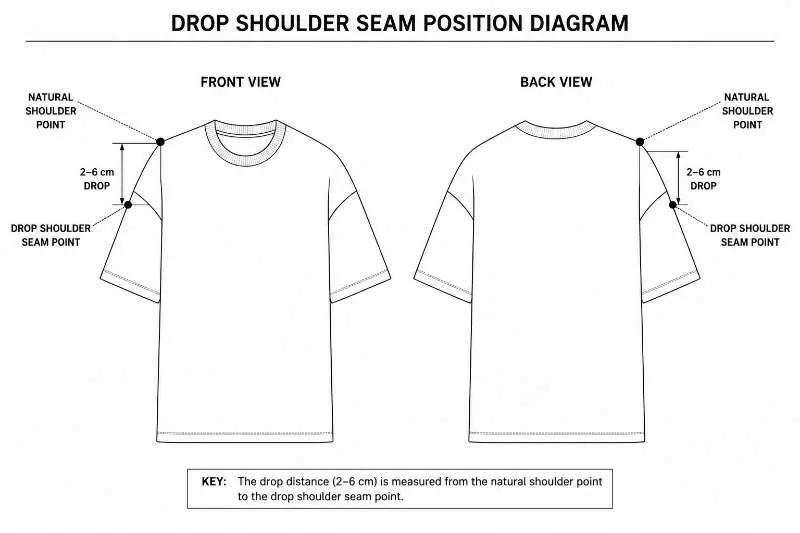
Beyond shoulder construction, body proportion matters. Oversized T-shirts are typically built with a higher chest-width-to-body-length ratio than standard tees. Brands need to state both the chest width (measured 1 inch below the armhole) and the body length (measured from the high point shoulder, or HPS) to give the factory a complete picture of the intended silhouette. A garment that is wide but short reads as cropped-oversized; one that is wide and long reads as tunic-style. Neither is wrong, but the distinction needs to be explicit.
GSM (grams per square metre) is the most practical indicator of fabric weight and, by extension, how the finished garment will drape, feel, and behave after washing. For oversized T-shirts ordered at wholesale, fabric weight divides into two clearly distinct production tiers based on end-use:
| Tier | GSM Range | Typical Fabric | Best For | Trade-offs |
|---|---|---|---|---|
| Lightweight | 160–200 GSM | Single jersey, 100% cotton or cotton-poly blend | Summer collections, layering pieces, price-sensitive SKUs | Less drape, may not hold shape after multiple washes as well as heavier options |
| Heavyweight/Premium | 220–280 GSM | Heavy jersey, heavyweight 100% cotton (open-end or ring-spun) | Premium drops, streetwear, vintage wash finishes, structured silhouette | Higher cost per unit; heavier to ship; may require extra attention to shrinkage and post-wash measurement |
For many brands launching a first oversized T-shirt programme, 200–240 GSM heavyweight jersey is a practical starting range to test during sampling. It is usually substantial enough for a premium hand feel while avoiding the shipping and drape issues that can come with very heavy fabric.
If your team is still comparing fabric weights, this fabric weight guide for apparel brands can help align GSM language before sampling.
Fabric weight also affects print compatibility. Heavier GSM fabrics generally support screen printing more cleanly because the surface is more stable. DTG (direct-to-garment) printing can be applied to either weight tier, but ink absorption differs between open-end and ring-spun cotton constructions — this is worth confirming with your factory at the sampling stage, not after bulk is ordered.
If a wash treatment is part of the design (enzyme wash, acid wash, garment wash), note that finished GSM will typically read lower than the greige weight, and dimensional stability depends on the wash cycle. Confirm the post-wash measurement spec with your factory before final bulk sign-off.
For broader cotton fabric specification references, Fibre2Fashion lists GSM, yarn count, weave type, and finish options as standard fabric data points brands may review during sourcing.
The most common source of inconsistency in oversized T-shirt production is not factory capability — it is a measurement brief that does not specify the construction intent clearly enough. The following spec points are the ones most likely to cause bulk variation if left undefined:
| Spec Point | Why It Matters for Oversized Tees | How to State It |
|---|---|---|
| Drop from natural shoulder point | Defines the silhouette; 2 cm and 5 cm produce visibly different garments | State in cm from natural shoulder point, not as a garment category label |
| Chest width at 1" below armhole | Sets the core body proportion | State in cm at the specific measurement point |
| Body length from HPS | Determines short/regular/long body read | State from high point shoulder (HPS), not from collar seam |
| Sleeve length measurement origin | From shoulder seam or from CB (centre back) — they produce different numbers | Specify the measurement origin explicitly |
| Hem width | Boxy vs. tapered — wide hem = boxy, narrower = slight taper | State finished hem width at the hem point |
| Wash treatment and sequence | Wash affects finished dimensions; order of operations matters | State wash type and whether measurement tolerance is pre- or post-wash |
Factories work from the numbers you provide, not from their interpretation of your aesthetic intent. The more precisely each of these points is stated in the tech pack, the less room there is for a bulk run to drift from the approved sample.
Brands that are still comparing factory requirements can use this T-shirt OEM partner guide to check what should be prepared before starting sample development.
One area where brands frequently underspecify is sleeve length measurement origin. A sleeve measured from the shoulder seam gives a different number than one measured from the centre back. Both methods are valid; the problem arises when the brand's tech pack and the factory's spec sheet use different reference points. On oversized styles, this can create a visible sleeve-length difference between the approved sample and the bulk run.
At Runtang, oversized T-shirts wholesale can be developed through OEM clothing production from 100 pieces per style per colour. This threshold makes it practical to test a new silhouette or colourway at small scale before expanding to a full production run. Sample development is recommended before bulk commitment — particularly for drop shoulder styles where the relationship between shoulder spec and sleeve attachment has to be verified in an actual garment.
Available fabric options for oversized T-shirts include:
Customization available on standard oversized T-shirt production includes cut and sew from spec, custom labels and hangtags, packaging, screen printing, DTG, embroidery, and wash treatments. All of these are confirmed at the sampling stage, not assumed from the order.
Before approving bulk production, confirm the following:
| □ | Drop shoulder distance confirmed on proto sample — measure from natural shoulder point to actual seam position |
| □ | Chest width and body length signed off from HPS — not from collar seam or from a reference size only |
| □ | Fabric weight (GSM) and composition confirmed on swatch, not on spec sheet alone |
| □ | Wash treatment type, sequence, and expected dimensional change reviewed and approved |
| □ | Print placement confirmed on the actual garment (not on a flat tech pack sketch), including position relative to drop shoulder seam |
| □ | Grade rule approved from base size — verify that the drop shoulder spec grades correctly across all sizes in the range |
| □ | Packaging and labelling spec confirmed before bulk cut |
MOQ at Runtang is 100 pieces per style per colour. Sample orders are available before bulk commitment and are strongly recommended for any new drop shoulder construction.
Yes, and you should. Providing the drop distance in centimetres from the natural shoulder point — rather than describing the look — is the most reliable way to ensure your bulk matches the approved sample. Factories need a number to work from.
Most premium streetwear oversized tees land between 220 and 260 GSM. Below 200 GSM, the garment typically lacks the drape and hand feel buyers expect at a premium price point. The right weight also depends on any planned wash treatment — post-wash GSM reads lower than greige weight.
State both chest width at 1 inch below the armhole and body length from HPS as absolute measurements in your target size. Do not describe the proportion in relative terms. If you want a long-body oversized look, provide the exact body length number — the factory cannot calibrate "long" without a reference.
A unisex oversized block is common and frequently used for streetwear collections. If separate men’s and women’s grading is required, the grade rule and fit model reference need to be stated separately. Confirming this at proto sample stage prevents a bulk run graded on the wrong set of assumptions.
Share your tech pack or a rough sketch of the silhouette you have in mind and we’ll get back to you with fabric options, a production timeline, and a factory-direct quote. Starting from 100 pieces per style, with sampling before bulk commitment.
 Sourcing & Supplier Guide
Clothing Quality Inspection: What Brand Buyers Should Check Before Shipment
READ MORE Hoodies Related
Oversized Hoodie Wholesale: Fit Spec, GSM and Bulk Order Guide for Brands
READ MORE Top Clothing Manufacturer Recommend
Top 8 Loungewear Manufacturers in China
READ MORE Garment Material Insights
Nylon vs Polyester Activewear: A Fabric Decision Guide for Apparel Brands
READ MORE Sourcing & Supplier Guide
Garment Production Lead Time: What Apparel Brands Should Plan For
READ MORE