World Class Textile Producer with Impeccable Quality

World Class Textile Producer with Impeccable Quality

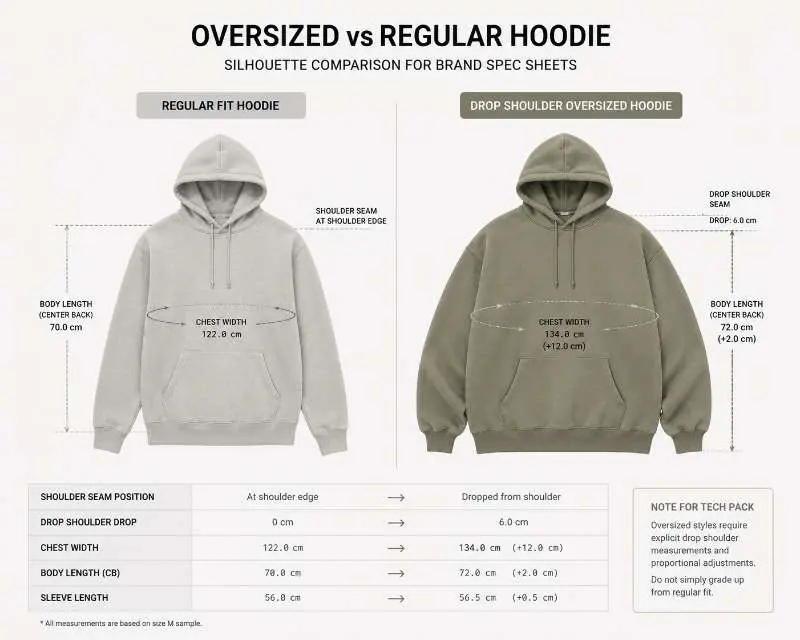
Most brands approaching oversized hoodie wholesale for the first time assume the main decision is where to source. In practice, the harder work happens before the RFQ goes out: defining the fit. Oversized is not a vague instruction a factory can interpret freely — it is a specific set of measurements, and the most consequential of these is the drop shoulder position.
This guide covers the three parameters that determine whether your bulk order actually delivers the oversized silhouette you intend: drop shoulder spec, GSM range, and fabric construction. Get these locked before sampling, and the rest of the production process becomes significantly more predictable.
The term "oversized" covers a wide range of silhouettes, and factories receive briefs at every point on that spectrum. What most apparel brands actually mean when they place an oversized hoodie wholesale order falls into one of three distinct fit directions:
For bulk production, the distinction matters because each of these fit types requires different spec points locked in the tech pack. A factory working from a vague "make it oversized" instruction will default to their existing block — which may not match your reference at all.
When brands work with Runtang on oversized hoodie production projects, the first question is always: what is your reference? Either a physical garment, a tech pack with measurements, or clear photos with callouts. That starting point determines how quickly the first proto sample can hit the right silhouette.
GSM — grams per square metre — determines how a fabric carries weight and holds shape. For oversized hoodies specifically, GSM is not just about warmth or premium feel. It is a silhouette decision.
A lower-GSM fabric on a drop shoulder construction will drape and fall softly — the hoodie hangs rather than stands. A higher-GSM fabric on the same construction will hold the shoulder position more firmly and create a more structured silhouette. Neither is right or wrong, but they serve different brand positions. A lifestyle brand targeting a soft, relaxed look needs a different GSM target than a streetwear label going for a heavy, structured drop.
Fabric construction compounds this further. Three constructions are most common for oversized hoodies in bulk OEM production:
| Fabric Construction | Typical GSM Range | Silhouette Effect | Best Brand Fit |
|---|---|---|---|
| French Terry | Lower to mid-weight GSM range | Soft drape, mid-weight structure | Athleisure, lifestyle brands |
| Fleece (brushed) | Mid-to-heavy GSM range | Fuller body, strong shape retention | Streetwear, campus brands |
| Cotton Loopback | Higher-GSM construction | Structured, heavy hand, slow recovery | Premium basics, luxury street |
GSM ranges above are directional references. Actual production targets should be confirmed with the factory during the sampling stage and locked in the tech pack.
One implication brands often miss: higher GSM fabrics place more load on seams. On a drop shoulder construction where the sleeve attachment sits below the natural shoulder, this matters — the seam at that junction takes tension differently than on a regular set-in shoulder. Stitch density and seam type need to be appropriate for the fabric weight. This is worth raising explicitly during sampling rather than discovering it after bulk inspection.
For brands that want to understand fabric options in more depth before committing to a direction, a broader look at hoodie fabric construction — covering French terry, fleece, and cotton loopback — can help inform the GSM decision before sampling begins.
Drop shoulder is where most oversized hoodie bulk orders run into problems — not because factories cannot produce it, but because the spec is not specific enough to be reproducible across a full size run and multiple production batches.
The core issue is reference point ambiguity. A brief that says "drop shoulder 3cm" is incomplete without stating: 3cm below what reference point, measured how. Without that clarity, the shoulder seam position can shift between the proto sample and the bulk run — and the accumulated tolerance across a full size run makes the problem visible.
The measurement points that need to be explicitly stated in the tech pack for a drop shoulder hoodie:
In Runtang's experience developing oversized styles for European and American brands, the most common revision cycle driver is not fabric or color — it is the silhouette shifting between proto and fit sample because the shoulder position was described in relative terms rather than fixed measurements. The fix is always the same: lock the shoulder point in the first round of comments on the proto, not in the fit sample stage.
A practical approach: request a fit sample in your mid-size first, measure against spec, and only approve for grading once the shoulder position is confirmed correct. Grading an incorrect shoulder position across the size run multiplies the problem.
For brands tracking casualwear and athleisure demand, oversized hoodies should be treated as a fit-sensitive bulk item rather than a simple size-up version of a regular hoodie. The production complexity this introduces means the pre-order checklist has become longer, not shorter. Industry sourcing coverage from Fibre2Fashion has also discussed the continued importance of casualwear and athleisure categories within global apparel sourcing.
The following spec items should be confirmed before any oversized hoodie wholesale order moves into bulk production:
| Spec Item | Why It Matters for Bulk |
|---|---|
| Drop shoulder position | Confirm the exact measurement from neck seam to shoulder point — this anchors the entire oversized silhouette. |
| Body length | Front and back measurements relative to your size run. Inconsistency here reads as defects in bulk. |
| Sleeve length + opening | Sleeve opening circumference determines whether the arm looks relaxed or too narrow for the fit direction. |
| Fabric weight (GSM) | State the target range and acceptable tolerance — not just a single number. |
| Fabric construction | French terry, fleece, or loopback? Construction type affects stitch tension and finishing method. |
| Rib cuff + hem spec | Rib weight and width affect how much the hem rides up — critical for oversized proportions. |
| Print/decoration method | Confirm compatibility with fabric weight before sampling (e.g., puff print requires adequate fabric density). |
This checklist covers the spec items most likely to cause bulk revision cycles. It is not exhaustive — additional technical requirements may apply depending on decoration method, fabric treatment, or target market compliance requirements.
A few additional points specific to bulk OEM ordering:
MOQ: Runtang's standard minimum order is 100 pieces per style per colour. This applies to oversized hoodies across all construction types and GSM ranges. Colour mixing within an order is supported — contact the production team for specific colour-split guidance.
Print and decoration compatibility: Oversized hoodies with higher GSM fabrics are well-suited to screen print, puff print, and silicone logo applications. DTG performs better on lighter constructions. If print is part of the brief, confirm the decoration method before finalising the fabric — not after.
Lead time: Direction depends on order complexity, fabric sourcing, and sampling rounds. Specific production timelines are request a production schedule estimate when submitting your inquiry.
Private label options: Full branding — woven neck labels, hangtags, poly bag packaging, and custom stickers — can be coordinated as part of the same order. Lead time for label development should be factored into the overall timeline.
For brands new to sourcing from China, the process of evaluating OEM partners and structuring a first oversized hoodie wholesale inquiry is covered in detail in Runtang's guide on how to find a hoodie manufacturer — a useful starting point before approaching factories with a brief.
It depends on the silhouette your brand is targeting. A soft, draped oversized look typically works better with a lower-GSM fabric, while a structured heavyweight drop shoulder hoodie usually needs a mid-to-heavy or higher-GSM construction. The right target should be confirmed with the factory during sampling, as GSM also interacts with fabric construction and the stitch requirements at the shoulder seam. Specific ranges are pending production confirmation.
Avoid descriptive language like 'a generous drop' or 'very oversized' — these mean different things to different factories. Instead, provide a reference garment or a flat measurement from the neck seam to the intended shoulder point. Also specify the across-shoulder measurement and chest width, as these interact with the shoulder drop. If you have a reference brand or style you're working toward, share it alongside your measurements.
Yes. Runtang's MOQ is 100 pieces per style per colour. Colour mixing within a style is possible — contact the production team for the minimum per-colour quantity that applies to your specific fabric and construction choice.
The standard MOQ is 100 pieces per style per colour. This applies across French terry, fleece, and cotton loopback constructions. For orders with multiple colourways or decoration methods, the production team can advise on how to structure the order efficiently.
Share your reference — a tech pack, a sample garment, or a sketch with callouts — and the Runtang production team will come back with a fabric recommendation, GSM range, and sampling timeline suited to your brief. Send your brief via the contact page, or explore the full range of oversized hoodies available for custom production. MOQ from 100 pieces per style per colour.
 T-shirts Related
How to Choose the Right T-shirt Garment Manufacturers to Create High-Quality Clothing
READ MORE Leggings Related
A Must-Read for Professional Sportswear Brands: How to Customize the Best Fleece Lined Leggings
READ MORE T-shirts Related
Custom Graphic T-Shirts Manufacturer Guide: Screen Printing, DTG, and Heat Transfer for Bulk Orders
READ MORE Polo Shirts Related
Sourcing Polo Shirts from China: A Brand Buyer’s Guide to Factories and Quality
READ MORE Top Clothing Manufacturer Recommend
Top 8 Hoodie Manufacturers in China
READ MORE