World Class Textile Producer with Impeccable Quality

World Class Textile Producer with Impeccable Quality

Key Sourcing Takeaways
Sourcing hoodies for your brand involves more than searching a supplier directory and requesting a quote. The factory you choose affects not just price, but your sample accuracy, bulk consistency, and how quickly you can move from first sketch to sellable product. This guide covers what to evaluate before your first conversation with a hoodie production partner—and what each hoodie style actually requires from a production standpoint.
Not all OEM factories offer the same scope of service. Before comparing prices, it helps to understand which type of production partner fits your brand's current stage.
Full-package OEM: The factory handles fabric sourcing, cutting, sewing, printing, and packaging. Best for brands that want a single point of accountability from development through delivery.
CMT (Cut, Make, Trim): You supply the fabric and trims; the factory contributes labor and machinery. Suitable for brands with established fabric relationships or proprietary materials.
Print-on-demand (POD): Pre-made blanks with decoration applied per order. Low upfront commitment, but minimal control over fabric quality, fit, and brand consistency. Not suitable for private label development.
For most clothing brands building a hoodie line from scratch, full-package OEM provides the clearest development path. Look for factories that own their fabric mill — vertical integration reduces inter-factory coordination gaps that often cause quality inconsistencies in bulk.
Key questions to ask at this stage:
MOQ varies significantly across the market. Entry-level OEM factories in China typically set minimums anywhere from 100 to 500 pieces per style per color — with higher MOQs often tied to more complex constructions or premium fabric options. At Runtang, the standard MOQ is 100 pieces per style per color, which allows brands to test new styles without bulk inventory risk.
For a clear picture of how factory pricing scales with order size, the production cost breakdown on our pricing page walks through the main cost variables. If you are unsure whether your order quantity is realistic, our clothing MOQ expectations guide explains how minimums change across fabric sourcing, decoration, and customization levels.
On sampling: the goal of the sampling stage is to lock in fit, fabric, and construction before committing to bulk. Most factories run three core stages:
The number of revision rounds between stages affects your overall development timeline. Brands that submit a tech pack or a detailed sketch at the start — including front/back flat drawings, measurement points, and fabric references — typically move through sample revisions faster than those starting from a verbal description.
If you don't have a tech pack ready, a clear sketch with key measurements and a fabric swatch reference is a workable starting point. For fabric-side decisions, the hoodie fabric guide can help you compare fleece, French terry, heavyweight blends, and other common hoodie materials before sampling. The factory's development team can build a spec from there.
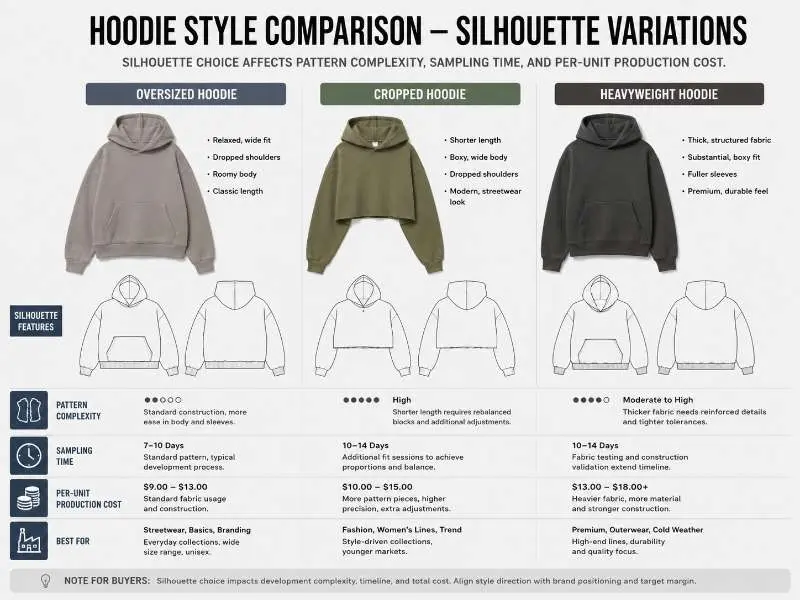
Different hoodie constructions place different demands on a factory's equipment and quality control process. This is one of the most commonly overlooked factors when evaluating OEM partners — a factory that handles blank basics well may not have the pattern-making precision required for a well-fitted cropped silhouette, or the wash expertise for a vintage-effect finish.
The table below maps each core hoodie style to its primary production consideration. Use it to identify which capabilities matter most for your collection.
| Style | Key Production Consideration | What to Confirm with Your Factory | Brand Fit |
|---|---|---|---|
| Oversized / Drop Shoulder | Shoulder point placement and sleeve drop angle must be locked before pattern cut — even small deviations shift the silhouette. | Drop shoulder spec, sleeve width, body length tolerance | Streetwear, unisex, lifestyle brands |
| Heavyweight | Higher fabric weight means denser construction, which affects stitching load and zipper or hardware sourcing lead time. | GSM range, seam reinforcement, lining options | Outdoor, premium basics, cold-weather brands |
| Cropped | Hem finish method (ribbed, raw hem, folded) changes cost, feel, and wash behavior — decide before sampling. | Hem construction, crop length spec, band elasticity | Womenswear, activewear-adjacent, streetwear |
| Sleeveless | Armhole finish quality is the main quality control point — raw edges or binding must be specified clearly. | Armhole binding type, fabric weight (lighter jersey typically), side seam method | Fitness, yoga-adjacent, summer athleisure |
| Short Sleeve | Fabric GSM tends lighter to preserve drape; confirm the factory can source appropriate weight within the same fleece/terry family. | GSM range, sleeve length tolerance, collar rib weight | Transitional season, resort, summer streetwear |
| Blank / Private Label | Fewer decoration variables, but label placement, woven neck label spec, and hang tag design must be confirmed before bulk. | Label pack spec, polybag/packaging type, folding standard | Basics brands, white-label resellers, starter collections |
| Graphic | Screen print and DTG both carry batch color variation risk — request a color standard swatch before bulk approval. | Print method (screen/DTG/sublimation), placement tolerance, color match standard | Graphic-focused DTC brands, event merchandise, gifting |
| Vintage / Washed | Wash effect repeatability across a bulk run is the main sourcing risk — each wash batch can vary. | Wash recipe documentation, batch-to-batch variation tolerance, base fabric pre-shrinkage | Vintage resellers, premium unisex, heritage-style brands |
| Kids | Drawcord elimination or length restriction is required for children's hoodies in the US and EU markets (CPSIA / EN 14682). | Drawcord compliance, chemical substance limits, sizing label standard | Children's apparel brands, family matching collections |
Each style above has a dedicated product page with full customization options. Use the table as a starting point for your style selection conversation. For style-specific development, review our pages on oversized styles with drop shoulder, heavyweight construction, cropped hem options, blank and private label hoodies, graphic decoration, and kids hoodies with drawcord safety before preparing your sampling request.
If your first priority is oversized production, the oversized hoodie wholesale guide gives a more detailed view of silhouette control, MOQ planning, and bulk order preparation.
Once you have a shortlist of potential production partners, the next step is capability verification. Price and MOQ are easy to compare — production consistency is harder to evaluate without the right checkpoints.
| Checkpoint | What to Look For | Red Flag |
|---|---|---|
| Vertical integration | In-house fabric mill + cutting + sewing under one roof — fewer handoffs, more consistent quality control | Factory outsources fabric and just does CMT assembly — quality control splits across parties |
| Sampling workflow | Clear sample stages: proto → fit sample → pre-production sample. Revisions are tracked. | No structured sample revision process; turnaround undefined |
| Export experience | Proven shipments to your target market (EU / US) — familiarity with customs docs, labeling reqs | Only domestic or regional sales experience |
| Communication response | Dedicated account contact responds within 24–48 hours; quotes include itemized breakdown | Generic email replies, no named contact, pricing is a single lump sum |
| Quality documentation | Provides fabric test reports, measurement spec sheets, AQL inspection records on request | Cannot produce QC documentation; quality is described verbally only |
Running through this checklist before sample placement reduces the risk of discovering quality or communication issues after bulk production has started.
On compliance and social standards: brands selling into the EU or US increasingly face supply chain transparency requirements. Factories that participate in recognized labor compliance programs, such as WRAP Responsible Apparel Production, can provide a documented baseline for working condition standards. Requesting a factory's audit status or social compliance certificate is reasonable due diligence, not an unusual ask.
Runtang has over 15 years of OEM export experience across European and North American markets. Our production chain — from in-house knitting and dyeing through to finished garment — operates under a single facility network, which means quality control is applied at each production stage rather than coordinated across separate suppliers.
MOQ varies by factory and construction complexity. Many OEM factories operate between 100 and 500 pieces per style per color, depending on fabric sourcing and customization requirements. Runtang's standard MOQ is 100 pieces per style per color, which is designed to let brands validate a new style before committing to bulk inventory.
A tech pack is the most efficient way to communicate your design to a factory. That said, it is not a hard requirement to get started. A clear front-and-back sketch with key measurements, fabric reference, and color direction gives a factory enough to produce a first proto sample. The tech pack is typically finalized during the sample revision stage.
OEM (Original Equipment Manufacturing) refers to producing garments built to your design specifications — fabric, construction, sizing, and branding are all defined by you. Private label typically refers to applying your brand to a factory's existing styles or blanks with minimal design input. OEM gives you more control over product differentiation; private label offers a faster path to market with lower development overhead.
Whether you're launching a first collection or expanding an existing range, the production decisions you make at this stage — factory type, MOQ threshold, style selection — affect your brand's ability to scale without quality risk. Share your design references or tech pack and we'll assess production fit, flag any construction considerations, and outline next steps. Get in touch with our production team — or go directly to our hoodie production overview to see the full range of styles and customization options.
 Leotard Related
Unitard vs Leotard: Why the Construction Differs and What Brands Should Specify
READ MORE Customization & Craft Guide
Size Grading for OEM Clothing: What Brands Need to Prepare Before Bulk Production
READ MORE Leotard Related
Custom Dance Costumes OEM: How Studios and Brands Order in Bulk from China
READ MORE Sourcing & Supplier Guide
Garment Sampling Process: What Apparel Brands Should Manage at Each Stage
READ MORE T-shirts Related
How to Choose the Right T-shirt Garment Manufacturers to Create High-Quality Clothing
READ MORE