World Class Textile Producer with Impeccable Quality

World Class Textile Producer with Impeccable Quality

Key Sourcing Takeaways
Choosing a T-shirt fabric is one of the first decisions a brand makes when developing a new style — and one of the most consequential for bulk production. Get it right and your garments arrive on spec, print as expected, and hold their size through wash cycles. Get it wrong and you face sampling reruns, GSM disputes, print adhesion failures, or — worst case — large-order shrinkage that pushes your finished sizes out of tolerance.
The challenge is that "fabric" in the context of T-shirts covers two separate things: how the yarn is knitted (construction) and what the yarn is made of (fibre content). Each variable interacts differently with print methods, dyeing processes, and mass-production tolerances. Most guides treat these as one topic. This one separates them, because confusing construction with fibre content is exactly how brands end up with misaligned expectations at the sampling stage.
What follows is a production-oriented breakdown of the fabric choices that matter most for T-shirt bulk orders — not which option feels softest, but which option works best for your brand's decoration method, order volume, and quality positioning.
When brands ask "what fabric should I use?", they are usually asking two questions at once — and mixing the answers creates problems down the line. Let's separate them cleanly.
Construction refers to the knitting structure — the mechanical arrangement of loops that gives a fabric its physical behaviour. For T-shirts, the two most relevant constructions are single jersey and interlock (also called double-knit). Construction determines a fabric's weight range, stretch behaviour, surface texture, edge stability, and sewing characteristics. A single jersey 160 GSM fabric and an interlock 160 GSM fabric will behave completely differently in production even though they share the same weight, because their internal structures are different.
Construction is set at the knitting stage, before fibre content enters the picture. A jersey fabric can be knitted from cotton, polyester, cotton-polyester blends, modal, bamboo, or any combination. The construction stays the same regardless of what the yarn is made of.
Fibre content describes the raw material — cotton, polyester, rayon, or a blend of two or more. Fibre content determines dyeability, shrinkage rate, breathability, moisture management, and print surface compatibility. A 100% cotton jersey and a 50/50 cotton-polyester jersey share the same construction but behave very differently when you dye them, wash them, or run them through a DTG machine.
For bulk orders, fibre content affects cost in two directions: raw material price and downstream processing cost. Cotton typically costs more than polyester at the fibre stage but may simplify dyeing and DTG printing. Polyester costs less per kilogram but requires reactive dye systems that some smaller factories may not have set up for your target GSM.
The practical consequence of this distinction is straightforward: your tech pack needs to specify both construction and fibre content to give your factory a workable brief. Specifying only "100% cotton" without noting the knit construction leaves the factory choosing between single jersey, interlock, piqué, and other options — all of which hit different price points and perform differently under the same sewing conditions.
For brands ordering T-shirts through an OEM partner: specify construction (e.g., single jersey), fibre ratio (e.g., 95% cotton / 5% elastane), GSM range, and any pre-shrinkage or pre-washing requirement. These four data points eliminate the most common source of sampling misalignment.
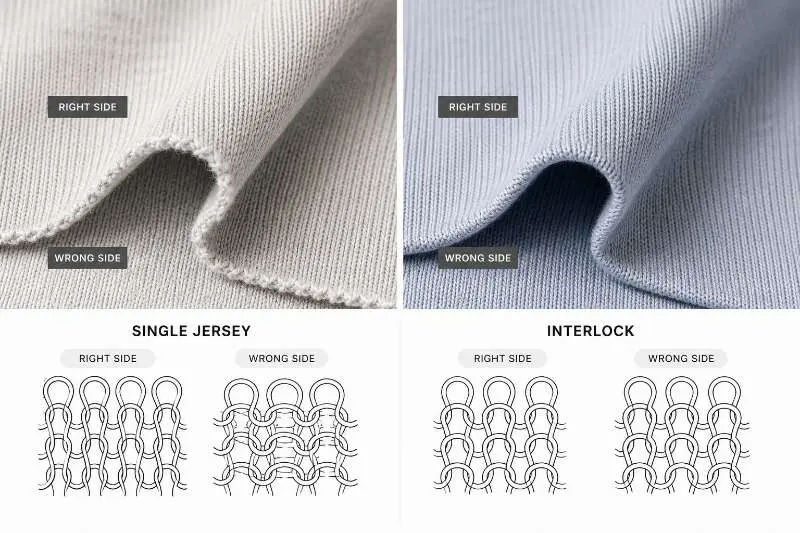
Most T-shirts produced at scale use single jersey construction. Understanding why — and when interlock makes sense instead — is foundational to specifying fabric correctly before you engage a factory.
Single jersey is knitted on a single needle bed using a circular knitting machine. Each needle forms one loop per course. The result is a fabric with a smooth face side (knit loops visible) and a textured reverse side (purl bars visible). The asymmetry of the structure gives jersey several defining production characteristics:
For most T-shirt brands ordering graphic tees, basics, or casual wear: single jersey is the correct construction. It prints well, sews efficiently, and is available in the widest GSM range from most OEM factories.
Interlock is produced on a double needle bed machine, creating two interlocked layers of jersey knit back to back. The result is a fabric that looks and feels the same on both sides, behaves more like a woven in terms of dimensional stability, and sits heavier and firmer in hand than a comparable single jersey.
From a production standpoint, interlock changes several parameters:
Interlock is better suited to: premium lifestyle T-shirts, corporate uniform pieces, children's T-shirts requiring dimensional stability through repeated washing, and any application where a firmer, more structured hand feel justifies the added cost.
The table below summarises the key production differences between the two constructions. Use it as a starting point when briefing your factory or filling in your tech pack construction field.
| Characteristic | Single Jersey | Interlock | Brand Implication |
|---|---|---|---|
| Needle beds | One | Two | Interlock costs more to knit |
| Edge behaviour | Curls at raw edges | Stable, no curl | Interlock simplifies finishing |
| Surface texture | Smooth face / textured back | Smooth on both sides | Both print well; jersey more common for DTG |
| Lateral stretch | Higher | Lower | Jersey for relaxed fit; interlock for structured fit |
| Shape retention after wash | Moderate | Higher | Interlock preferred for uniform or premium applications |
| Typical GSM range | 120–220 GSM (typically) | 150–300 GSM (typically) | Interlock skews heavier |
| Relative cost per metre | Lower | Higher | Jersey more cost-efficient at scale |
GSM figures are directional; confirm with your factory based on yarn count and machine gauge. Final GSM should be locked in your tech pack before sampling.
Once construction is decided, the next variable is fibre content. For T-shirt OEM orders, the relevant choices reduce to three practical categories: 100% cotton, 100% polyester, and cotton-polyester blends (with or without a third fibre such as viscose or elastane). Each behaves differently in dyeing, large-order washing tests, and decoration processes.
Cotton remains the most widely specified fibre for consumer-facing T-shirt brands, particularly those targeting lifestyle, streetwear, and premium casual markets. The reasons are partly functional and partly commercial: cotton accepts reactive dye well, produces a deep, accurate colour on DTG printing, and carries strong consumer perception of quality and comfort.
From a bulk production standpoint, however, 100% cotton introduces the most significant shrinkage risk of any T-shirt fibre choice. Cotton fibres absorb moisture and swell during washing, causing the fabric to contract — a behaviour known as hygral relaxation shrinkage. Without pre-treatment (pre-shrinking or sanforisation), cotton single jersey can shrink in the length and width after the first wash, shifting finished garment measurements outside your approved size tolerance.
Several points matter here for bulk orders:
For brands ordering graphic or lifestyle T-shirts, fabric performance should be evaluated alongside shrinkage control and print requirements. Industry resources such as CottonWorks fibre and fabric performance resources can provide additional technical background when comparing cotton specifications. 100% ring-spun cotton single jersey with specified pre-shrinkage treatment is typically the preferred starting point for many branded T-shirt programs.
Polyester is the standard fibre for performance T-shirts, sportswear, and sublimation-printed garments. As a synthetic fibre, polyester absorbs very little moisture, which means it dries quickly — a functional advantage for activewear and a practical one for production, since polyester garments move through finishing processes faster than cotton equivalents.
The more important characteristic for most OEM brands, however, is polyester's relationship with sublimation printing. Sublimation dye bonds specifically to synthetic polymer chains — and does not bond to natural fibres. On a 100% polyester blank, sublimation produces vivid, full-colour prints that are embedded in the fabric rather than sitting on the surface. On a 50/50 cotton-polyester blend, sublimation only bonds to the polyester portion, resulting in prints that appear washed out, pale, or dull — a problem that is invisible at the initial sampling stage if the sample is viewed next to the digital proof rather than against a consistent colour standard.
Additional polyester production considerations:
For activewear and sublimation-print T-shirts: 100% polyester is the correct fibre specification. If your range mixes sublimation-printed and non-printed styles, your factory needs to manage these as separate fabric streams — confirm this capability before ordering.
Cotton-polyester blends occupy the middle ground that most branded casual T-shirt collections settle on: the feel and print compatibility of cotton, with the dimensional stability and wash durability of polyester. The two most common ratios in bulk production are:
Tri-blends (cotton/polyester/rayon or viscose) add a third fibre to improve drape and softness. Viscose or rayon introduces a more fluid, drapey handle that many contemporary lifestyle brands find attractive. The production consideration: rayon is less stable during wet processing than cotton or polyester, and tri-blend fabrics can show more variation in finished measurements batch-to-batch. For brands requiring tight size consistency across large orders, tri-blends require additional tolerance checks during bulk production.
The table below provides a direct comparison across the three fibre categories most relevant to T-shirt OEM decisions. Performance indicators are directional — confirm specific parameters with your factory or request fabric certification data during sampling.
| Factor | 100% Cotton | Cotton-Poly Blend | Cotton-Poly Blend 100% Polyester |
|---|---|---|---|
| Shrinkage risk | Higher — pre-shrinkage treatment required | Moderate — lower than pure cotton | Low — most stable across wash cycles |
| DTG print result | Best — high ink absorption, vivid detail | Good — slightly reduced vs pure cotton | Poor — ink sits on surface, may crack |
| Screen print result | Excellent | Excellent | Good (adhesion may vary by ink type) |
| Sublimation compatibility | Not suitable | Partial only — dull result at low poly % | Ideal — full colour saturation at 100% poly |
| Dye system required | Reactive dye | Reactive + disperse (complex process) | Disperse dye |
| Colour retention (after 30 washes) | Moderate — fades with time | Good — blend improves colour stability | Very good — polyester holds dye well |
| Cost at fibre stage | Higher | Moderate | Lower |
| Typical brand positioning | Premium, lifestyle, streetwear | Casual, corporate, mid-market | Activewear, performance, sublimation print |
Performance ratings are directional based on standard production conditions. Specific GSM, yarn quality, and finishing treatment all affect final results. Request fabric test reports during sampling for production-critical specifications.
One of the most avoidable delays in T-shirt OEM development is discovering — at the sampling stage — that the selected fabric does not work with the intended decoration method. Fabric and print method are not independent choices. They interact at a physical level, and misalignment between the two results in either aesthetically unacceptable samples or in prints that degrade rapidly after washing.
This section covers the three decoration methods most commonly applied to T-shirts in bulk OEM orders: screen printing, DTG (direct-to-garment), and sublimation. Heat transfer is included briefly as a supplementary method.
Screen printing deposits ink on the fabric surface through a mesh screen, with a separate screen for each colour. It is the most cost-effective method for high-volume, limited-colour designs — and the method most tolerant of fabric variation. Screen printing works across cotton, polyester, and blended jerseys without significant compatibility issues, provided the ink system matches the fibre type.
The main fabric consideration for screen printing is surface smoothness and stability during printing. Single jersey with a smooth face side prints cleanly. Interlock, with its identical-surface-on-both-sides structure, also prints well. Higher GSM fabrics can absorb more ink, which is relevant for white ink on dark grounds — a specification worth confirming with your factory if your design calls for it.
For polyester and high-polyester blends, your factory should use low-cure or polyester-compatible inks to prevent dye migration — a phenomenon where the disperse dye in polyester bleeds into the screen print ink during curing, discolouring the print. Confirm ink system compatibility if your design uses light colours on a coloured polyester blank.
DTG printing jets water-based ink directly into the fabric fibres, producing prints that feel soft and integrate with the fabric rather than sitting on top. Print vibrancy and washability are directly tied to cotton content: the higher the cotton percentage, the better the ink absorption and the more accurate the colour reproduction.
For OEM bulk orders using DTG, the fabric specification should reflect this requirement. Key parameters:
For brands relying on DTG for bulk fulfilment: specify cotton content minimum in your tech pack as a production requirement, not a preference. DTG print houses will refuse to guarantee results on fabrics below their minimum cotton threshold.
Sublimation is a dye process, not a surface print. Heat converts solid sublimation ink into a gas that bonds with polyester polymer chains within the fabric. Once cooled, the dye is permanently embedded in the fibre — not sitting on the surface. This produces prints that do not crack, peel, or fade with washing, and allows for full-coverage, edge-to-edge pattern design on T-shirts.
The critical fabric requirement is clear: sublimation requires polyester content, and the higher the polyester percentage, the more vibrant and accurate the print. On a 100% polyester blank, sublimation achieves its maximum colour saturation. On a 50/50 blend, only the polyester portion bonds dye — the result is a visibly muted, faded version of the intended design. On 100% cotton, sublimation does not work.
This creates a specific OEM risk: if a brand places a bulk order of mixed-fibre T-shirts for sublimation printing without confirming polyester content with the factory, the entire order may print incorrectly. Brands specifying sublimation-compatible T-shirts should:
Heat transfer applies pre-printed designs to fabric using heat and pressure. Unlike sublimation (which bonds dye to the fibre), heat transfer creates a surface layer that adheres to the fabric. The method works across fabric types but produces a slightly tactile, on-surface print feel.
For bulk OEM T-shirt orders, heat transfer is most commonly used for: small runs where screen setup cost is prohibitive; designs with photographic detail that screen printing cannot reproduce accurately; and reflective or metallic finishes. Fabric compatibility is broad — heat transfer works on cotton, polyester, and blends. The key variable is the surface finish of the fabric: textured, brushed, or napped surfaces reduce adhesion quality.
| Decoration Method | Recommended Fabric | Critical Constraint |
|---|---|---|
| Screen printing | Cotton, cotton-poly blend, or 100% polyester (with polyester ink) | Specify anti-migration ink for polyester blanks with light-colour designs |
| DTG printing | 100% ring-spun cotton or CVC (min. 50% cotton) | Cotton % minimum must be stated in tech pack; pre-treatment method must be confirmed |
| Sublimation | 100% polyester (min. 80% poly for acceptable results) | Any cotton content degrades print; fabric supplier must not change between sampling and bulk |
| Heat transfer | Cotton, poly, blends (broad compatibility) | Textured or napped surfaces reduce adhesion — confirm with a physical adhesion test |
The fabric and decoration method must be confirmed as a pair before bulk fabric is sourced. Changing either variable after sampling may require a new sample round.
Fabric shrinkage is one of the most common sources of disputes between brands and OEM factories on T-shirt orders. A garment can measure correctly at the point of delivery and still fail to meet stated measurements after the brand's first wash test — not because the factory made an error, but because shrinkage was not specified as a performance requirement before bulk production began.
Understanding the mechanics of shrinkage, and how to control it through fabric specification, is a practical production skill for any brand placing bulk T-shirt orders.
Cotton fibres are hydrophilic — they absorb water readily. When a cotton yarn absorbs moisture, the fibre swells radially and contracts longitudinally. This causes the knitted loops in the fabric to pull tighter, reducing the overall dimensions of the garment. The first wash is the most significant shrinkage event for untreated cotton; subsequent washes produce progressively less contraction.
Polyester fibres are hydrophobic — they resist moisture absorption. Polyester T-shirts retain their dimensions through repeated washing without the hygral relaxation that causes cotton to shrink. This is why polyester and high-polyester blends are the default choice for applications where consistent sizing across the garment's lifespan matters more than the natural feel of cotton.
Two finishing treatments are standard in T-shirt production to reduce cotton shrinkage before the garment reaches the consumer:
Brands should specify which pre-shrinkage treatment applies in their tech pack, and should confirm that the factory has applied it by requesting a wash test report from the sample stage. If no pre-shrinkage requirement is stated, the factory may or may not apply treatment depending on their standard practice — and this ambiguity is where measurement disputes originate.
Industry practice for branded T-shirts typically targets residual shrinkage of 3% or less in both length and width after a standard wash cycle. This figure should be explicitly stated as a performance requirement in your tech pack's fabric specification section — not assumed.
When reviewing samples for bulk approval: wash the sample at least once using the garment's care label instructions and measure the key dimensions (body length, chest width, sleeve length) against the approved size spec before signing off on bulk production. Fabric that meets the visual standard at sample approval can still fail the measurement standard after washing if pre-shrinkage treatment was inadequate or inconsistently applied.
Specific shrinkage rates vary by fabric construction, GSM, fibre content, and finishing treatment — and should be confirmed with your factory's lab rather than estimated from general industry norms.
The choices described in the preceding sections only have production value if they are correctly communicated to your factory. A tech pack that lists only "cotton jersey" leaves five or six variables unspecified — and each unspecified variable is a decision the factory will make on your behalf, not always in the direction your brand intends.
This section covers what a complete T-shirt fabric specification looks like and where common omissions occur.
As covered in the previous section, your fabric specification and your decoration method must be confirmed as a pair. Once you have determined your print method, add a note in your tech pack's decoration section that cross-references the fabric specification — for example: "DTG printing. Fabric must meet minimum 50% ring-spun cotton content as specified in fabric section. Factory to confirm pre-treatment method."
This cross-reference makes fabric-print compatibility a shared responsibility and creates a documented audit trail if discrepancies arise during quality inspection.
Fabric specification should be locked before your first sample is produced, not refined through multiple sampling rounds. Changing fibre content or GSM after a first sample is approved restarts the fabric-related portion of the development cycle — new yarn must be sourced, new fabric must be knitted and finished, and new samples must be produced against the revised specification.
In practice, brands often approach fabric selection iteratively, using first samples to feel the hand of a fabric before committing to a spec. This is reasonable for a first collection. For repeat or seasonal orders, the factory should carry your confirmed fabric specification on file, allowing bulk orders to proceed without re-opening the fabric selection process.
Runtang's production team reviews fabric specifications alongside tech packs before sampling begins — brands can request a sample to confirm fabric choice before committing to a bulk order.
| Omission | What the Factory Decides | Likely Consequence |
|---|---|---|
| No GSM specified | Factory selects lowest-cost available weight in the fibre | Garment hand feel is lighter than brand expects; customer returns or brand complaints post-delivery |
| Fibre ratio stated as range, not fixed percentage | Factory uses whichever ratio is currently in stock | Print results and shrinkage behaviour vary between production runs |
| Pre-shrinkage treatment not stated | Factory applies (or does not apply) per standard practice | Garment shrinks outside size tolerance after first consumer wash |
| Decoration method not cross-referenced in fabric spec | Factory selects fabric independently of print method | Sublimation on cotton-heavy blend produces incorrect colour; DTG on polyester-heavy fabric produces poor ink absorption |
| Yarn type not specified (ring-spun vs open-end) | Factory uses lowest-cost yarn available in stated fibre | Surface texture, pilling resistance, and print quality fall below brand standard |
Incomplete tech pack specifications are one of the most common causes of sampling revision rounds. Each revision round adds lead time and potentially cost. A complete fabric specification on the first brief reduces both.
Jersey (specifically single jersey) is knitted on one needle bed, producing a fabric with a smooth front face and textured back, with inherent edge curl. Interlock uses two needle beds, creating a thicker, dimensionally stable fabric that looks and feels the same on both sides and does not curl at edges. For most T-shirt bulk orders — casual, graphic, lifestyle — single jersey is the standard construction. Interlock is better suited to premium or structured applications where shape retention across repeated washing is a priority.
100% cotton shrinks more than cotton-polyester blends under standard wash conditions, particularly in the first wash cycle. The polyester component in blended fabrics resists moisture absorption, stabilising the fabric structure and reducing dimensional change post-wash. Both cotton and blended fabrics can be treated with mechanical pre-shrinkage finishing (sanforisation) to reduce residual shrinkage before the garment reaches the consumer. Brands should specify pre-shrinkage requirements explicitly in their tech pack — this is not a default treatment in all factories.
Screen printing works well across cotton, cotton-polyester blends, and polyester, making it the most fabric-tolerant decoration method. For polyester blanks with light-colour designs, specify anti-dye-migration ink to prevent bleed-through during curing. DTG printing produces its best results on high-cotton fabrics — 100% ring-spun cotton or CVC blends with at least 50% cotton. Polyester-heavy fabrics produce noticeably poorer DTG results due to reduced ink absorption. Confirm your fabric's cotton content as a minimum specification in your tech pack if DTG is your primary decoration method.
Changing fabric suppliers between approved samples and bulk production introduces consistency risk — particularly for colour (dye batch variation), GSM (weight differences between mills), and print behaviour (especially sublimation, where polyester content and dye affinity vary by yarn source). For brands where colour consistency and print quality are core to the product, the factory should source bulk fabric from the same mill that supplied the approved sample fabric. Confirm this requirement in writing before bulk fabric is ordered.
At minimum, your fabric brief should state: construction (single jersey or interlock), fibre content and ratio (e.g., 95% ring-spun cotton / 5% elastane), target GSM with tolerance (e.g., 180 GSM ± 10 GSM), and any pre-treatment or finishing requirements (e.g., sanforised, enzyme washed). For graphic T-shirts, also cross-reference the decoration method to confirm fabric-print compatibility. These four to five data points cover the most common sources of specification disputes and sampling revision rounds.
Fabric specification is one of those decisions that looks straightforward at the brief stage and costly at the bulk stage if it has been made without full information. Jersey or interlock, cotton or blend, DTG or sublimation — each pairing has production consequences that show up in sampling rounds, shrinkage tests, and delivered garment quality.
Runtang's production team works with apparel brands at the fabric selection stage — before sampling begins — to confirm that construction, fibre content, GSM, and decoration method are aligned as a set. If you have a design in development or are planning a T-shirt range, share your design or tech pack and our team will advise on fabric specification from a production standpoint. MOQ from 100 pieces per style.
Not sure where to start on the fabric brief? We can walk you through the specification process before your first sample request — no commitment needed.
 Pajamas Related
What Makes Custom Pajama Sets the Ideal Gift | Personalized Sleepwear Guide
READ MORE Pajamas Related
How to Quickly Lay Out the Christmas Pajama Market
READ MORE Hoodies Related
How to Choose the Right Blank Hoodies Manufacturer for Your Brand
READ MORE Customization & Craft Guide
Embroidery vs Print for Custom Apparel: Durability, Cost and Bulk Quality Compared
READ MORE Hoodies Related
The Most Popular Different Types of Hoodies and Their Specialties
READ MORE