World Class Textile Producer with Impeccable Quality

World Class Textile Producer with Impeccable Quality

Key Sourcing Takeaways
Fabric choice is one of the first decisions a brand makes when developing a hoodie, and it is also one of the hardest to reverse. By the time a sample comes back and something feels off—too stiff, pilling after wash, embroidery puckering—the production timeline has already been compressed. The fix is rarely just changing a fabric; it means a new sample round, a new cost review, and often a missed launch window.
This guide focuses on the three fabric families that account for the majority of hoodie OEM production: French terry, fleece, and cotton blends. The goal is not to declare a winner. Each has a place in a well-built brand range. The goal is to give brand buyers the production-side information needed to make the call before the tech pack goes to the factory—not after the PP sample arrives.
Looking at a swatch, the three fabric types can seem interchangeable—all knit, all medium weight, all available in similar colourways. The differences become visible in production.
Shrinkage is the first divergence. Higher cotton-content fabrics absorb more moisture during dyeing and finishing, which means dimensional change is a real risk if pre-shrinkage is not built into the spec. A factory that produces to tolerance on the sample may still deliver large-run pieces that measure short if the pre-shrink step is not explicitly called out in the tech pack.
If shrinkage risk is a concern, brands should treat clothing shrinkage as a sampling approval item rather than a post-production complaint.
Colour consistency is the second. Different fabric constructions absorb dye at different rates. Fleece, with its raised brushed surface, has more fibre contact area than the flat face of French terry. This affects how dye lots read in finished garments—particularly in deep colours like navy and black, where brushing depth variation across batches can create a perception of shade difference even when the dye formula is identical.
The third divergence is decoration compatibility. Screen print, DTG, heat transfer, and embroidery each interact differently with the fabric surface. Getting this wrong means print cracking at the first wash or embroidery that pulls the fabric out of shape. These are not quality control failures—they are predictable outcomes of a mismatch between decoration method and fabric construction, and they are avoidable if the choice is made early.
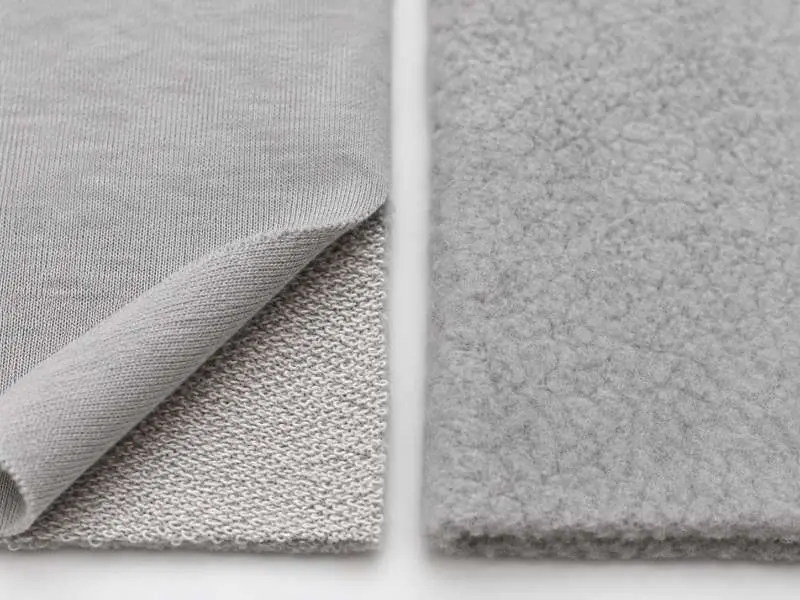
French terry is a knit fabric with a smooth, flat outer face and an unbrushed looped interior. It is not fleece. The inner loops are left uncut, which retains breathability while providing a comfortable next-to-skin texture. The result is a fabric that sits between a jersey and a fleece in terms of weight and warmth—light enough for year-round wear, substantial enough to carry a brand's quality cues.
In bulk production, French terry's smooth outer face is its most commercially useful characteristic. Screen printing and DTG printing both require a flat, consistent substrate to achieve sharp registration and even ink coverage across a print run. The face of French terry delivers this reliably. Brands that plan to decorate their hoodies with front graphics, chest logos, or sleeve prints will find fewer print-quality headaches with French terry than with fleece.
The fabric also tends to hold its structure through repeated washing better than lower-weight fleece options. For brands positioning their hoodies as year-round basics or athleisure staples, this durability-to-weight ratio is useful—the garment does not degrade to a limp shell after six months of customer use.
The main production consideration is cotton content and pre-shrinkage. French terry is often produced in cotton-dominant or cotton-polyester blends, so brands should specify pre-shrinkage treatment clearly in the tech pack. If a specific fabric weight is required, use a GSM tolerance instead of a single number, and confirm the selected construction with the factory during swatch approval. Runtang’s hoodie production supports a broad hoodie fabric weight range, but the final GSM should be confirmed by fabric type, fibre ratio, and target season before sampling.
Fleece starts life as a knit fabric. The distinction is in finishing: the inner surface is mechanically brushed to raise the fibres into a soft, napped pile. This process—called brushing or raising—is what gives fleece its characteristic warmth and plush hand-feel. It also changes how the fabric behaves in the rest of the production process.
Embroidery often performs well on fleece when the fabric weight, backing, and stitch density are matched correctly. The raised pile can help support logo embroidery, but dense stitch areas still need sampling to avoid distortion around the design edge. For printed fleece hoodies, brands should test the exact artwork on the approved fabric surface before bulk approval, especially for fine-line graphics or dark colourways. For GSM, avoid publishing a fixed fleece range unless it has been confirmed by the factory; state the target season, hand-feel, and decoration method first, then let the factory narrow the fabric options during sampling.
Brands developing winter hoodies should review how fleece fabric behaves after brushing, dyeing, and decoration before locking the bulk spec.
Cotton blends are not a single fabric type—they are a category that describes the fibre composition strategy underlying both French terry and fleece constructions. However, brands often encounter the term specifically when working with 100% cotton or high-cotton-ratio fabrics that are positioned on naturalness and breathability rather than performance.
The appeal is clear: cotton feels familiar, communicates quality to end consumers, and suits brands that want to use GOTS-compatible or organically sourced fibres as part of their product positioning. These fabric options are available for hoodie production; the relevant question is what the higher cotton content means for the production process.
Shrinkage is the central issue. Cotton fibres absorb moisture and contract. A garment produced in 100% cotton or a high-cotton blend without pre-shrinkage treatment will shrink noticeably in the consumer's first wash. This is not unusual—it is a well-understood characteristic of the fibre. The problem arises when the spec does not account for it. Brands should explicitly state in the tech pack whether pre-shrinkage treatment is required, and confirm with the factory what their standard finishing process includes. Do not assume it is applied by default.
Polyester in the blend reduces shrinkage risk and adds dimensional stability. A 50/50 or 60/40 cotton-polyester construction gives brands a more manageable production profile—closer to sample dimensions in finished large-run pieces—while retaining much of the cotton hand-feel. For brands choosing between full cotton and a blend, the decision usually comes down to how tightly they need to control finished dimensions across a large run, and whether their target consumer cares about fibre purity in the product description.
Recycled polyester can also be used as a blend component for brands with sustainability positioning requirements. If your brand needs organic cotton, recycled content, or other responsible-material claims, confirm the exact certification scope before sampling rather than relying on a general material name. Runtang can discuss GOTS-compatible cotton options at the enquiry stage, but brands should verify what documentation is required for their own market and claim wording. For guidance on evaluating organic and recycled fibre certification claims across the supply chain, Textile Exchange's fibre standards resources provide a useful reference for brand buyers.
The table below summarises the key production-side factors across the three fabric options. Use it as a starting point for the conversation with your factory at the enquiry stage—ideally before a tech pack is finalised, so fabric choice and decoration method can be aligned from the outset.
| Fabric | Seasonal Fit | Print Suitability | Embroidery Suitability | Brand Positioning | Primary Bulk Risk |
|---|---|---|---|---|---|
| French Terry | Year-round/transitional | High — flat face ideal for screen & DTG | Good — lighter weight limits stitch density | Athleisure, basics, year-round drops | Pre-shrinkage must be specified in tech pack |
| Fleece | Autumn/winter | Moderate — raised pile requires careful method selection | High — thick pile prevents puckering | Streetwear, heavyweight, premium winter | Batch brushing depth variation — affects shade perception in dark colourways |
| Cotton Blend | Year-round | Good — depends on construction | Good | Natural fibre positioning, classics, GOTS-compatible options | Shrinkage without pre-treatment — must be called out in tech pack |
The table above reflects general production-side behaviour. Actual outcomes depend on the specific GSM, fibre ratio, and construction confirmed during sampling. Use it to narrow options before the conversation with your factory—not to replace it.
French terry and fleece account for the majority of bulk hoodie orders across casual, streetwear, and athleisure categories. Cotton blends—whether in a French terry or fleece construction—are a strong choice for brands prioritising natural-fibre positioning. The right option depends on your seasonal strategy, decoration plan, and retail price point.
French terry is generally better suited to screen printing. Its smooth outer face gives the print a flat, consistent surface, which improves edge definition and colour layering across a large run. Fleece's raised pile can cause ink to sit unevenly, particularly with finer graphics. For embroidery-first programmes, fleece has the advantage—but for brands leading with printed graphics, French terry reduces print risk.
State the GSM range as a tolerance, not a single figure—for example, "300 GSM ± 5%". Include the fibre composition ratio (e.g., 80% cotton / 20% polyester), construction type (French terry or fleece), and whether pre-shrinkage treatment is required. If your brand has a specific hand-feel target, request a fabric swatch approval step before bulk cutting begins. Factories can match a reference swatch far more accurately than a verbal description.
If you are still comparing factory capabilities, this hoodie manufacturer guide can help you check fabric sourcing, sampling, MOQ, and decoration support before sending an RFQ.
Fabric choice is easier to get right at the start of development than to fix after sampling has begun. If you are building a hoodie range and working through the fabric decision—whether the question is French terry vs fleece, GSM range, or how cotton content affects your decoration options—share your brief with the production team.
Runtang produces custom hoodies across French terry, fleece, and cotton blend constructions, with MOQ from 100 pieces per style per colour. Share your design direction or a rough brief and the team will confirm fabric options, GSM range, and print/embroidery compatibility before sampling starts.
 Hoodies Related
How to Find a Hoodie Manufacturer for Your Clothing Brand
READ MORE T-shirts Related
How to Choose the Right T-shirt Garment Manufacturers to Create High-Quality Clothing
READ MORE Leggings Related
Why Are Leggings So Expensive? A Manufacturing Cost Breakdown
READ MORE Sourcing & Supplier Guide
Clothing Quality Inspection: What Brand Buyers Should Check Before Shipment
READ MORE Sourcing & Supplier Guide
OEM vs ODM Clothing: What’s the Difference and Which Is Right for Your Brand
READ MORE