World Class Textile Producer with Impeccable Quality

World Class Textile Producer with Impeccable Quality

Key Sourcing Takeaways
Ordering plain t-shirts in bulk looks straightforward until the first bulk delivery arrives and the hand-feel differs from the sample, the neckline has stretched, or the DTG print has bled on a fabric that was never set up for it. Most of those problems trace back to spec decisions made — or not made — before production started.
This guide works through the four spec areas that matter most for brand buyers ordering blank t-shirts at scale: what the numbers on a spec sheet actually mean, how pre-shrinking affects consistency across batches, how fabric construction shapes print performance, and what private label setup requires in terms of labeling and lead time. The goal is to give you a framework you can use before you send a brief to any production partner.
A spec sheet for plain t-shirts in bulk typically lists four variables: GSM, fiber content, yarn type, and knit construction. Each one affects the finished garment differently, and none of them tells the full story on its own.
GSM (grams per square metre) measures how much the fabric weighs per unit area. A higher GSM means a heavier, denser fabric; a lower GSM means a lighter one. What it does not measure is softness, durability, or print-readiness — two fabrics at the same GSM can perform completely differently depending on how they are constructed.
For bulk buyers, the practical question is: what GSM fits the end use and target market? Below is a directional reference:
| GSM Range | Typical Application | Trade-off for Brands |
|---|---|---|
| 140–160 GSM | Lightweight promotional tees, warm-weather basics | Lightweight and breathable; thinner hand-feel, lower opacity, and lower perceived value |
| 170–200 GSM | Retail basics, private label essentials | Most common range for mid-market brands; balances cost, opacity, and hand-feel |
| 210–240 GSM | Streetwear, premium blanks, heavyweight lines | Stronger drape and hand-feel; higher fabric cost and weight-based shipping |
| 240 GSM+ | Heavyweight streetwear, structured tees | Premium positioning; verify print method compatibility before ordering |
GSM ranges are directional. Final selection should be confirmed against a physical swatch and your target print method.
Yarn type affects how the fabric feels and how it holds its shape. Ring-spun cotton — where the fibres are twisted continuously — produces a smoother, more consistent surface than carded (open-end spun) cotton, which is coarser and more variable. Combed ring-spun goes further by removing short fibres before spinning, resulting in the softest hand commonly used in retail-grade blanks.
For brands running print-heavy programs, a combed ring-spun surface matters: it gives screen printing and DTG a cleaner ink bed and sharper edge definition.
Knit construction — typically single jersey for standard t-shirts — determines stretch, opacity, and how the garment recovers after washing. Interlock (two layers knitted together) is heavier and more stable but less common in basic t-shirts. If your spec sheet does not specify construction, clarify before approving the fabric.
Shrinkage is one of the most common sources of complaint after bulk delivery, and it is almost always preventable at the spec stage. Natural cotton fibres stretch under tension during knitting; without a stabilising finish, they contract when exposed to heat and moisture in the wash.
Pre-shrunk or compacted fabric is treated before cutting and sewing to reduce residual shrinkage in the finished garment. If a buyer specifically requires Sanforized finishing, that process should be confirmed with the factory before sampling.
In bulk orders, size consistency across hundreds or thousands of units is non-negotiable. A shirt labelled Medium needs to measure Medium after the customer's first wash. If pre-shrink treatment is not specified, factories may apply different finishing standards across batches — especially when orders span multiple production runs.
The practical fix is straightforward: include a shrinkage tolerance in your tech pack (expressed as a percentage, e.g., ≤3% in length and width after one wash), and request a wash test on the production sample before bulk sign-off. This is also the stage to verify that the pre-shrunk spec matches between your sample and the bulk fabric lot.
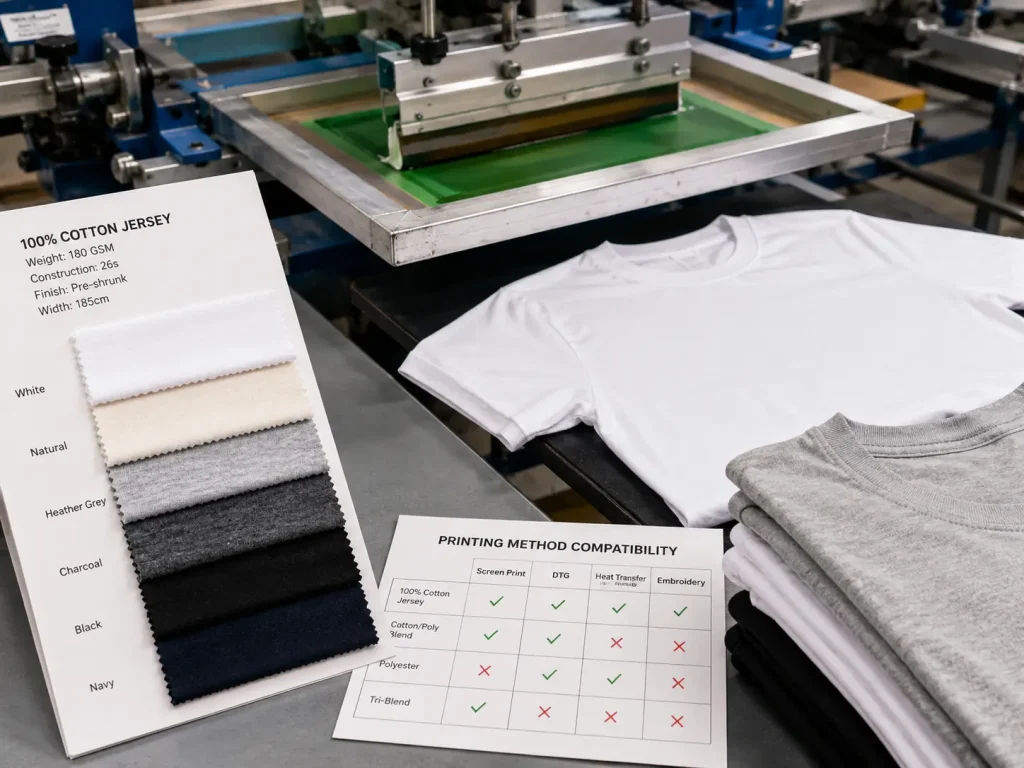
Sourcing plain t-shirts in bulk for a print program means the fabric spec and the print method need to be chosen together. A fabric that works well for screen printing may not be the right choice for DTG, and vice versa. Getting this wrong at the spec stage leads to ink bleed, poor opacity, or adhesion failure on bulk units.
| Fabric Type | Recommended Print Methods | Notes for Bulk Buyers |
|---|---|---|
| 100% Cotton Jersey (combed ring-spun) | Screen printing, DTG | Best ink absorption; consistent surface for high-volume print programs |
| Cotton/Polyester Blend (50/50 or 60/40) | Heat transfer, sublimation (poly-dominant blends) | Dye migration risk with DTG; sublimation works best on poly-dominant blends; confirm the exact polyester ratio with your print test. |
| Enzyme-washed / Bio-washed Cotton | DTG, screen printing | Enzyme finish removes surface fuzz; improves print edge sharpness for DTG |
| Slub Cotton Jersey | Screen printing, embroidery | Irregular texture adds visual interest; uneven surface not ideal for fine-detail DTG |
Print method suitability depends on ink system, press settings, and pre-treatment. Always run a decoration test on the approved production sample before bulk sign-off.
One detail that often gets missed in OEM briefs: bio-washing (enzyme washing) is a finishing step applied after knitting, not a fabric type. If your print partner or in-house print team requires a clean, fuzz-free surface for DTG — which is common for direct-to-garment programs producing detailed artwork — specify enzyme wash in the fabric treatment section of your tech pack. Without it, surface fibres can scatter ink and reduce edge sharpness on fine line work.
For brands adding their own identity to plain t-shirts in bulk, the label setup is not a last-minute detail. It runs in parallel with fabric and construction approval, and it affects lead time.
For US-bound plain t-shirts, label copy should be confirmed before bulk cutting. According to the FTC textile labeling requirements, most textile products need labels showing fiber content, country of origin, and the identity of the manufacturer, importer, or another responsible business. Apparel care instructions are also covered by FTC care-labeling rules, so brands should confirm fiber percentages, RN or company identity, origin wording, and care instructions before neck labels or care labels are printed.
Label artwork and copy should be submitted alongside — or before — fabric approval. In a typical OEM flow, label proofs go through approval in parallel with the production sample, so both can be confirmed before cutting begins. Submitting labels late is one of the most common reasons bulk delivery is delayed beyond the planned window.
MOQ for plain t-shirts with custom labels starts from 100 pieces per style per color. This can apply to branded label setup as well, depending on label type and artwork complexity. Standard neck labels and care labels can usually be planned within the garment MOQ, while special woven labels, hangtags, or packaging details should be confirmed during quotation.
The brands that avoid bulk sourcing problems are not the ones with the most detailed briefs — they are the ones that lock the right decisions at the right stage. For plain t-shirts in bulk, that means three things confirmed during sampling before anything is cut at scale.
For brands still comparing factory capabilities, our t-shirt manufacturer overview outlines available blank t-shirt options, customization methods, and MOQ structure before sampling begins.
The fourth decision — label copy — should be submitted in parallel with the sample stage so both are ready for simultaneous sign-off. Brands that queue label approval after sample approval add unnecessary time to an otherwise efficient flow.
It depends on your end use and brand positioning. The 170–200 GSM range covers most retail basics and private label essentials — it balances cost, opacity, and hand-feel for mid-market programs. If you are building a premium or heavyweight streetwear line, 210–240 GSM gives a more structured drape. Confirm the final weight against a physical swatch and your print method before locking the spec.
Not automatically. Pre-shrunk or Sanforized finishing is a treatment that must be specified in your purchase order. Without it, 100% cotton fabric will shrink to some degree after washing. Include a maximum shrinkage tolerance in your tech pack and request a wash test on the production sample to verify before bulk approval.
Yes. Private label setup covers woven or printed neck labels, care and content labels, size labels, and hangtags. Label artwork should be submitted alongside — or before — sample approval so both can be confirmed before bulk cutting begins. For US-bound orders, label copy must comply with FTC fiber content and care instruction requirements.
MOQ starts from 100 pieces per style per color. Standard neck labels and care labels can usually be planned within the garment MOQ, while special woven labels, hangtags, or packaging details should be confirmed during quotation.
If you have a GSM target, a print method in mind, or a label brief ready to go, share it with us and we can advise on fabric options and confirm what is feasible at your order volume. Not sure where to start? A sample order is the lowest-risk way to validate the spec before committing to bulk.
 T-shirts Related
Sourcing Oversized T-Shirts Wholesale: What Drop Shoulder Spec and GSM Tell Your Factory
READ MORE Leggings Related
Why Are Leggings So Expensive? A Manufacturing Cost Breakdown
READ MORE Polo Shirts Related
Types of Polo Shirt Fabric: Piqué, Interlock and Jersey Compared for Bulk Orders
READ MORE Garment Material Insights
Fabric GSM Guide for Apparel Brands: How Weight Affects Bulk Orders and Brand Positioning
READ MORE T-shirts Related
How to Make Tie Dye Personalized T-Shirts: Full Step-By-Step Process to Customize Tie Dye T-shirts
READ MORE