World Class Textile Producer with Impeccable Quality
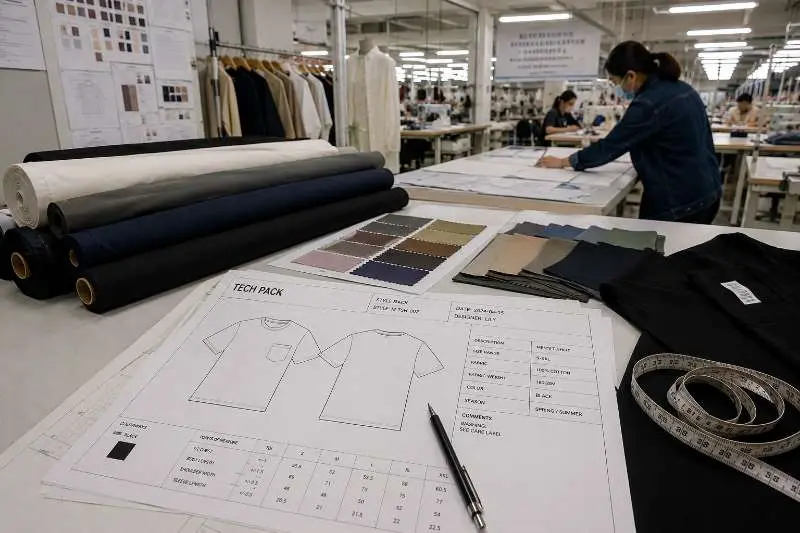
World Class Textile Producer with Impeccable Quality

Key Sourcing Takeaways
Many brands run both: ODM for seasonal or trend-led pieces, OEM for core products. Knowing when to transition is as important as knowing which to choose. Two brands contact the same factory. One sends a tech pack, fabric swatches, and a grading chart. The other sends a reference image and asks for something similar. Both can place an order — but the production process, timeline, and outcome are structurally different. That difference is the OEM vs ODM distinction, and it matters more than most sourcing guides suggest.
The confusion arises because many factories use the terms loosely, often calling themselves OEM manufacturers regardless of whether they actually produce from a buyer's original design or from their own existing patterns. Sorting out what a factory genuinely offers — and which model fits where your brand is right now — is the real question this article addresses.
OEM (Original Equipment Manufacturer) in the apparel context refers to a production arrangement where the factory manufactures garments according to specifications the brand provides. The brand is the originator of the design — the silhouette, fabric selection, construction details, trims, and branding are all determined by the buyer before the factory begins work. The factory's role is to execute that brief accurately at scale.
ODM (Original Design Manufacturer) works in the reverse direction. The factory develops its own base patterns, samples, or catalog styles. The brand selects from those existing designs and customizes them within limits — typically choosing colorways, adding a private label, or making minor adjustments to fit or trims. The factory is the originator of the design; the brand is adapting it.
Neither model is inherently superior. The right one depends on how developed your product concept is, how much design exclusivity matters to your brand at this stage, and how prepared your team is to supply the documentation an OEM order requires.
| Dimension | OEM | ODM |
|---|---|---|
| Design Source | Brand provides full design, tech pack, specs | Factory provides existing base patterns / styles |
| Customization Depth | Unlimited — fabric, silhouette, trims, branding | Limited — typically color, label, minor adjustments |
| IP Ownership | Brand owns the design fully | Factory retains the underlying pattern IP |
| What You Need to Prepare | Tech pack, fabric selection, trim specs, branding files | Style selection, color/fabric confirmation, logo files |
| Typical Buyer Profile | Established or growing brands with a clear product direction | New entrants testing a category without a finalized design |
| Speed to First Sample | Slower — pattern development adds lead time | Faster — pattern exists, sampling starts sooner |
| Cost Structure | Higher upfront (pattern fees, more sampling rounds) | Lower upfront (no new pattern development) |
| Brand Differentiation | High — product is exclusive to your brand | Lower — other buyers may use similar base patterns |
OEM and ODM differ most significantly in who owns the design, how much preparation the brand needs to supply, and how quickly sampling can begin.
The most practical difference between OEM and ODM is the documentation burden on the brand side. In OEM, the factory cannot begin pattern development — let alone sampling — until the brand has supplied a sufficiently detailed design brief. In ODM, sampling can often start within days of the brand confirming a style from the factory's catalog.
OEM — What Your Brand Needs to Prepare
| Document / File | What It Contains |
|---|---|
| Tech Pack | Flat sketches with measurements, construction notes, and seam details |
| Fabric Specification | Fabric type, composition, GSM direction, color reference (Pantone or swatch) |
| Trim & Component Specs | Zipper type, drawstring width, label placement, hardware finish |
| Branding Files | Logo in vector format; label and hang tag design (or brief) |
| Size Range & Grading | Size set definition and grading increments between sizes |
OEM orders require a more complete documentation package before the factory can open a pattern and start sampling.
ODM — What Your Brand Needs to Prepare
| Document / File | What It Contains |
|---|---|
| Style Selection | Reference number or sample of the base pattern from factory's catalog |
| Color / Fabric Choice | Selection from the factory's available fabric and colorway options |
| Logo & Label Files | Vector logo for embroidery, print, or woven label; tag design if required |
| Packaging Notes | Poly bag size, hang tag attachment method, carton specifications |
ODM requires fewer upfront documents because the factory's existing pattern eliminates the development stage.
Why incomplete OEM documentation creates extra costs. From the factory's intake perspective, the most common cause of additional sampling rounds is an incomplete brief at the point of order. If a tech pack is missing measurements for a key size, if the fabric weight is unspecified, or if the logo file is supplied in a raster format rather than vector, the factory has to either make assumptions and sample on them — or pause and request clarification. Each pause adds time. Each assumption that turns out to be incorrect adds a sampling round. A brand that arrives at OEM sourcing with a complete, clearly annotated tech pack will consistently reach bulk production faster and with fewer revision cycles than one that plans to develop the brief collaboratively with the factory during sampling.
What ODM preparation gaps typically cause. ODM is simpler on the documentation side, but brands still underestimate two things: the importance of clear colorway specifications (factories produce what the color reference shows, not what you have in mind), and the lead time required for branding files. A woven label requires a confirmed artwork file before it can be ordered from the trim supplier. If the brand's logo is still being refined, that delay flows directly into the sample delivery date.
Cost and timeline comparisons between OEM and ODM are often oversimplified in sourcing guides. The reality is more nuanced: the upfront cost structure differs significantly, but unit costs at scale tend to converge, and MOQ is a factory policy rather than a function of the model chosen.
| Factor | OEM | ODM |
|---|---|---|
| Pattern / Toile Fee | Applies — new pattern must be developed | Not applicable — pattern already exists |
| Sample Rounds | Typically more rounds due to fit and construction confirmation | Fewer rounds — pattern is proven, adjustments are limited |
| MOQ | From 100 pcs/style/color, subject to style and fabric requirements | Often flexible; varies by factory and base style |
| Lead Time to First Sample | Longer — includes pattern development stage | Shorter — sampling can begin immediately after style confirmation |
| Bulk Production Lead Time | Standard once samples are approved | Similar to OEM at bulk stage |
| Unit Cost at Scale | Comparable or lower long-term (no design royalty or catalog fee) | May include a small premium on base styles with proprietary patterns |
Specific lead times and sampling fees vary by factory, fabric complexity, and order volume. Direction-level figures shown above are indicative; confirm at the inquiry stage.
Many brands assume that OEM production requires significantly higher minimum order quantities than ODM. This is not accurate as a general rule. At Runtang, both OEM and ODM projects can start from 100 pieces per style per color, subject to fabric choice, construction complexity, and final order requirements. The MOQ a factory sets is a function of its setup costs and production economics, not a penalty for choosing a custom design model. If a factory tells you OEM requires 500 pieces when ODM requires 100, that is worth clarifying — it may reflect a specific product's tooling cost, or it may simply be the factory's standard policy.
The lead time advantage ODM offers is concentrated in the pre-sampling phase. Because the base pattern already exists, the factory can cut a sample immediately after style and color confirmation. In OEM, a patternmaker must first interpret the tech pack and develop the block — a stage that takes additional time depending on the complexity of the design. Once both models reach the bulk production stage, lead times are broadly comparable, as both go through the same fabric sourcing, cutting, and sewing process.
For brands working against a hard launch date, this distinction matters. If market entry timing is a constraint, ODM's faster path to a confirmed sample can be the deciding factor — even if OEM is the long-term preference.
ODM styles may carry a subtle premium when ordered at low volumes, because the factory has invested in pattern development and will recoup that investment across multiple buyers at small quantities. At higher volumes, that premium typically disappears. OEM, by contrast, involves an upfront pattern fee — which is often a one-time charge — but once that cost is amortized across a larger order, per-unit pricing is generally comparable. For brands planning regular reorders of the same style, OEM almost always becomes more cost-efficient over time.
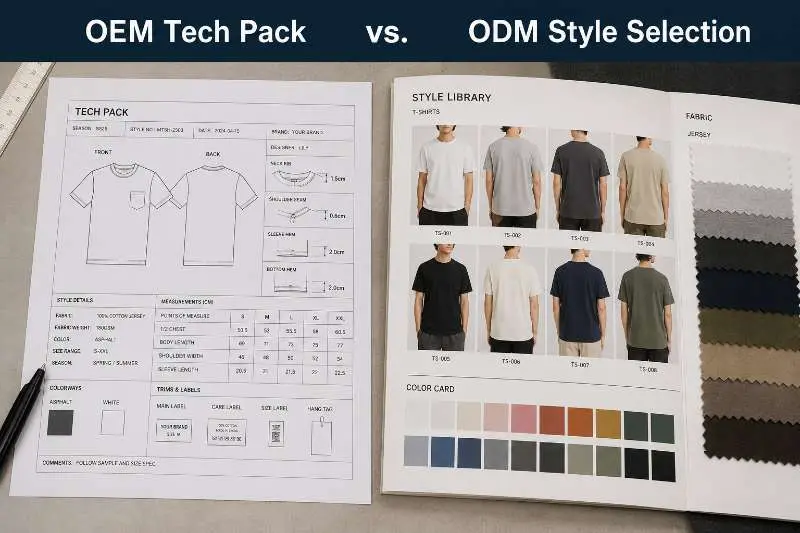
The OEM vs ODM decision is not a one-time, permanent commitment. Most growing brands use both models at different points in their lifecycle, and some use both simultaneously for different product lines. The question is not which model is better — it is which model is right for this product, at this stage, given this timeline.
| Brand Stage/Scenario | Recommended Model | Rationale |
|---|---|---|
| Testing Stage (First 1–3 SKUs) | ODM | Speed is critical. Design IP is not yet the priority — market validation is. ODM reduces upfront investment and gets product in front of customers faster. |
| Growth Stage (Proven SKUs, reordering) | OEM | Once a category sells consistently, locking in a proprietary design protects brand equity and prevents other buyers from selling an identical base pattern. |
| Mature / Multi-line Stage | OEM as primary, ODM selectively | Core hero products run on OEM. Trend-driven or seasonal pieces may still use ODM for speed, especially when there is no time for full pattern development. |
| Activewear / Technical Apparel | OEM (often preferred) | Performance fabrics and compression fits often require more control than standard ODM pattern libraries can provide. OEM gives full control over fabric spec and construction. |
| Basics and Core Essentials | Either, case by case | Plain T-shirts, basic fleece — ODM can work if the base pattern meets spec. OEM is preferable if specific weight, fit, or label placement requirements are strict. |
This framework is a starting point for decision-making, not a fixed rule. Product complexity, market positioning, and factory capability all influence the final choice.
One of the most practical and underused strategies for early-stage brands is to start with ODM to validate, then transition to OEM to scale. The logic is straightforward: ODM lets you test whether a category sells without committing to the full upfront investment of pattern development and extended sampling. Once you have reorder data confirming that a style has real demand, the business case for OEM investment becomes clear.
This transition is not automatic. In most cases, an ODM sample should be used as a reference point rather than treated as a finished OEM production specification. The factory may need to develop a new pattern or rebuild key details based on the confirmed style. Expect an additional development stage when making this switch, with sampling needs depending on garment type and factory workflow. Brands that budget for this transition in advance — both in cost and in time — execute it much more smoothly than those who treat it as a simple continuation of the existing order.
For performance-driven product categories — gym leggings, compression pieces, seamless knits, or fitted sweatshirts — OEM is often the safer starting point when the brand needs control over fabric specification, pattern fit, and construction details. Some ODM base patterns can work for simpler stretch products, but they may not match the recovery, compression, or measurement requirements of technical apparel. For these categories, buyers should confirm fabric composition, stretch direction, recovery expectations, and sample testing requirements before choosing the model.
Before placing a sample order under either model, the following questions help clarify whether the factory actually supports the production approach you need — and whether its capability matches your requirements.
For compliance-related questions — particularly for brands selling into the U.S. market — understanding the regulatory requirements that apply to specific apparel categories is a separate but related step. The U.S. International Trade Administration's textile and apparel market entry requirements page covers labeling, flammability, and CPSIA obligations by product type — useful context for any brand preparing to import garments from China regardless of which production model they use.
Understanding OEM and ODM conceptually is one thing. Applying that understanding correctly in a live sourcing scenario is another. The following errors appear consistently — and each of them costs brands either time, money, or both.
Some brands find a strong-selling style through ODM and continue ordering it without moving to OEM. The risk is real: the base pattern belongs to the factory, not the brand. Other buyers can order the same base, potentially with identical colorways, which erodes the differentiation your brand depends on. If a product proves itself commercially, the move to OEM — with a custom pattern developed from that base — is almost always worth it.
From a factory's perspective, the single biggest cause of extra sampling rounds is incomplete documentation at the point of inquiry. Missing measurements, unspecified seam types, unclear trims, or a logo file in the wrong format — any one of these adds at least one extra sample round. Before contacting a factory about OEM production, the tech pack should cover fabric composition, construction notes, all measurements across the size range, and finalized branding files. The more complete the brief, the shorter the development cycle.
ODM catalog styles are, by definition, available to multiple buyers. Some factories will grant exclusivity for a specific colorway or label combination, but the underlying pattern may be shared. Brands that need genuine exclusivity — particularly those competing on product differentiation — should be explicit about this requirement before sampling, or move to OEM.
A common misconception is that OEM always means higher MOQ. In practice, MOQ is set by the factory, not by the production model. At Runtang, both OEM and ODM projects can start from 100 pieces per style per color, subject to fabric choice, construction complexity, and final order requirements. The choice between models should be driven by design control requirements and development readiness, not assumed MOQ differences.
Brands that start with ODM for speed often have no clear plan for when and how to transition to OEM. This matters because ODM samples are usually used as references rather than final OEM production specifications, and the factory may need to rebuild the pattern or key construction details. The transition point to plan for is when reorder volumes justify the upfront pattern investment and when the product is stable enough that design changes are unlikely after sampling.
Yes — and this is one of the most practical sequencing strategies for early-stage brands. The important thing to understand is that the transition usually requires a separate development stage: the ODM sample should be treated as a reference, not as a finished OEM production specification. Expect an additional development stage when making the switch, although the exact sampling requirements depend on the garment type and factory workflow. Brief the factory clearly that the ODM style is being used as a design reference rather than reordered as-is. Brands that communicate this intent upfront often find factories more willing to support the development process.
Not necessarily. OEM involves an upfront investment in pattern development and typically more sampling rounds before a style is confirmed for bulk. However, at comparable order volumes, per-unit pricing in OEM and ODM tends to converge. Over multiple reorder cycles of the same style, OEM often becomes more cost-efficient: there is no catalog premium on the base pattern, and the design is fully owned by the brand. The more accurate framing is that OEM costs more earlier in the product lifecycle, while ODM distributes its cost across lower upfront investment but potentially higher per-unit pricing at small volumes.
MOQ is set by the individual factory, not by the OEM model itself. At Runtang, the standard MOQ for OEM custom clothing is 100 pieces per style per color. Higher complexity garments or styles requiring specialty fabrics may have different minimums — confirm at the inquiry stage. The key point is that OEM does not automatically mean a higher MOQ compared to ODM; that is a factory-specific variable, not a model-specific rule.
A tech pack is the clearest and most efficient way to communicate your design to a factory. That said, not every brand arrives at OEM with a complete tech pack. Runtang's team can work from detailed reference samples, sketch briefs, or a combination of both — but the further your brief is from a complete tech pack, the more sampling rounds will likely be needed to reach an approved sample. If your brand does not have in-house technical design capability, working with a freelance technical designer to produce a basic tech pack before engaging a factory is an investment that consistently pays off in reduced development time.
A genuinely OEM-capable factory will have an in-house pattern development team or a clear, documented process for working with brand-supplied tech packs. Ask to see examples of styles developed from scratch versus styles adapted from a base catalog — the two should look meaningfully different. Ask about their typical intake process for a new OEM style, and whether they can provide a sample costing breakdown that distinguishes pattern fee from sample material cost. Factories that conflate OEM and ODM in their marketing often cannot answer these questions precisely.
Whether you are working from a finalized tech pack or exploring base styles to test a new category, Runtang's production team can advise on which path makes sense for where your brand is right now. We handle both models — from full OEM custom development starting at 100 pieces, through to ODM sampling for brands that need to move quickly.
Share your design brief, reference sample, or a rough sketch, and we will get back to you with a clear recommendation on the most efficient path to your first sample.
 Polo Shirts Related
The Ultimate Guide to “What Is a Polo Shirt”: Explore the Charm of the Polo Shirt
READ MORE T-shirts Related
How to Find a T-Shirt Manufacturer for Your Apparel Brand
READ MORE Garment Material Insights
Corduroy Fabric Characteristics and Application
READ MORE Top Clothing Manufacturer Recommend
Top 8 Polo Shirt Manufacturers in China
READ MORE T-shirts Related
Cotton vs Polyester T-Shirt: Which Fabric Works Better for Bulk Brand Orders
READ MORE