World Class Textile Producer with Impeccable Quality
World Class Textile Producer with Impeccable Quality

Key Sourcing Takeaways
Searching for China clothing suppliers returns hundreds of factory names within minutes. The real challenge is not finding a list — it is knowing which factories are worth a conversation, which sourcing channel fits your brand's current stage, and what your team needs to prepare before production can actually start.
This guide covers exactly that: how to compare your three main sourcing routes, the signals that separate a credible OEM partner from a middleman, and the preparation work that determines whether your first order runs smoothly or becomes an expensive lesson.
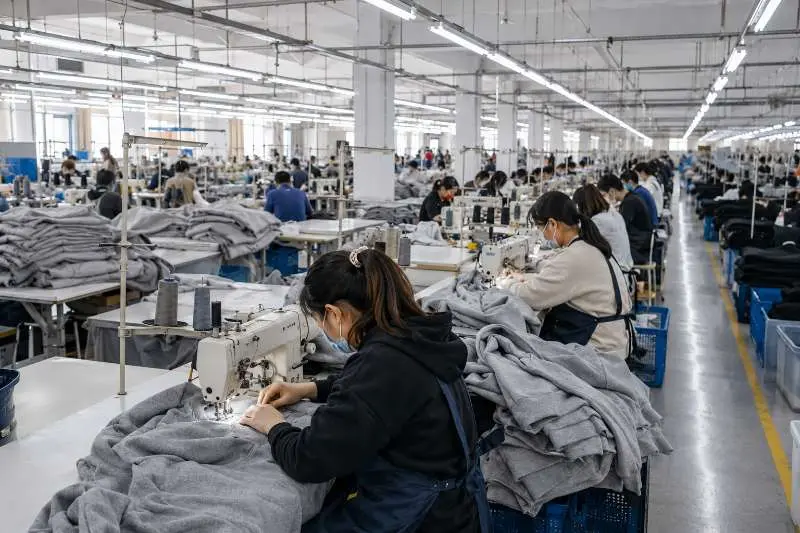
China's apparel manufacturing ecosystem is large enough that two factories with identical websites can operate at completely different levels of capability. One might run a vertically integrated operation with in-house knitting, dyeing, and cut-and-sew production. Another might be a trading company that outsources everything and adds a margin in the middle. The difference matters enormously for quality control, communication, and pricing transparency.
Before reaching out to any supplier, it helps to clarify two things internally: what production model you actually need, and what stage your brand is at.
On the production model question: OEM means you bring the design and the factory manufactures to your specifications. This is the standard route for brands with established styles or a tech pack ready to submit. ODM means the factory provides existing designs that you can modify and label — a lower-barrier entry point for brands still developing their product direction. Most China clothing suppliers offer both, but their core strength usually lies in one or the other.
On the brand stage question: an early-stage brand testing its first SKU has different needs from a growing brand placing quarterly bulk orders. The sourcing channel and the factory tier you target should reflect where you are, not where you plan to be in two years.
Most apparel brands discover China clothing suppliers through one of three routes. Each has a different risk profile, time investment, and fit for different brand sizes.
| Channel | Best For | Advantages | Watch-outs |
|---|---|---|---|
| B2B Platforms (Alibaba, Global Sources) | Early-stage brands; initial supplier comparison | Fast shortlisting; price transparency; large supplier pool | High proportion of trading companies; hard to verify factory claims without a visit or audit |
| Canton Fair & Trade Shows | Brands placing mid-to-large orders; relationship-building | Face-to-face evaluation; see samples in person; better access to factory decision-makers | Significant time and travel investment; many exhibitors are also trading companies |
| Direct Factory Outreach (brand websites, referrals) | Brands with a clear product direction and a spec ready to share | Faster decision cycles; no intermediary margin; cleaner communication | Requires more research upfront; factories vary widely in export readiness |
The table above summarises the practical tradeoffs. For most brands at the sample-order stage, a combination of direct outreach and platform research delivers the best results: platforms for initial comparison, direct contact for the factories that pass your shortlisting criteria.
One channel worth particular attention is direct factory outreach via manufacturer websites. Factories that have invested in clear English-language product pages, detailed capability descriptions, and visible MOQ information are typically further along in their export experience — which reduces friction at every stage from RFQ to delivery.
Once you have a shortlist, the evaluation work begins. The following five signals, developed from working with brands across Europe, North America, and Australia, consistently separate factories worth a deeper conversation from those that will waste your sampling budget.
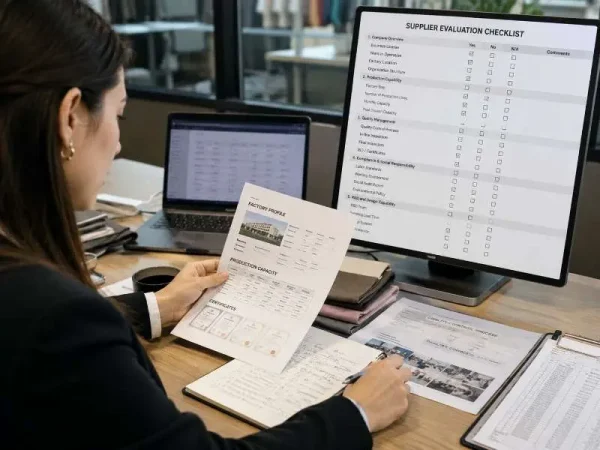
A factory that claims to produce everything — hoodies, suits, swimwear, workwear, and activewear — is almost certainly outsourcing large portions of its range. A credible OEM partner has a defined product focus: knitted casualwear, woven bottoms, seamless activewear. Category depth translates directly into fabric knowledge, machine investment, and quality consistency.
When you ask a factory "what is your core product?", the answer should be specific. If it is "anything you need", move on.
Legitimate factories publish or quickly share their minimum order quantities per style, per colour, and their sampling terms. A supplier that avoids giving you a number until late in the conversation is either hiding a high MOQ or operating as a middleman who needs to check with their actual production source.
At Runtang, for example, the standard MOQ is 100 pieces per style per colour across all product categories — a figure we share upfront because it directly affects whether a brand can realistically start with us. Brands ordering custom hoodies in bulk or T-shirt production at scale can begin at that threshold without committing to large inventory risk.
Export-ready factories invest in their client-facing communication. When you send an RFQ, the quality of the response tells you a great deal: does the reply address your specific product and requirements, or is it a template with your enquiry pasted in? Do they ask about your tech pack, fabric preferences, or target market? Do they flag potential issues before you discover them?
A factory with strong communication capability will save you significant time and money across every sampling and production cycle. Poor communication at the RFQ stage reliably predicts miscommunication at the bulk production stage.
Most factories list certifications and compliance claims, but few can clearly explain what those certifications cover and what they do not. A credible supplier can tell you which certification applies to which product category, where to verify the certificate number on the issuing body's database, and what the certification does not cover.
For brands sourcing activewear leggings or children's garments, this distinction is especially important: a facility-level certification does not automatically mean every fabric or trim in your order is compliant. Asking the factory to walk you through the scope of their certifications is a reliable way to gauge their compliance maturity.
A factory with in-house fabric knitting, dyeing, and garment production has more control over quality, lead time, and cost than one that sources fabric externally and subcontracts finishing. It is not the only viable model, but it is the more predictable one.
If a factory does outsource parts of the process, ask them to map it: which stages are in-house, which are subcontracted, and to whom. A factory that can answer that question clearly is managing its supply chain; one that cannot is probably not.
Once you have identified a factory worth working with, the speed and quality of your first order depends heavily on what your team brings to the table. In our experience working with brands across multiple categories, the majority of sampling delays and bulk-order quality issues trace back to gaps in brand-side preparation — not factory execution failures.
A tech pack is the primary document through which your design intent reaches the factory. It should include construction drawings with measurements, fabric specifications, colour references (Pantone or physical swatch), trim details, label placement, and any special finishing requirements. The more complete the tech pack, the fewer the clarification rounds — and each clarification round adds time.
Brands that submit incomplete tech packs — sketch without measurements, Pantone without physical confirmation, or a reference garment without dimension annotations — typically require additional sampling rounds that add weeks to the development timeline. Preparing this document carefully before outreach is one of the highest-leverage actions a brand can take. Brands planning their first OEM project can also review our guide on selecting blank hoodie manufacturing partners, which explains several supplier evaluation factors that apply across apparel categories.
MOQ is not a single number — it applies per style and per colour. A brand planning to launch three colourways of a single hoodie style is effectively placing three separate MOQ-sized orders. Understanding this distinction before negotiation prevents a common early-stage miscalculation where brands assume they can spread an MOQ across colours.
Knowing your colour plan in advance also affects fabric ordering. Factory fabric procurement is often tied to minimum dye lot quantities, so late colour decisions after fabric has been ordered can result in additional cost or lead time extension. Brands unfamiliar with how MOQ structures are calculated should also understand how minimums are applied across styles, colours, and fabric programs before negotiating with suppliers.
A standard OEM sampling process typically moves through: proto sample (first construction attempt based on tech pack), fit sample (refined dimensions confirmed against size chart), and pre-production sample (final approved version used as the bulk reference). Each round requires clear, written feedback from the brand.
The most common cause of extra sampling rounds is verbal or imprecise feedback. "The fit feels a bit off" does not help a factory adjust a pattern. "The chest width at size M needs to decrease by 1.5 cm, and the sleeve length needs to increase by 1cm" does. Brands that invest time in learning to give measurement-specific feedback move through sampling faster and with better outcomes.
Lead times across the full development and production cycle vary depending on product complexity, fabric sourcing, and order volume. We provide direction on typical timelines during the inquiry stage — specific figures are confirmed at the tech pack submission point.
It is also worth noting what slows production from the brand side once bulk is confirmed: late sign-off on lab dips (colour approval swatches), changes to trim specifications after material has been ordered, and delayed responses to factory queries during production are the most common culprits. Building clear internal approval workflows before production starts avoids most of these.
A test order is not just a quality check — it is a relationship audit. The factory is evaluating your brand as much as you are evaluating them. Brands that place clear briefs, give structured feedback, approve samples decisively, and pay on schedule are the clients factories prioritise when capacity is tight.
From a factory's perspective, the most valuable long-term clients are those whose orders are predictable, whose communication is clear, and who treat the relationship as a partnership rather than a transaction. That means sharing seasonal plans in advance where possible, giving lead time for material sourcing, and flagging design changes early rather than after production has started.
Most successful OEM relationships follow a consistent pattern: a sample order to validate quality and communication, followed by a small first bulk order, followed by growing order volumes as trust builds on both sides. Brands that try to negotiate large-volume discounts from their first order — before the factory has had a chance to demonstrate reliable execution — typically get worse outcomes than those that start small and scale.
Runtang has been manufacturing and exporting garments for over 15 years, with production partners and brand clients across Europe, North America, and the Asia-Pacific. Our vertically integrated model — in-house knitting, dyeing, and garment production at our Foshan facility — means we can maintain quality and lead-time control across categories from hoodies and T-shirts to leggings and pyjamas, with a standard MOQ of 100 pieces per style per colour.
For brands evaluating whether China remains the right sourcing decision, the combination of technical depth, flexible minimum order quantities, and supply-chain transparency that established factories offer is difficult to match elsewhere at comparable price points. The key is knowing how to find the right factory and how to set the partnership up for success from the first conversation.
For brands importing to the US market, the Office of Textiles and Apparel (OTEXA) provides trade guidance, industry resources, and regulatory information that can help brands understand textile and apparel import requirements before their first shipment.
MOQ varies by factory and product category. At Runtang, the standard minimum is 100 pieces per style per colour across all categories, including hoodies, T-shirts, leggings, and pyjamas. This applies to both sample orders and bulk production, giving brands the flexibility to test a style before committing to larger volumes.
Ask the supplier to share their business licence, which in China specifies whether the registered entity is a manufacturer or a trading company. You can also request photos or video of their production floor, ask about their in-house equipment and capacity, and check whether their certifications are facility-level (issued to the factory address) or product-level (issued to specific goods). Many brands also request a live video walkthrough of the cutting, sewing, and finishing areas to confirm that production is actually taking place at the stated facility. A factory that cannot answer questions about its own production process in detail is likely acting as an intermediary.
A complete tech pack is not required for an initial inquiry, but having one ready significantly accelerates the process. Factories can provide rough quotes based on a reference garment or a detailed description, but accurate pricing and timeline commitments require a tech pack with measurements, fabric specifications, and construction details. Brands that invest in tech pack preparation before outreach consistently get more useful responses and move to sampling faster.
Share your tech pack or a brief product description and we will get back to you with a clear assessment of fit, MOQ, and timeline. No middleman, no template reply.
 Polo Shirts Related
The Ultimate Guide to “What Is a Polo Shirt”: Explore the Charm of the Polo Shirt
READ MORE Hoodies Related
How to Find a Hoodie Manufacturer for Your Clothing Brand
READ MORE Hoodies Related
How to Choose the Right Blank Hoodies Manufacturer for Your Brand
READ MORE Leotard Related
Custom Dance Costumes OEM: How Studios and Brands Order in Bulk from China
READ MORE T-shirts Related
The Charm of T-shirts Factory Custom Printing: A Good Helper for Brands
READ MORE