World Class Textile Producer with Impeccable Quality

World Class Textile Producer with Impeccable Quality

Key Sourcing Takeaways
Polo shirts look straightforward — but sourcing polo shirts from China involves decisions that most guides skip entirely. The collar construction, placket stitching, and fabric weight all affect how a polo performs after repeated washing, and a factory that handles T-shirts well may not have the specialist knitting equipment that polo collars require.
This guide covers what brand buyers actually need before sourcing polo shirts from China: fabric choices, RFQ essentials, sample approval criteria, logo technique selection, and the compliance steps US and EU markets require. No rankings, no generic platform recommendations — just the decisions that determine whether your bulk order matches your sample.
Polo shirts have more structural complexity than most knitwear categories. Where a T-shirt is essentially a flat jersey cut-and-sew operation, a polo requires coordinated production of at least three distinct components: the body fabric, the rib-knit collar, and the woven or knitted placket. A factory that excels at blank hoodies or basic custom T-shirts may not have the flat-bed knitting setup or collar-pressing equipment that polo production demands.
This structural difference has a direct implication for sourcing polo shirts from China: the vetting criteria you'd apply to a T-shirt factory are insufficient for polo shirts. Beyond general OEM capability, buyers need to confirm that the factory can produce collars in-house (not outsource them), maintain consistent collar height across a production run, and handle multiple branding techniques — embroidery, printed placket tapes, woven labels — without quality variation.
For buyers considering Guangdong-based polo shirt production, the main advantage is supplier coordination. When fabric sourcing, dyeing, collar development, sewing, and finishing can be managed through one production partner, it becomes easier to control colour matching between the body fabric and rib collar. This is especially important for polo shirts, where a small shade difference between the collar and garment body is visible in bulk production.
Fabric selection is one of the most common sources of sample-to-bulk discrepancy when brands order polo shirts from China. Buyers who leave fabric choice to the factory often receive a quote based on the factory's default stock — which may not match the weight, texture, or performance specification the brand needs.
Three fabric constructions cover the majority of polo shirt production from China:
| Fabric | Construction | Typical Weight Direction | Best For | Logo Technique Fit |
|---|---|---|---|---|
| Piqué knit | Textured knit, structured surface | Often midweight, depending on yarn and collar structure | Branded polos, corporate uniforms, premium collections | Embroidery (holds thread well on textured surface) |
| Interlock | Smooth double-knit, softer hand | Often light to midweight, depending on finish | Lifestyle brands, retail-facing casual polos | Screen print, heat transfer |
| Performance blend | Polyester-dominant, moisture-wicking | Often lightweight to midweight, depending on performance target | Activewear brands, sports teams, outdoor use | Sublimation, heat transfer, screen print |
The table above reflects general industry norms; actual GSM and performance will vary by yarn count and factory specification. Confirm exact fabric parameters during the sampling stage.
For a deeper comparison of piqué, interlock, jersey, and performance blends, review our guide to types of polo fabric before finalising your RFQ.
When writing your RFQ, specify at minimum: fabric construction (piqué/interlock/performance), fibre composition (e.g. 100% cotton, 65/35 cotton-polyester, 100% recycled polyester), and weight direction. If your brand has sustainability requirements, custom polo shirts can be produced in organic cotton or recycled polyester blends — but this needs to be confirmed in the RFQ, not requested after sampling begins.
An incomplete RFQ produces inaccurate quotes. When a factory receives an inquiry without fabric specs, logo details, or size range, they quote based on assumptions — and those assumptions rarely align with what the buyer actually needs. The result is either a price that changes significantly at sampling, or a sample that misses the brief.
A well-structured polo shirt RFQ covers six core areas:
RFQ Checklist:
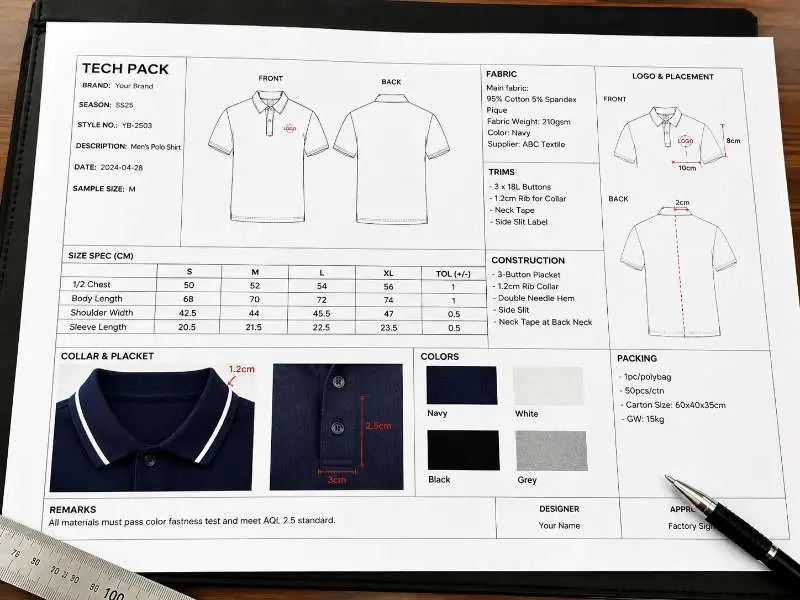
Sample approval is where most polo shirt sourcing problems are caught — or missed. Buyers who approve samples based only on colour and overall fit often discover post-production issues with collar distortion, placket puckering, or shrinkage that wasn't tested. These are harder to resolve at the bulk stage.
A thorough polo shirt sample review covers more dimensions than most other apparel categories:
For brands ordering regular polo runs, it's worth distinguishing between a pre-production (PP) sample and a production sample. PP samples are made before cutting bulk fabric and allow for final fit and construction corrections. Production samples are cut from bulk fabric and confirm that the factory's production setup matches the approved sample. Both checkpoints are standard practice with reliable factories and should be confirmed as part of your sampling agreement.
Logo placement and technique decisions made too late in the process — after fabric is sourced and patterns are cut — can result in either quality compromise or additional sampling cost. The right technique depends on the fabric construction, the placement area, and the brand's quality expectations.
| Technique | Best Fabric Match | Placement | Durability | Notes |
|---|---|---|---|---|
| Embroidery | Piqué (textured, structured) | Left chest, collar back, sleeve | High — withstands repeated washing | Adds weight; avoid on lightweight interlock |
| Screen print | Smooth interlock or jersey | Chest panel, back | Good on cotton; fair on poly blends | Not suited for piqué texture |
| Heat transfer / HTV | Performance blends, polyester | Chest, sleeve | Moderate — avoid high-heat washes | Good for small runs |
| Sublimation | 100% polyester performance fabric | All-over or panel | Excellent on polyester | Cannot be used on cotton or blends |
The table reflects general technique suitability; exact results depend on specific fabric weight and construction — confirm with your factory at the sampling stage.
For uniforms, events, and corporate apparel programs, custom team polos usually need logo placement, size range, packaging, and reorder planning confirmed before sampling.
Beyond logo technique, polo shirts offer several branding touchpoints that often get overlooked at the RFQ stage: collar back woven labels, inside neck printed labels, placket tape branding, and button colour matching. For brands building a premium collection, coordinating all of these elements through a single factory is significantly more efficient than sourcing trims separately.
Private label packaging — custom polybags, hang tags, and folded presentation for retail — can be coordinated through the same production run when working with a vertically integrated facility. Confirm packaging requirements in your RFQ rather than raising them after bulk production begins.
Compliance is the dimension most often omitted from polo shirt sourcing guides — and the one most likely to cause problems at customs or with retailers. For brands shipping China-sourced polo shirts into the US or EU, requirements exist at both the labelling and product safety level.
For US-bound polo shirts, FTC textile labelling rules generally require fibre content, country of origin, and the identity of the manufacturer, importer, or another responsible business. Care instructions are handled under a separate FTC care labelling rule, so brands should confirm both content-label wording and care-label wording before bulk production. Instead of finalising labels from an early sample, confirm the final fibre composition after trims, decorations, and fabric approvals are locked.
For brands new to US import, the US International Trade Administration publishes requirements for textile and apparel market entry. Confirming HTS code classification for your polo style with a customs broker before bulk production avoids misdeclaration risk, which can result in delayed clearance or reclassification penalties.
EU regulations require fibre composition labels in the official language of the market country where the garment is sold. For EU sales, fibre composition wording and label language should be prepared for the specific member state where the garment will be placed on the market. Brands distributing across multiple EU markets need to plan label versions accordingly — this is a production decision, not a post-production fix.
REACH compliance requires that no restricted substances (listed in REACH Annex XVII and the SVHC candidate list) are present above threshold levels in any garment component. Reputable factories can provide test reports from accredited labs confirming REACH compliance; confirm this as a requirement when placing your order.
For official U.S. textile and apparel trade policy resources, refer to the U.S. International Trade Administration Office of Textiles and Apparel
The range of factories producing polo shirts from China is wide, and not all of them are equipped for brand-level OEM production. Understanding the difference between factory types helps buyers set realistic expectations and avoid costly supplier switches mid-season.
If this is your first time sourcing from China, separate factory capability, trading company support, and OEM production visibility before comparing quotes.
| Factory Type | What They Do Well | Limitations | Best Fit For |
|---|---|---|---|
| CMT (Cut, Make, Trim) | Cost-efficient for buyers who supply their own fabric | No fabric sourcing, limited design input, buyer manages trims | Brands with established fabric vendors and detailed tech packs |
| Vertically integrated OEM | In-house fabric, dyeing, garment finishing; tighter quality control | Higher MOQ than some CMT; needs clear RFQ to quote accurately | Brands that need fabric + construction + branding coordination |
| Trading company | Flexible, English-speaking; manages factory relationships | Adds margin layer; less visibility into production process | Buyers who want hands-off sourcing and accept higher per-unit cost |
The table reflects general trade-offs; specific factories may differ. Always request production references relevant to your polo shirt category before committing.
When evaluating a factory, the specific questions to ask about polo shirts are:
Factories that can answer these questions with specifics — rather than vague references to "years of experience" — are generally the ones whose samples will hold up at bulk. For brands sourcing polo shirts from China for the first time, starting with a clear RFQ, requesting a PP sample before bulk commitment, and confirming labelling requirements upfront reduces the most common sourcing risks.
MOQ varies by factory and style complexity. For most vertically integrated OEM factories producing branded polo shirts, a starting point of 100 pieces per style per colour is common. Styles with complex collar constructions or multi-colour embroidery may carry higher minimums. Confirm MOQ at the RFQ stage — not after sampling has begun.
Sampling timelines depend on how complete your RFQ is. A well-specified inquiry with fabric reference, colour confirmation, and logo artwork allows a factory to move quickly. As a direction: PP sample development typically runs longer than basic T-shirt sampling due to the collar and placket components. Build additional buffer into your timeline if you anticipate multiple revision rounds.
Yes — most OEM factories that produce for brand buyers offer private label options including custom woven labels, printed care labels, hang tags, and individual polybag packaging. Specify your full branding and packaging requirements in the RFQ; adding these requirements after bulk production is confirmed typically affects the timeline.
China-origin polo shirts can fully comply with US import requirements when the correct labelling and documentation are in place. The key requirements include accurate fibre content labelling, country of origin labelling, suitable care instructions, and correct HTS code classification. Work with your factory to confirm label wording before bulk production, and consult a customs broker for classification guidance on your specific polo style.
If you have a polo reference, a fabric direction, or a tech pack ready, share it and we'll come back to you with a quote based on your actual specs — not a templated price list. Custom polo shirts from MOQ 100 pieces per style, with coordinated fabric development, collar and body colour control, and private label options.Not sure where to start? Drop us a message and we'll guide you through fabric selection and RFQ preparation before you commit to a sample.
 Garment Material Insights
Cotton Dance Leotards: Choosing the Right Fabric for OEM Bulk Production
READ MORE T-shirts Related
T-Shirt Sourcing Guide: Single Jersey, Interlock and Slub Jersey for Brand Buyers
READ MORE T-shirts Related
The Charm of T-shirts Factory Custom Printing: A Good Helper for Brands
READ MORE Garment Material Insights
Fabric GSM Guide for Apparel Brands: How Weight Affects Bulk Orders and Brand Positioning
READ MORE Polo Shirts Related
Sourcing Polo Shirts from China: A Brand Buyer’s Guide to Factories and Quality
READ MORE