World Class Textile Producer with Impeccable Quality

World Class Textile Producer with Impeccable Quality

Key Sourcing Takeaways
Leggings are one of the most-searched activewear items online — and one of the most misunderstood products to source. Brands new to OEM production often assume the price gap between a $15 pair and a $95 pair is mostly branding markup. From a factory floor perspective, that assumption leads to budget errors, sampling surprises, and orders that don't perform the way the brand expected.
This breakdown looks at where leggings manufacturing costs actually come from — fabric selection, construction method, order size, and branding setup — and what each of those decisions means for a brand building an activewear line from scratch.
Fabric is typically the largest variable in leggings production, especially when the style moves beyond casual lounge fabric. Once a brand specifies four-way stretch, recovery after repeated wear, squat-proof opacity, compression feel, or moisture management, the fabric brief becomes more technical and the cost changes with it.
Most performance leggings use nylon-elastane or polyester-elastane blends. Nylon-dominant fabrics are often selected for a softer hand feel and premium positioning, while polyester-dominant fabrics may support stronger cost control and certain printing or recycled-content goals. For a deeper sourcing comparison, brands can review our guide to nylon vs polyester activewear before confirming the first sample fabric.
For opacity-sensitive products such as squat-proof leggings, fabric density, color, elastane content, and stretch direction should be checked together rather than treated as one isolated spec. A black sample and a pale sample can behave differently under stretch, so brands should confirm opacity during sample fitting before bulk approval.
Beyond fiber composition, finishes matter. A moisture-wicking treatment, a peach-skin finish, or a brushed interior are each additional processing steps applied after the base fabric is knitted. Each step adds time in the textile mill and cost in the supply chain. Brands specifying these finishes for the first time are often surprised to find that what they thought of as a standard feature requires deliberate selection at the sourcing stage.
For brands working with Runtang on activewear development, one of the most useful early decisions is narrowing the fabric direction before sampling begins. The choice between a nylon-dominant blend and a polyester-dominant blend, for example, shapes not just the fabric cost but the construction approach, the care label requirements, and how the finished product performs on the end consumer. Our production team can walk brands through the trade-offs during the inquiry stage — before a single sample is cut.
Fabric cost is visible in a spec sheet. Construction cost is less obvious — but it shows up every time a consumer squats, stretches, or washes the garment.
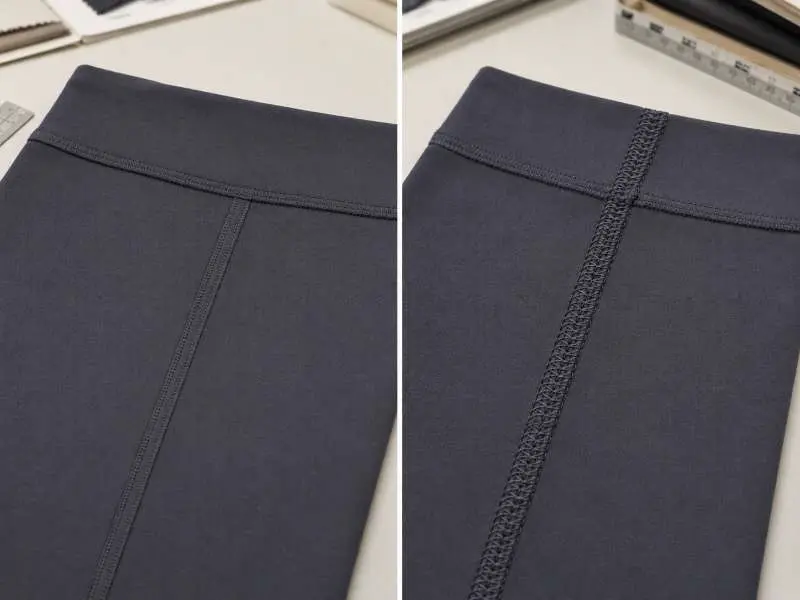
Standard leggings can be sewn on a basic serger machine. Performance leggings — the kind that justify a higher retail price — typically require flatlock or flatseam construction. These stitch types place the seam flat against the skin rather than creating a ridge, which matters in high-friction zones like the inner thigh and the waistband edge. Flatseam machines are specialized equipment, slower to operate per unit than a serger, and not every factory has them. When a factory does have them, the hourly labor cost per unit reflects that.
Waistband construction is another point where cost and quality intersect. A wide, stable waistband that stays in place during movement typically involves multiple layers of fabric and sometimes an internal elastic strip. A basic folded-and-topstitched waistband is faster to produce; a properly engineered wide waistband with a clean external finish takes more cutting, more sewing passes, and more QC time. Similarly, a crotch gusset — a fabric insert that allows greater mobility and reduces seam stress — is one more piece, one more cut, and one more seam to execute.
The table below shows how key construction choices map to production complexity and the type of brand positioning they support:
| Construction Feature | Standard Approach | Performance Approach | Brand Use Case |
|---|---|---|---|
| Seam type | Overlock/serger | Flatlock/flatseam | Athletic, yoga, compression |
| Waistband | Single-layer fold + topstitch | Multi-layer, wide band with inner elastic | Lifestyle, yoga, premium sport |
| Crotch gusset | Not included | Separate panel insert | High-movement sport, yoga |
| Hem finish | Raw hem / basic coverstitch | Clean coverstitch or bonded hem | Premium and sustainable lines |
Construction method determines both the production cost and the durability claim a brand can honestly make to its customers.
Every production run carries fixed costs that don't change regardless of how many units are ordered. Setting up a cut pattern, preparing the fabric rolls, calibrating a flatseam machine for a specific stitch width, producing and approving a sample — these are setup activities that a factory completes once per style, regardless of whether the final order is 100 units or 1,000.
When those fixed costs are spread across a small order, the per-unit cost is higher. When they're spread across a larger order, the per-unit cost comes down. This is the core reason why small-batch activewear feels expensive to produce: the garment itself might not cost much more to sew, but the cost-per-unit overhead from setup, sampling, and minimum material purchases is proportionally larger.
Runtang's standard MOQ is 100 pieces per style per color. This threshold is set to allow emerging brands to test a design in the market without overcommitting on inventory, while still making the production run viable from a factory cost perspective. Brands ordering at MOQ should expect per-unit costs that reflect the small-run reality; scaling to larger orders in subsequent seasons is typically where the cost structure becomes more favorable.
A practical approach for new brands: launch with two or three styles rather than six or eight, confirm performance and market fit, then expand the range on the next order cycle. This reduces the fixed cost burden across fewer SKUs and gives the brand real customer data before committing to a wider range.
When a pair of branded leggings reaches a premium retail price, only part of that price reflects manufacturing cost. The rest may include brand margin, product photography, marketing, warehousing, platform fees, retail markup, and distribution overhead. From a factory perspective, the manufacturing cost is only one layer of the final retail price.
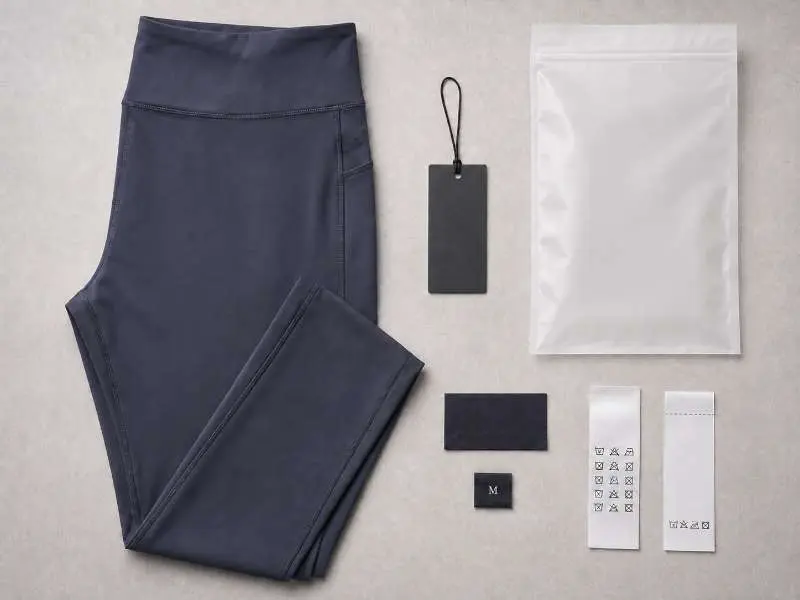
For brands building their own line, understanding which costs are fixed and which are variable helps with budget planning. The following elements all contribute to what a brand pays before goods are landed:
Where brands most commonly miscalculate: treating the factory price as the full cost. The landed cost — what it actually costs to get the product into your warehouse, branded and duty-paid — is the number that matters for margin planning. Brands that work this out before sampling have fewer surprises when the final invoice arrives.
If the line includes recycled polyester, recycled nylon, or other verified responsible-material claims, brands should also budget for documentation and claim control. Textile Exchange maintains recognized material standards such as RCS and GRS, which brands can use as a reference point for Textile Exchange standards when planning certified or claim-based activewear programs.
New activewear brands face a compounding challenge: they need to order small to manage risk, but small orders carry higher per-unit costs. At the same time, performance fabric specifications require a higher base material cost than casual apparel. And the construction standards that separate a credible activewear product from a generic one add both equipment requirements and production time.
For founders preparing to start an activewear brand, the safest budget plan is not to cut the key performance features first. It is usually better to reduce the number of launch SKUs, simplify colorways, and keep the fabric and construction standard consistent enough for customer testing.
The brands that navigate this well tend to do a few things consistently:
The cost structure of leggings production is not arbitrary — it reflects the material science, the equipment, and the labor required to make a garment that performs consistently across thousands of units. Understanding that structure doesn't just help with budgeting; it makes for more productive conversations with the factory from the first inquiry forward.
Brands planning their first activewear order or expanding an existing line can explore the full range of gym leggings styles — including seamless and legging set options — through Runtang's product pages.
The standard MOQ is 100 pieces per style per color. This applies to cut-and-sew styles including gym leggings, yoga leggings, high-waisted styles, and legging sets. Seamless leggings may have different MOQ requirements depending on the construction method — confirm at the inquiry stage.
For a first activewear order, a mid-weight polyester-elastane blend is a practical starting point — it manages cost while still delivering four-way stretch and basic moisture-wicking performance. Brands wanting a premium hand feel or higher durability typically move toward nylon-elastane blends. The right choice depends on your target price point and end-use positioning. Runtang's production team can advise on fabric direction during the sampling stage.
The most effective approach is to concentrate your initial order on fewer styles at a higher unit count per style, rather than spreading across many SKUs at minimum order quantities. This lowers per-unit fixed costs without reducing construction standards. Confirming your fabric and colorway selection before sampling also reduces costly revision rounds. For brands on a tight development budget, starting with a proven fabric direction and a focused two- or three-style range gives the best quality-to-cost ratio at launch.
Understanding manufacturing costs is the first step. The next is finding a production partner who can work with your spec, your timeline, and your MOQ from the start.
Share your design brief or a rough tech pack and we'll get back to you with a clear picture of what production looks like for your range. Not sure where to start? Drop us a message and we'll guide you through.
 T-shirts Related
Cotton vs Polyester T-Shirt: Which Fabric Works Better for Bulk Brand Orders
READ MORE Private Label & Brand Building
Private Label Clothing OEM Setup: A Stage-by-Stage Production Guide for Brand Buyers
READ MORE Leggings Related
What Makes Leggings Squat-Proof? A Fabric and Construction Guide for Brands
READ MORE Leotard Related
Gymnastics Competition Leotards: Custom Design, Print and Bulk OEM Guide for Clubs
READ MORE Top Clothing Manufacturer Recommend
Top 8 Clothing Manufacturers in China
READ MORE