World Class Textile Producer with Impeccable Quality
World Class Textile Producer with Impeccable Quality

Key Sourcing Takeaways
Starting a clothing brand is rarely the hard part. You already know what you want to make — a hoodie silhouette, a leggings fabric feel, a pyjama set for a specific market. What most founders are less clear on is what happens next: how do you go from a design idea to a factory sample to a shipment ready for your warehouse?
That gap — between product concept and physical product — is where most early-stage brands lose time and money. Not because the idea is wrong, but because the production process is opaque. Factories speak in acronyms, quote sheets arrive with unexplained line items, and sampling rounds drag on longer than expected.
This roadmap is written from the factory side of that relationship. It covers the four OEM production stages every brand goes through when starting a clothing brand: tech pack preparation, factory inquiry, sampling, and bulk order. At each stage it explains what you need to have ready, what the factory needs from you, and where the common sticking points are.
Before contacting a single factory, it helps to be clear about the type of production relationship you're entering. Two models dominate the market:
| Model | What the Factory Does | What You Bring |
|---|---|---|
| OEM (Original Equipment Manufacturer) | Manufactures your design — pattern, cut, sew, trim — to your specification | Design files or tech pack, fabric direction, branding requirements |
| ODM (Original Design Manufacturer) | Designs and manufactures; you select from existing styles and add your branding | Brand identity, label requirements, minor customisation requests |
The right model depends on how differentiated your product needs to be. OEM gives you full control over construction and materials; ODM is faster and cheaper for a first range but limits how distinctive your product can be. Most founders starting a clothing brand with a clear product vision choose OEM — which is the focus of this guide.
A third term worth clarifying is private label. This refers to the branding arrangement — products are sold under your own label — rather than a separate manufacturing model. Private label clothing can be produced through OEM or ODM, depending on how much control you need over pattern, fabric, trims, and packaging. For a fuller setup process, see our guide to private label clothing production and how it differs from wholesale sourcing.
A tech pack is the specification document you send to a factory before sampling begins. It tells the factory everything they need to produce your garment correctly: what it looks like, what it's made of, how it should be constructed, how it should be labelled. For anyone starting a clothing brand through OEM production, getting this document right is the single highest-leverage thing you can do before approaching a factory.
Factories receive dozens of inquiries a week. The ones with clear, complete tech packs get prioritised — not out of favouritism, but because incomplete briefs require back-and-forth that delays production scheduling for everyone. A well-prepared tech pack is read by the factory as a signal that the brand is production-ready.
What a factory-ready tech pack should include:
If you don't have a full tech pack yet, that's not a blocker — most OEM factories with development capabilities can work from a detailed sketch and a reference garment. What matters is being honest about what you have. Send your best available brief and ask what additional information the factory needs before sampling begins.
Not sure whether OEM or ODM better fits your product concept? See our comparison of OEM vs ODM clothing production for a side-by-side breakdown.
Once your tech pack is ready — or at least in a shareable state — the next step is the factory inquiry. A strong inquiry is not a price request. It's an introduction: who you are, what you're making, what you need, and what your timeline looks like. Brands starting a clothing brand for the first time often underestimate how much this framing matters — factories that work with emerging labels weigh communication quality as part of their own risk assessment.
An effective first inquiry includes:
When evaluating factory responses, pay attention to three things beyond price: how quickly they responded, whether they asked clarifying questions (a sign they read your brief), and whether the sample quote was itemised. A quote that separates fabric cost, CMT (cut-make-trim), trims, and sampling fee is easier to interrogate than a single lump sum.
MOQ in practice — what 100 pieces per style means:
| Scenario | Implication |
|---|---|
| 1 style, 1 colour, 100 pieces | Minimum viable order — good for testing market response before scaling |
| 1 style, 3 colours, 100 pcs each | 300 pieces total — spreads inventory risk across colours |
| 3 styles, 1 colour, 100 pcs each | 300 pieces total — tests multiple products simultaneously |
Starting with a single style in one colour is the lowest-risk approach. Factories that specialise in working with emerging brands understand this, and most are structured to scale with you as order volumes grow.
Runtang’s OEM production setup supports brands starting from 100 pieces per style per colour, with development assistance available for founders who do not yet have a complete tech pack.
Sampling is where most of the development time is spent — and where brands most often underestimate the timeline. Understanding what each round is for helps you give better feedback and keep the process moving.
| Sample Stage | Purpose and What to Check |
|---|---|
| Proto Sample (First Prototype) | Checks overall silhouette, construction method, and fabric direction. Focus on shape and proportions, not minor finishing details. This is the round to flag any fundamental design issues. |
| Fit Sample | After proto revisions are confirmed, a fit sample tests measurements against your size chart. Wear-test on a fit model if possible. Approve or request graded corrections before moving on. |
| PP Sample (Pre-Production) | Made from production-run materials and production-line labour. This is the sample you approve before bulk starts. Check fabric consistency, label placement, trim quality, and colour accuracy against your standards. |
A note on realistic expectations: the number of rounds varies depending on design complexity and the completeness of your original tech pack. Simple basics with clear specs may reach PP approval in two rounds; more complex garments — woven constructions, multi-panel designs, garments with functional hardware — typically require more. Factoring in international shipping time for physical samples is a common oversight in launch planning.
Sampling fees should be confirmed before development starts. They usually cover pattern work, material sourcing for the sample, sample-room labour, and revision handling, but whether the fee can be credited against a bulk order depends on the order structure. Per-round timing also depends on garment complexity, fabric availability, and revision depth, so the safer approach is to request a sampling schedule before setting a public launch date.
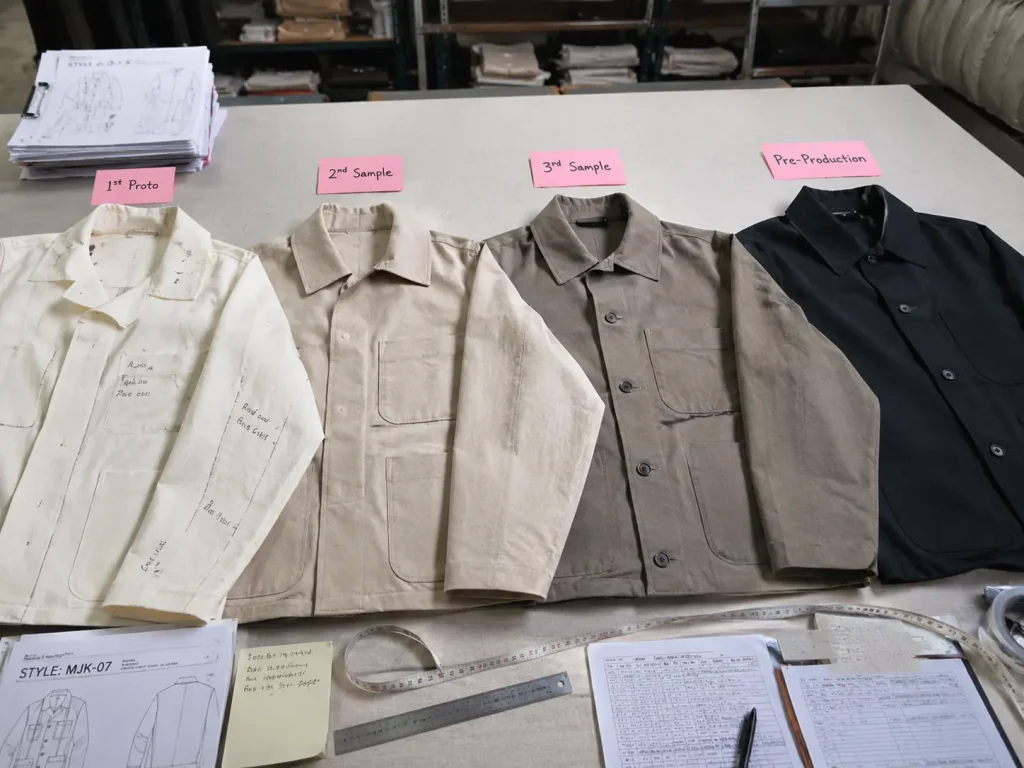
Approving your PP sample is not the same as placing your bulk order. Before production starts, there are several confirmations that need to happen on both sides — skipping them is how brands end up with bulk that doesn't match the sample.
Pre-production confirmation checklist:
Private label packaging — labels, woven tags, hang tags, branded polybags — should be specified and approved before the bulk order is placed, not after. For most garments, labelling is integrated during the sewing stage, and retrofitting labels to completed garments is expensive and time-consuming.
The categories you start with matter less than how well-specified your first order is. Whether you're opening with custom T-shirts, hoodies, or gym leggings as your first product line, the factory relationship works the same way — the clearer your brief, the tighter your first bulk run will be.
For brands sourcing globally, supply chain and responsible sourcing requirements should be reviewed before the first bulk order. The American Apparel & Footwear Association Supply Chain & Sourcing resources provide useful reference points for traceability, sourcing commitments, and risk management.
A tech pack is the fastest path to accurate sampling, but it's not the only starting point. If you're starting a clothing brand with detailed sketches, reference garments, and a clear fabric direction, most full-service OEM factories can assist with tech pack development as part of the process. Be transparent about what you have — factories can work with a strong brief even if it's not in a formal tech pack format.
At Runtang, OEM orders start from 100 pieces per style per colour. This makes it viable to test a single product with a small initial run before scaling. Multi-style or multi-colour orders are structured the same way — 100 pieces per SKU rather than across the order as a whole.
OEM means the factory manufactures your design — you own the design and all the specifications. ODM means the factory designs and manufactures, and you select from their existing styles to brand as your own. OEM offers more product differentiation; ODM is faster and lower-cost for initial product development. Most brands with a clear product vision choose OEM.
Yes — and for most first-time founders, starting with one style is the recommended approach. It concentrates your sampling time and budget, gives you a clear quality benchmark, and reduces inventory risk on your first order. Many brands that now run multi-category lines launched with a single hero product.
For many basic garment types, two to three sampling rounds is a practical planning assumption. Simple styles with clear tech packs may need fewer revisions, while complex construction, special fabric, or detailed trims can add more rounds. The most effective way to reduce revision time is to provide complete, unambiguous specifications before sampling begins.
If you're starting a clothing brand and ready to find a production partner, the next step is straightforward: share your tech pack or design brief, and a realistic picture of your timeline and order volume. From there, we can advise on fabric options, confirm MOQ structure, and outline a sampling schedule.
Share your tech pack, sketch, or product brief with our OEM production team. We’ll review the style, MOQ structure, sampling needs, and category fit before preparing a quote.
 Leggings Related
How to Start an Activewear Brand: From Design to OEM Production
READ MORE Polo Shirts Related
Sourcing Polo Shirts from China: A Brand Buyer’s Guide to Factories and Quality
READ MORE T-shirts Related
T-Shirt Sourcing Guide: Single Jersey, Interlock and Slub Jersey for Brand Buyers
READ MORE T-shirts Related
Plain T-Shirts in Bulk: What Apparel Brands Need to Confirm Before Ordering
READ MORE Customization & Craft Guide
Lab Dip and Bulk Color Approval for Custom Apparel Orders: A Brand Buyer’s Guide
READ MORE