World Class Textile Producer with Impeccable Quality

World Class Textile Producer with Impeccable Quality

Key Sourcing Takeaways
One of the first decisions in a graphic T-shirt inquiry is the print method. It affects setup cost, production speed, fabric compatibility, hand feel, and how consistently the approved result performs after repeated laundering.
This guide walks through the three methods most relevant to OEM bulk orders — screen printing, DTG, and heat transfer — from the production floor perspective. The goal is to help you arrive at your factory conversation already knowing which method fits your collection, your quantity, and your timeline. Brands still evaluating production partners should first define what they need from a T-shirt production partner before comparing decoration capabilities.
Print method selection for graphic T-shirts should start with four inputs: artwork type, blank fabric composition, garment color, and expected reorder volume. A design that works on a white high-cotton jersey may require a different underbase, pretreatment, or transfer system on a dark cotton-poly blend.
Three mistakes create most approval problems:
Artwork scale and placement may be checked digitally, but color, hand feel, adhesion, and wash performance should be approved using the same method intended for bulk production.
Screen printing is commonly selected for repeat bulk orders with spot-color artwork because screen preparation is largely fixed while production throughput improves as volume rises. Each spot color typically uses a separate screen, and dark garments may require an additional underbase. The final screen count depends on color separations, halftones, special effects, and garment color.
A change in T-shirt colorway does not automatically require a completely new screen set. The same artwork screens may be reusable, but the ink recipe, underbase, flash sequence, and test print may need adjustment for the new blank color. Treat every colorway as a separate approval condition rather than assuming the previous result will reproduce automatically.
| Dimension | Screen Printing |
|---|---|
| Runtang order starting point | Regular custom T-shirt MOQ starts at 100 pieces per design per color; screen-print feasibility and pricing still depend on artwork, screen count, and garment color. |
| Color count sweet spot | Best suited to controlled spot-color separations; confirm the total screen count including any underbase. |
| Design suitability | Logos, flat-color graphics, text, streetwear prints |
| Fabric compatibility | Cotton, cotton-poly blends, most knits |
| Durability | Potentially high when the ink system and curing conditions are validated through wash testing. |
| Reorder consistency | Strong when screens, ink recipes, blank fabric, garment shade, and approved references remain controlled. |
Screen printing parameters vary by factory and design. Confirm the total screen count, underbase requirements, fabric surface, garment color, and available print area before finalizing artwork.
Archived screens can support repeat orders, but they do not guarantee identical output by themselves. Reorder consistency also depends on the blank fabric, garment shade, ink formulation, mesh, curing conditions, and approved color reference.
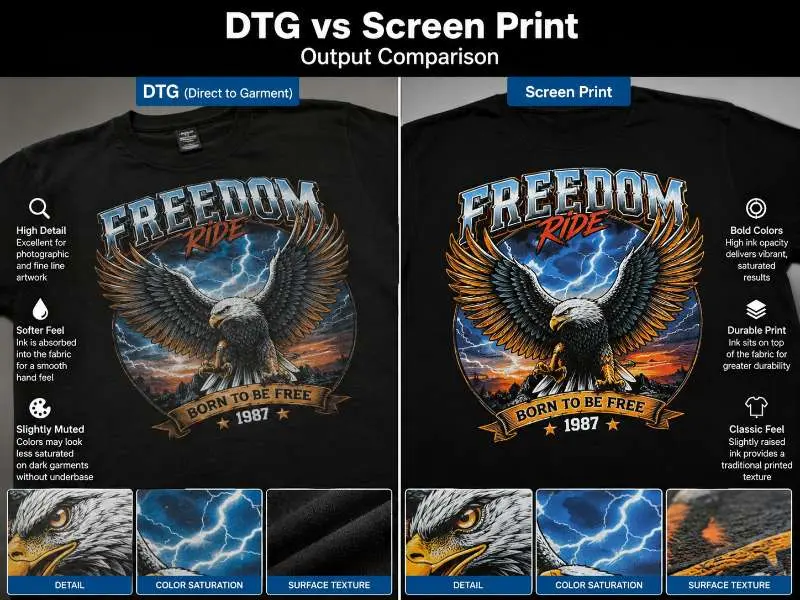
Direct-to-garment printing is useful for full-color artwork, gradients, photographic detail, and variable-design runs because it does not require a separate screen for each spot color. Its suitability depends heavily on the garment. High-cotton fabrics are generally more straightforward, while polyester-rich blends may require specialized pretreatment and testing for vibrancy, washability, and dye migration.
A DTG sample can check graphic scale, placement, and overall composition, but it should not be used as the approval standard for a later screen-printed bulk run. DTG and screen printing build color, underbase, surface texture, and curing differently. Before screen-printed production, approve a screen-print strike-off or pre-production sample on the intended T-shirt fabric and colorway.
Heat transfer is a process family, not a single finish. OEM options may include heat-transfer vinyl, direct-to-film transfers, screen-printed transfers, and other digital or specialty films. Their hand feel, opacity, stretch, application temperature, and wash performance differ, so the exact transfer type should be named in the quotation and tech pack.
Heat transfer can suit variable names or numbers, detailed small logos, full-color artwork at lower quantities, and fabrics that are difficult for a factory’s DTG setup. The main bulk risks are incorrect time, temperature, or pressure; adhesive incompatibility; dye migration; and excessive film coverage that changes hand feel. Do not use a blanket rule that large-area transfers will lift. Require a method-specific strike-off and wash test on the actual blank.
Choosing the method is only half the approval. The tech pack should define print width and height, vertical drop from a fixed seam or collar reference, horizontal centerline, size-grade rules, and an agreed placement tolerance. The factory should create an approved placement reference for the first size and confirm whether the same coordinates or graded placements apply across the size range.
Use a platen template, jig, or another documented positioning control appropriate to the selected method. Approve a photo or marked sample from your own development run rather than requesting references from another customer’s production.
Artwork file requirements:
| Requirement | Screen Printing | DTG | Heat Transfer/DTF |
|---|---|---|---|
| File format | Vector AI, EPS, or PDF preferred | Editable master plus high-resolution PNG or PSD | Vector or transparent raster file according to the transfer workflow |
| Raster resolution | Confirm at final print size; 300 PPI is a common starting point | Confirm at final print size; 300 PPI is a common starting point | Confirm at final transfer size; 300 PPI is a common starting point |
| Color setup | Named Pantone spot colors or factory-requested separations | Factory-requested RGB or CMYK profile | Factory- or transfer-provider-requested color profile |
| Background / underbase | Transparent unless a printed background is intentional | Transparent background; white underbase handled through the approved production workflow | Transparent background; knockout or white layers supplied when required |
| Layer setup | Separate color layers or production-ready separations | Editable master plus transparent production export | Retain editable layers and provide cut paths or spot-white layers when requested |
Confirm artwork specifications with your factory before submission. Requirements may vary by equipment and production setup.
Brands should include print dimensions, garment color, placement references, and approval requirements in the tech pack. For a broader comparison, review garment print methods; the same artwork may require different controls when applied to custom hoodies because fabric weight, seams, and available print area change.
The ASTM International textile standards catalogue includes apparel and fabric test methods that can support a broader quality specification. Confirm the exact laundering, colorfastness, and appearance method with the testing laboratory before adding it to the purchase specification.
The method that fits your brand depends on where you are in the product development cycle and what the current order looks like. Here is a practical decision table:
| Your situation | Recommended method | Key reason |
|---|---|---|
| Repeat bulk order with controlled spot-color artwork | Screen printing | Fixed setup is spread across the run and documented screens support reorders |
| Full-color, gradient, or photographic artwork | DTG | Reproduces tonal detail without separate spot-color screens |
| Small pilot run on a suitable high-cotton blank | DTG | Reduces screen setup while allowing artwork and placement evaluation |
| Variable names, numbers, or detailed lower-volume graphics | DTF or HTV, depending on design | Supports personalization without separate screens for every version |
| High-volume simple graphic | Screen printing | Offers efficient throughput after setup, subject to screen count and curing requirements |
| Fabric or finish remains uncertain | Compare method-specific strike-offs | Allows hand feel, color, adhesion, and wash results to be approved before bulk |
This framework is directional. Final method selection should account for your specific fabric composition, colorway count, and delivery timeline. Discuss with your production team during the sampling stage.
Do not approve DTG and assume that screen printing will match it. Whenever the bulk method changes, repeat method-specific color, hand-feel, placement, and wash approval on the intended blank.
Runtang’s regular custom T-shirt MOQ starts at 100 pieces per design per color. Screen-print feasibility and setup cost still depend on the artwork, total screen count, garment color, and required underbase. Higher quantities usually distribute fixed setup costs across more units.
DTG can be quoted for 500 pieces, but it should not be selected by quantity alone. Compare the actual artwork, fabric composition, garment color, production throughput, and required hand feel against screen printing or a transfer method before confirming bulk.
Submit the editable master artwork plus the factory’s requested production file. For screen printing, vector artwork with named spot colors and separable layers is preferred. For DTG or DTF, provide a high-resolution transparent file at final size and retain the editable source. Add print dimensions, placement references, garment color, and the required approval sample to the tech pack.
Placement consistency in a bulk run depends on whether written placement specs are provided and whether the factory uses jigs or registration fixtures. Confirm both before approving production. Request a placement photo from the first approved piece — this becomes the reference for the entire run.
Planning a graphic tee collection? Send your artwork, intended T-shirt fabric, garment colorways, print dimensions, and target quantity. Our team can review the production path before sampling and prepare a quote for your custom T-shirt production.
 T-shirts Related
T-Shirt Sourcing Guide: Single Jersey, Interlock and Slub Jersey for Brand Buyers
READ MORE Hoodies Related
How to Find a Hoodie Manufacturer for Your Clothing Brand
READ MORE Customization & Craft Guide
Clothing Shrinkage in Bulk Production: What Brands Should Approve Before Cutting
READ MORE Leggings Related
A Must-Read for Professional Sportswear Brands: How to Customize the Best Fleece Lined Leggings
READ MORE Leotard Related
Dance Leotards: A Sourcing Guide for Studio Uniform and Private Label Programs
READ MORE