World Class Textile Producer with Impeccable Quality

World Class Textile Producer with Impeccable Quality

Apparel brands should not ask only how many weeks garment production takes. They should first define when the factory starts counting, what must be approved before that point, and whether the quoted end date means bulk completion, inspection release, or warehouse arrival. For Runtang orders, bulk production lead time begins after the Pre-Production Sample is approved and ends when the finished goods leave the factory. International freight, customs clearance, and destination warehousing are separate planning periods. This boundary gives buyers a usable production calendar and makes delays easier to assign to a specific approval, material, manufacturing, inspection, or logistics stage.
Garment production lead time is the factory-controlled period between the approved Pre-Production Sample and the goods leaving the factory, provided the order is otherwise ready to execute. A Pre-Production Sample, usually shortened to PP sample, is the final garment reference used before bulk manufacturing. It should reflect the approved fabric, color, measurements, construction, trims, decoration, labels, and other details that the production team must follow.
The PP gate does not erase the other commercial requirements. The final PO, deposit, materials, colorways, size breakdown, label artwork, packaging instructions, and production slot should be confirmed by or before PP approval. If one of these items remains open, the factory may need to reconfirm the promised ex-factory window even though the physical sample has been approved.
| Planning period | Start | End | Manage it as |
| Product development | Initial design or tech pack submission | PP sample approval | A separate development timeline |
| Bulk garment production | PP sample approval, with executable order conditions confirmed | Goods leave the factory | The factory production lead time |
| Logistics | Factory dispatch or carrier pickup | Delivery to the brand's warehouse | A separate freight and import timeline |
A reliable production calendar is built around written approvals rather than informal progress updates. The following sequence keeps the product standard, materials, and delivery window aligned.
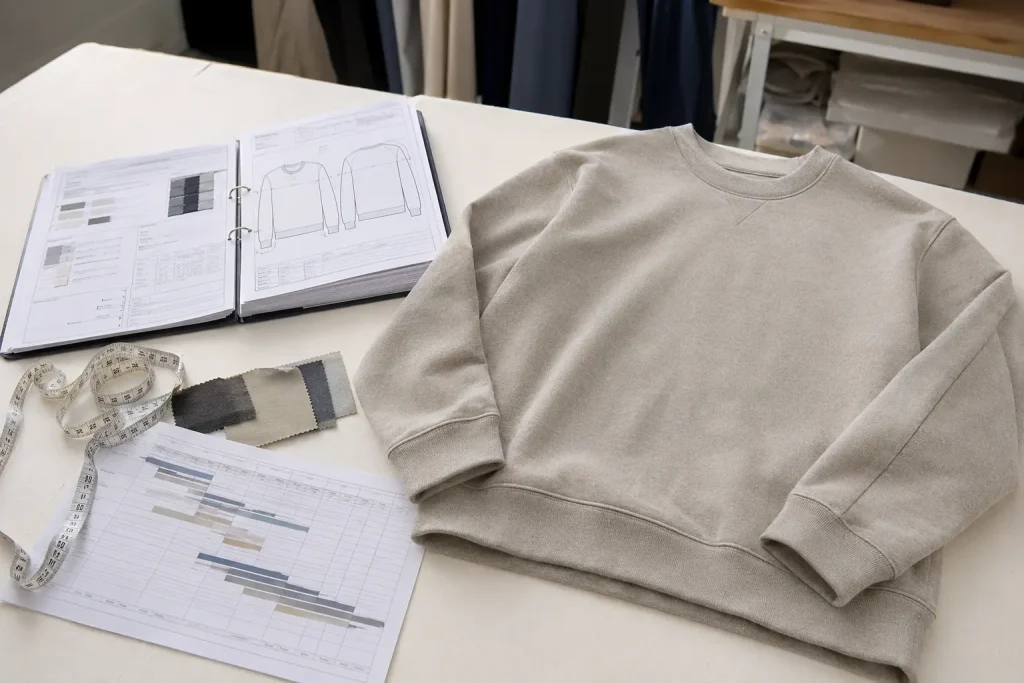
The most common buyer-controlled delays are incomplete technical information and repeated confirmation of the design. These issues have the greatest impact when they remain unresolved after materials or production capacity have already been reserved.
| Buyer action | Downstream effect | Better control |
| Tech pack contains TBD items | Materials, operations, costing, or measurements cannot be locked | Close construction and specification gaps before PP approval |
| Design drawing requires repeated confirmation | Pattern, artwork, decoration placement, or sample approval may need another round | Consolidate comments into one version-controlled response |
| Color or fabric changes after PP approval | Lab dips, sourcing, testing, and the production reference may need to restart | Treat the change as a new scheduling event |
| Label or packaging files arrive late | Finished garments may wait for packing materials | Approve artwork and packing ratios alongside the PP sample |
| Size quantities change late | Cutting markers, bundle plans, labels, and carton ratios may be affected | Freeze the size breakdown before bulk cutting |
| Launch date is treated as the factory date | Freight, customs, and warehouse intake are omitted | Track ex-factory and in-hand dates separately |
Production complexity comes from the number of approvals and operations, not simply from the garment category. A basic style made from available fabric has fewer variables than a style requiring custom dyeing, several decorations, garment washing, or coordinated set packaging.
Runtang's directional ranges are 3–15 working days for basic styles using in-stock fabric and 1–3 months for custom-dyed or complex orders. An unchanged repeat order is quoted case by case because fabric availability, capacity, quantity, and the required ex-factory window can differ from the previous run.
Brands should plan from the date stock must be available at their warehouse, then separate each earlier milestone. This avoids using a marketing launch date as if it were a factory shipment date.
Marketing should not lock a launch date until the brand has an approved PP sample and a confirmed ex-factory window. A provisional launch can be used earlier, but it should remain adjustable until those two controls are in place.

Before the PO, the factory can provide only a provisional timing estimate. To assess whether the required in-hand date is feasible, provide the tech pack, target fabric, color count, total quantity, size breakdown, decoration files, label and packaging requirements, target market, and required warehouse-arrival date.
The confirmed bulk schedule comes after written PP approval. Runtang counts the bulk lead time from that approval date; the PO, deposit, materials, colorways, size quantities, labels, packaging, and production slot should already be ready for execution. If any prerequisite remains open, the ex-factory window should be reconfirmed.
For an OEM clothing production project, this two-stage approach is more useful than a single promise such as “delivery in four weeks.” The pre-PO figure remains an estimate, while the post-approval schedule is tied to defined inputs, inspection timing, and an ex-factory dispatch range. The written schedule should identify the PP approval date, bulk start condition, inspection window, ex-factory range, and what types of post-approval changes require re-quotation or rescheduling.
Runtang counts bulk garment production lead time from written approval of the PP sample. The PO, deposit, materials, colorways, size quantities, labels, packaging, and production slot should also be ready for execution; an unresolved prerequisite can require the ex-factory window to be reconfirmed.
Not necessarily. PP approval closes the product reference, but cutting or sewing may start according to the confirmed production slot and material readiness. The written calendar should distinguish the lead-time start date from the physical line-start date.
Additional colors can extend the timeline when each shade requires a separate lab dip, custom dye lot, matching trim, print approval, or PP reference. Existing approved materials may reduce the added work, but new color development should be scheduled as its own approval path.
No, not when the endpoint is ex-factory dispatch. International freight, customs clearance, local delivery, and warehouse receiving should be planned separately and added after the factory release date.
 Top Clothing Manufacturer Recommend
Top 8 Polo Shirt Manufacturers in China
READ MORE T-shirts Related
The Secrets Behind T-Shirt Manufacturing: From Design to Finished Product
READ MORE T-shirts Related
T-Shirt Sourcing Guide: Single Jersey, Interlock and Slub Jersey for Brand Buyers
READ MORE Top Clothing Manufacturer Recommend
Top 8 Loungewear Manufacturers in China
READ MORE Customization & Craft Guide
Tech Pack Clothing Manufacturer Guide: What to Include Before Sampling
READ MORE