World Class Textile Producer with Impeccable Quality
World Class Textile Producer with Impeccable Quality

Key Sourcing Takeaways
Apparel brands should approve the shrinkage test method, care procedure, report format, and acceptable dimensional-change limit before bulk fabric is released for cutting. A garment can meet the size specification at final inspection and still fall outside tolerance after washing if the fabric lot, drying method, or construction was not tested against the intended care label.
This guide is for buyers developing cotton T-shirts, hoodies, pajamas, and other washable garments. It explains where shrinkage control belongs in the OEM workflow, what information a useful test report should contain, and when a new test is required. It does not apply one universal shrinkage percentage to every order.
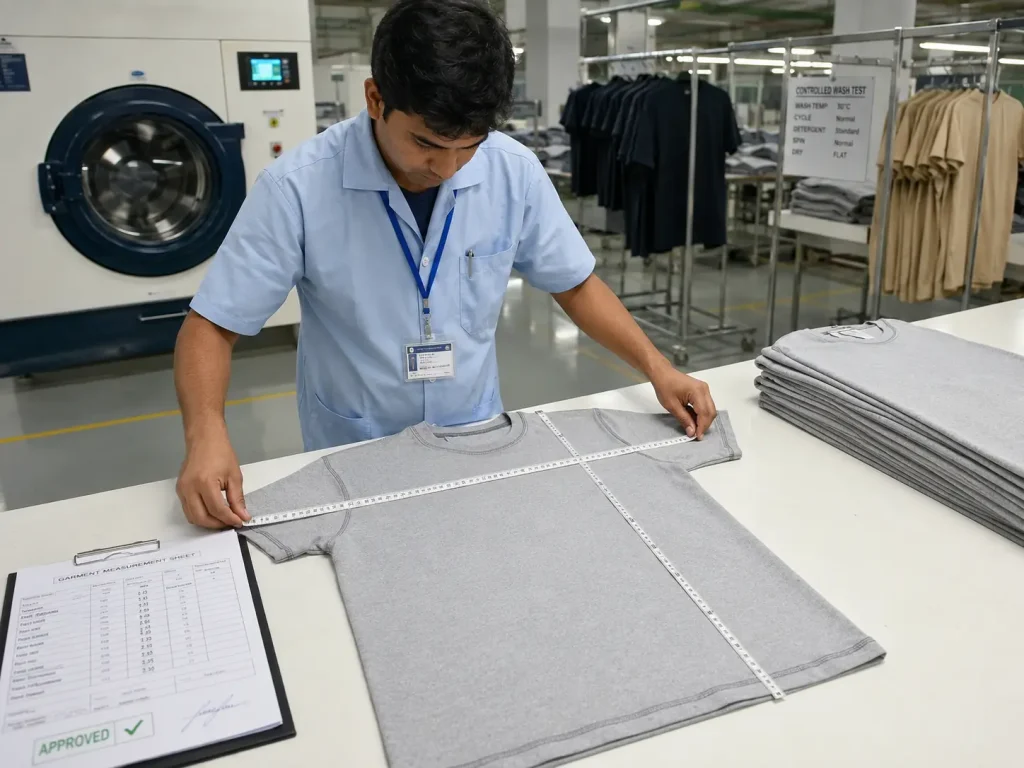
Clothing shrinkage is the measurable change in fabric or garment dimensions after an agreed washing and drying procedure. For a brand buyer, the practical question is not whether a material may shrink; it is whether the finished garment remains within the approved post-wash size and construction requirements.
Length and width may change at different rates. Body fabric, neck rib, cuffs, waistbands, linings, and pocket materials can also react differently. A T-shirt may lose body length while its chest width remains acceptable, or a hoodie rib may recover differently from the brushed body fabric. These changes affect grading, seam alignment, fit consistency, and the relationship between joined components.
Shrinkage therefore needs to be treated as an approval item during development, not as a complaint to investigate after shipment. The buyer should define the intended care method, the test level, the measurement points, the limit, and the action required if the result fails.
Fiber content is a shrinkage-risk indicator, not an approval result. Cotton-rich fabrics may show more dimensional change than comparable polyester-rich blends, but knit density, finishing tension, laundering conditions, and joined components can change the final outcome.
For brands approving bulk orders, the decision should therefore rely on a test tied to the actual fabric lot and intended care method—not on fiber content or GSM alone. Broader material-selection factors can be reviewed in the T-shirt fabric guide for bulk orders.
Runtang uses both mechanical pre-shrinking and wet pre-shrinking, depending on the fabric and order requirement. Mechanical treatment controls relaxation through compaction or controlled mechanical finishing. Wet pre-shrinking exposes the fabric to moisture and a controlled drying process before cutting so that part of the dimensional change occurs before the garment reaches the buyer.
Wet pre-shrinking can provide tighter control for some constructions, but it may also change the fabric hand feel. That trade-off should be reviewed during sample approval rather than added automatically to every order. A softer or more relaxed surface may be acceptable for one product but inconsistent with the approved hand feel of another.
Pre-shrinking is not a universal default. The brand should specify its target shrinkage and intended care procedure because the test needs to represent how the finished product will be labeled and used. A line-dry requirement should not be approved using a tumble-dry result, and a hand-wash product should not be assessed only through a machine-wash procedure.
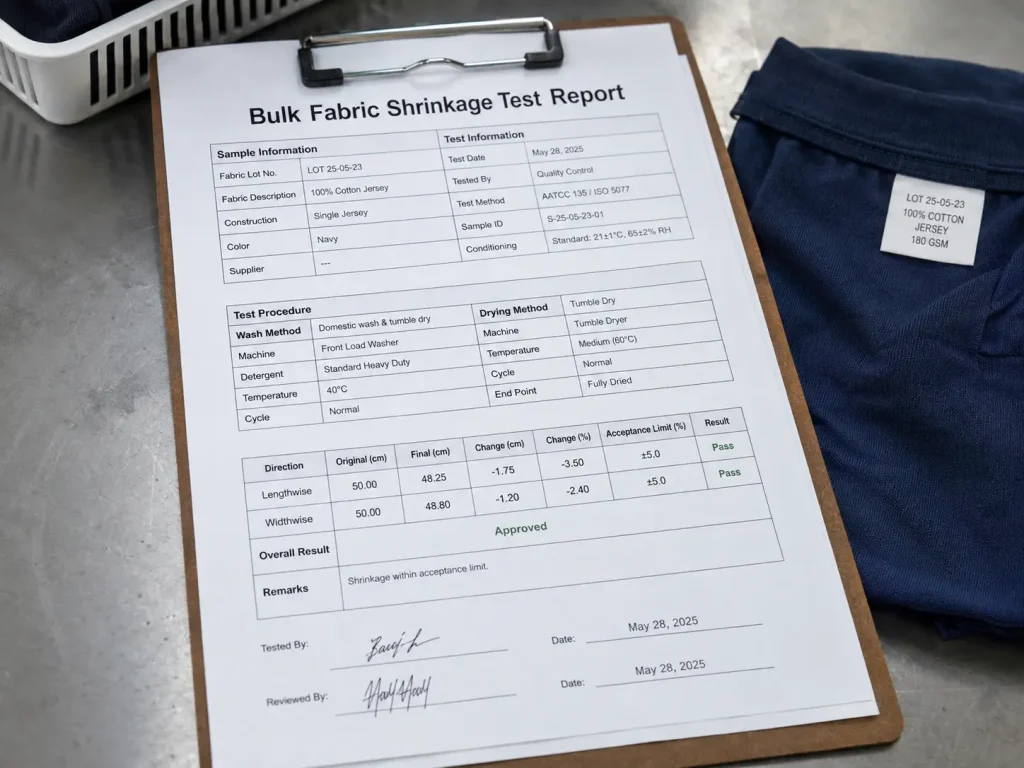
A report should allow the buyer to identify exactly what was tested, how it was tested, and whether the result is relevant to the bulk order. A single percentage without the fabric lot, laundering method, measurement direction, and acceptance limit is not enough for cutting approval.
| Report Field | What It Should Record | Why the Brand Needs It |
| Style and material identity | Style number, fiber content, construction, and GSM | Prevents a report from being applied to the wrong material |
| Fabric lot or batch | The exact bulk lot or sample batch tested | Confirms whether the result can release the production material |
| Test level | Fabric specimen or finished garment | Shows which production risk the test is addressing |
| Test method | Agreed standard or internal procedure | Makes the test repeatable and reviewable |
| Wash conditions | Machine or hand wash, cycle, temperature, detergent, and cycle count | Connects the result to the intended care instruction |
| Drying conditions | Line dry, flat dry, tumble dry, or another approved method | Drying can materially change the result |
| Measurement direction | Length and width, or defined garment points of measure | Prevents one-direction reporting |
| Before-and-after values | Original and final measurements with calculated change | Allows the buyer to check the calculation |
| Acceptance and action | Limit, pass/fail result, approver, and corrective action | Determines whether cutting can proceed |
Fabric and garment tests answer different questions. A fabric result helps the development team decide whether pre-shrinking, finishing adjustment, or pattern allowance is needed. A finished-garment result checks whether the construction remains stable after the body fabric, rib, elastic, lining, print, and seams have been combined.
| Test Level | Main Purpose | Typical Approval Stage | What It Cannot Prove Alone |
| Fabric specimen | Measures length and width change in the material | Fabric development and bulk-lot release | Cannot confirm the behavior of the assembled garment |
| Finished garment | Checks post-wash points of measure and component compatibility | Sample or pre-production approval | Cannot prove that every later bulk lot is equivalent |
| Bulk-lot verification | Confirms the actual production material against the approved basis | Before bulk cutting | Does not replace a garment wash test |
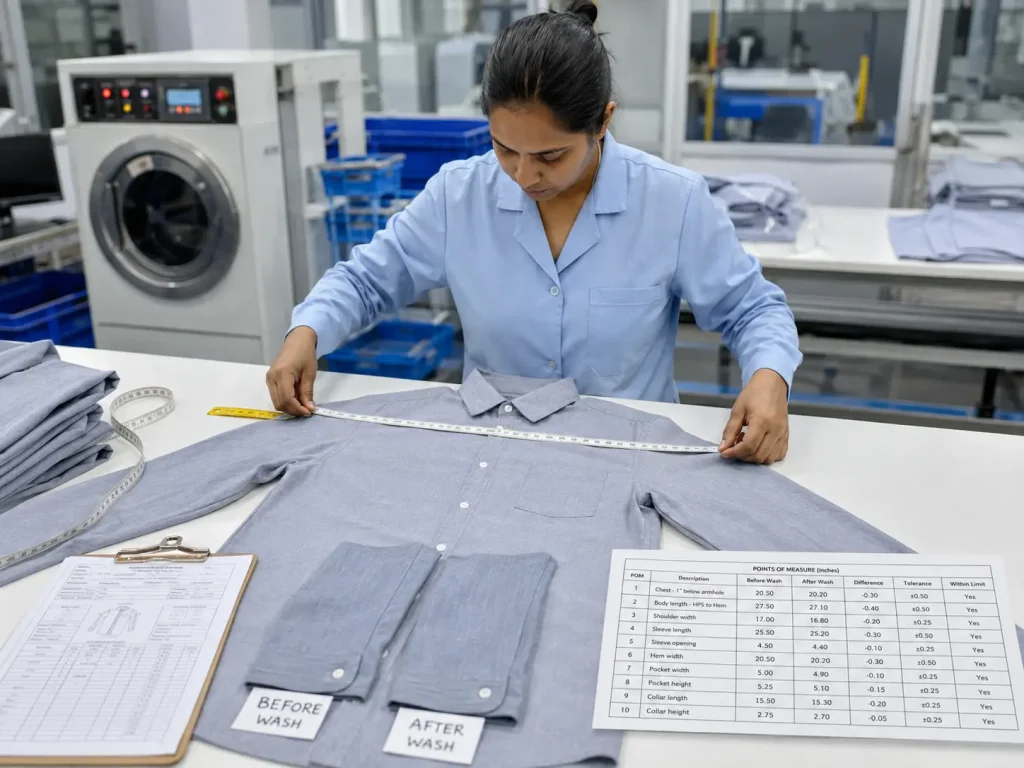
Pattern compensation should be based on the measured direction and construction, not one blanket percentage. Length and width may require different treatment, and the body fabric may need a different allowance from the rib, elastic, or lining. The buyer should also state whether the specification controls the garment before washing, after washing, or at both stages.
Runtang does not apply one fixed limit to every product. A working ceiling in the 3–6% range may be discussed for some orders, but the exact requirement must be approved for the fabric, product type, target market, and care method. A compact polyester-rich knit and a loose cotton waffle should not share the same default simply because both are used in casual garments.
The approved value should appear in the tech pack or quality plan together with the test method and corrective action. This prevents a general statement such as “control shrinkage” from becoming the only instruction available to the production and QC teams.
Retesting should be coordinated with the wider clothing quality inspection checklist so the release decision, sample basis, and inspection documents use the same acceptance criteria.
For T-shirts, confirm body length, chest width, sleeve length, neck opening, and rib compatibility after the intended laundering procedure. Cotton-rich single jersey and loose constructions need closer review than a compact polyester-rich blend, but the actual test result should control the decision.
For bulk hoodie production, test the body fabric together with cuffs, waistband rib, hood panels, zipper or placket, and any brushed or washed finish. A change in body length may be acceptable only if the hood, rib, pocket, and zipper still align with the approved construction.
For custom pajama sets, check top-and-bottom proportion, trouser length, elastic recovery, and size consistency across the range. The care method should reflect the target label because frequent home laundering can expose small dimensional differences across set components.
A shrinkage requirement that is not written into the tech pack, purchase order, or quality plan is likely to become an assumed standard. Buyers should convert it into a measurable and signed approval before production begins.
There is no universal percentage for every bulk garment. The approved limit should be defined for the fiber content, construction, product type, target market, care procedure, and post-wash size specification.
No. Pre-shrinking is a production treatment, while testing verifies whether the treated fabric or finished garment meets the approved dimensional-change requirement. Brands should still define the test method and acceptance limit before cutting.
Cutting should remain on hold until the affected lot is isolated and the corrective action is approved. Depending on the cause, this may involve reprocessing, retesting, pattern revision, or material replacement.
The first wash can reveal dimensional change, but brands should not assume that all shrinkage ends after one cycle. The agreed number of wash and dry cycles must be written into the test method, especially for materials, finishes, or care conditions that can continue changing with repeated laundering.
Share your tech pack, target fabric, care procedure, order range, and post-wash measurement requirements before sampling begins. Runtang can review the shrinkage-control points that should be confirmed before your bulk T-shirt order is released for cutting.
 Pajamas Related
How to Quickly Lay Out the Christmas Pajama Market
READ MORE Private Label & Brand Building
How to Start a T-Shirt Business: From Design to OEM Production
READ MORE Customization & Craft Guide
Clothing Shrinkage in Bulk Production: What Brands Should Approve Before Cutting
READ MORE Garment Material Insights
Hoodie Fabric Guide for Apparel Brands: French Terry, Fleece and Cotton Compared
READ MORE Sourcing & Supplier Guide
Clothing MOQ Explained: What Apparel Brands Should Expect from OEM Factories
READ MORE