World Class Textile Producer with Impeccable Quality
World Class Textile Producer with Impeccable Quality

Key Sourcing Takeaways
Leotards and unitards look like style choices, but for a brand placing a bulk order they are two different construction problems. A leotard ends at the hip with a clean, high-cut leg opening; a unitard extends that same panel down the leg to the ankle. That single decision about where the leg attachment line sits changes the gusset, the seam structure, the fabric stretch you need to specify, and ultimately which routine or product line the garment is built for. Here is what apparel brands need to settle before a tech pack goes to the factory floor.
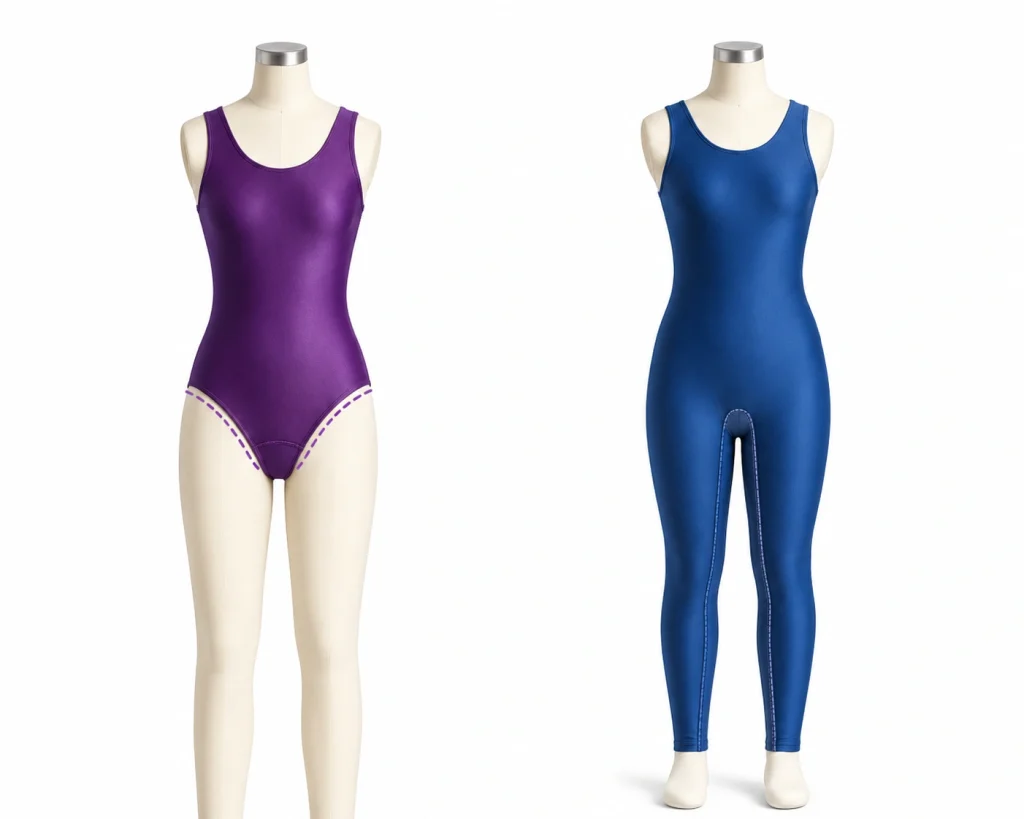
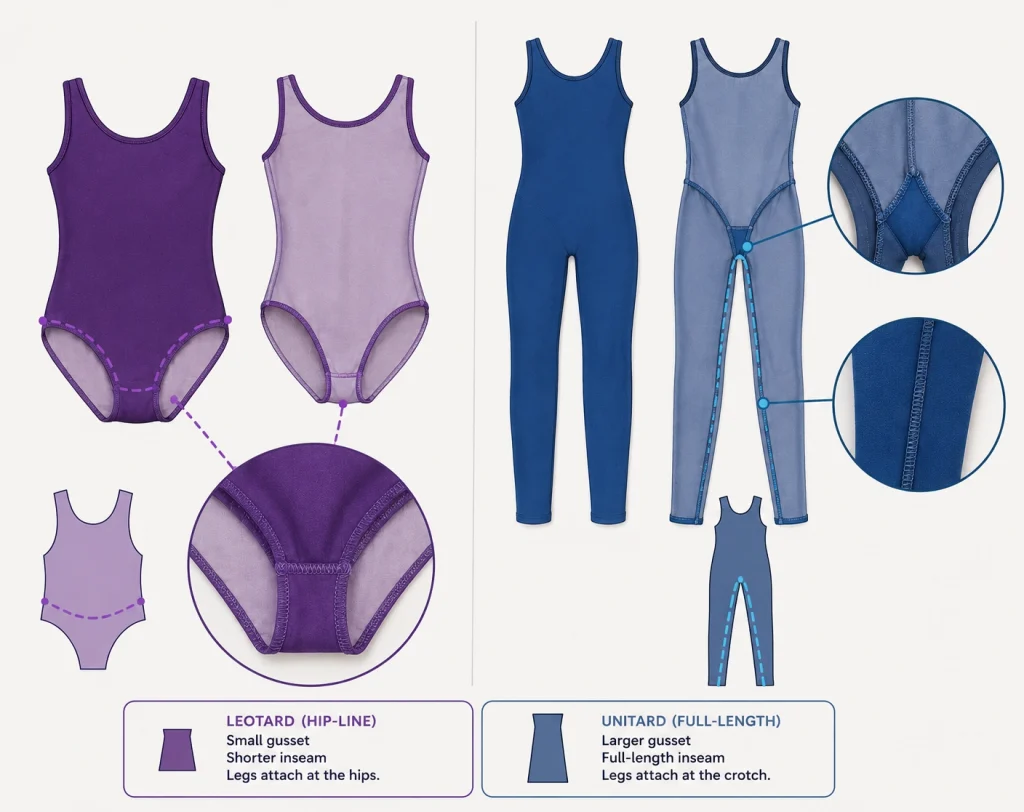
Leotard vs unitard construction starts with one structural choice: where the garment stops covering the leg. On a leotard, the body panel terminates at the hip line, and the leg opening is finished with elastic or a bound edge cut high to free the upper thigh. On a unitard, the body panel continues uninterrupted into a full leg, so the construction has to manage stretch and recovery along the entire leg length, not just around the hip opening.
That difference is not cosmetic. It dictates how the gusset is built. A leotard concentrates the four-way stretch demand at the hip and crotch, where the body folds most during high kicks and splits, so the gusset is a compact reinforced panel. A unitard distributes that demand down the leg, which means the inseam and gusset have to be engineered to hold compression and shape from crotch to ankle without bagging at the knee. For brands ordering either piece, this means the same fabric weight will not perform identically in both builds, and the tech pack has to call out the leg attachment line position explicitly rather than leaving it to the factory to assume.
The table below summarizes the construction points that change between the two, so they can be specified rather than discovered during sampling.
| Construction point | Leotard | Unitard |
|---|---|---|
| Leg attachment line | Ends at the hip, high-cut leg opening | Extends down the full leg to the ankle |
| Gusset/crotch | Compact reinforced panel at the hip and crotch | Engineered into a continuous inseam down the leg |
| Stretch demand | Concentrated at hip and crotch | Distributed crotch to ankle; must resist knee bagging |
| Leg seam structure | No full-leg seam; leg opening is the critical finish | Full-leg seam and recovery along the inseam |
| Typical end use | Competition, warm-studio dance training | Floor work, cool studios, activewear crossover |
If the buyer is still deciding between sleeveless, long-sleeve, skirted, or full-coverage silhouettes, a leotard style plan should be finalized before the unitard comparison stage.
In short: the leotard build optimizes the hip opening while the unitard build has to manage stretch and recovery across the whole leg—so they are not interchangeable specs even when the fabric is the same.
Competition is the one area where brands should not treat unitard vs leotard as a pure style decision. Some federations and event levels allow both leotards and unitards, while others set specific coverage, identification, or decoration rules. A leotard remains the more familiar competition build in many programs because it keeps the leg line visually open, but the safer spec decision is to check the rulebook before sampling rather than assume a unitard is not allowed.
For a brand supplying competition programs, the spec follows the rulebook of the federation the team competes under, not the designer’s aesthetic. Once the garment type is confirmed, the construction consequence is straightforward: a leotard makes the leg opening the critical finish point, while a unitard adds inseam recovery, knee shape retention, and ankle hem control to the fit test.
For brands moving from a competition-approved sample into bulk dance leotard production, the rulebook should be checked before fabric, decoration, and grading are locked.
Unitards earn their place in training and private label programs for the opposite reason: coverage. For cooler studios, floorwork, rolling, aerial-adjacent practice, or acro-inspired routines, the extended leg panel adds warmth and skin coverage without removing the one-piece feel. Keep this as an end-use argument rather than a rule claim, because competition acceptance still depends on the event.
For a private label brand building an activewear-adjacent line, the unitard’s full-leg construction overlaps closely with leggings engineering, which is why the same fabric platform and compression logic used for gym leggings often carries over. The practical takeaway: if the end use involves floor contact, cool environments, or a fashion-activewear crossover, the unitard build is usually the more defensible spec; if it involves competition or warm-studio dance training where leg visibility matters, the leotard build is usually the safer starting point.
Specifying leotard vs unitard construction in your tech pack is where most avoidable problems get solved or created. A professional buyer usually arrives with a tech pack on their own template, and that is the cleanest input a factory can receive. When a brand does not have one, our team works from the factory's template, and in the simplest cases a brand can start with reference images and a size chart, or even just a logo, and we build the spec out from there. For brands new to working with an OEM apparel partner, that flexibility lowers the barrier to a first sample.
Two recurring issues are worth flagging from real production communication. First, many brands now arrive with AI-generated design images, and while these are useful for direction, the renders are often idealized in ways that are not manufacturable as drawn, so the construction details get reconciled during sampling rather than assumed from the image. Second, color is where screen-based references fail most often: a logo or panel color sent as a photograph will shift across devices because every screen renders differently, so the reliable path is a standard color code, a HEX value or a Pantone number, rather than a picture of the intended shade.
If the buyer requests recycled nylon, certified cotton, or other preferred material claims, list the applicable standard and chain-of-custody expectation in the same tech pack section; Textile Exchange’s standards can be used as a reference point for material-level verification and traceability.
A non-leotard example shows why design intent and producible construction have to be reconciled early. One brand wanted half of a heart outline printed on the front of a garment and the other half on the back, expecting the two halves to read as one continuous heart when worn. In practice, fabric drape and natural folds at the side seam make a perfect front-to-back alignment impossible to guarantee, because the garment does not hang as a flat plane. The honest answer is that the seamless effect cannot be promised, but our team works to a practical version that comes as close to the rendered concept as the garment's behavior allows. The same principle applies to leotard and unitard specs: the tech pack should describe what the construction can actually hold, not only what the render shows.
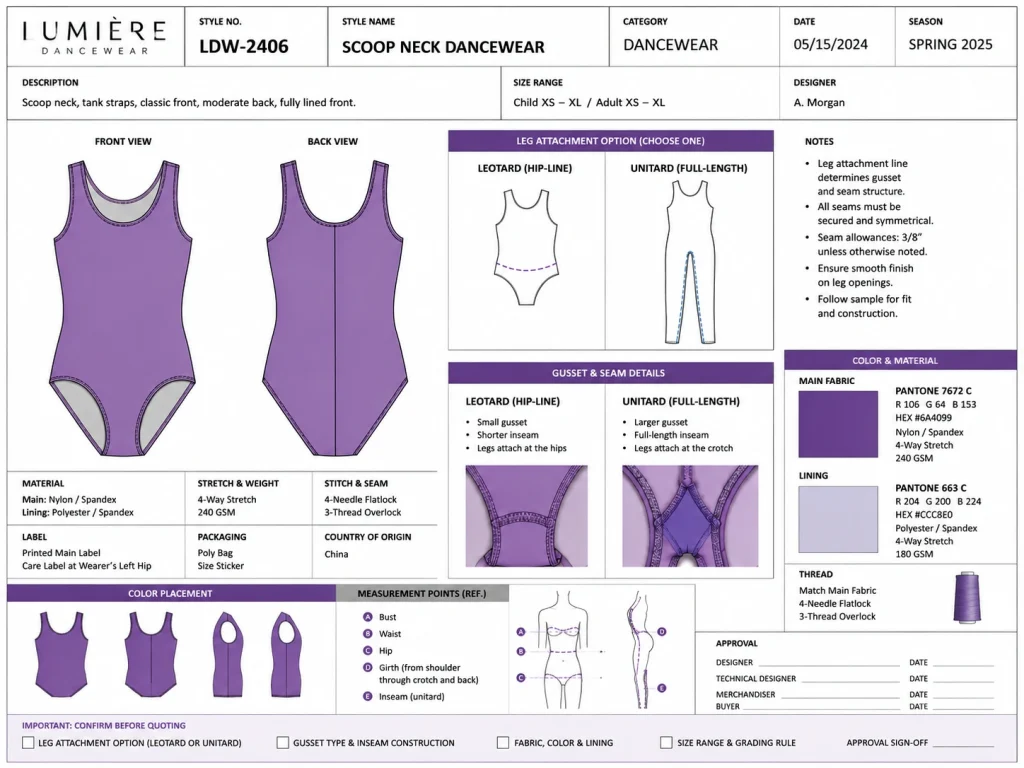
The checklist below is the minimum a factory needs to quote and build either piece accurately.
For quick reference, the spec fields that most often need clarification before quoting:
| Tech pack field | What to provide |
|---|---|
| Garment type | Leotard or unitard, with leg attachment line marked |
| Construction notes | Gusset, inseam, and leg finish method |
| Fabric | Composition, GSM range, stretch direction, recovery target, and any recycled or certified material claim |
| Color | HEX or Pantone code, not a photo reference |
| Logo/artwork | Vector file plus placement; AI renders confirmed in sampling |
A tech pack that locks these fields down moves straight to an accurate quote; gaps in any one of them are what pull a project back into extra sampling rounds.
Leotard vs bodysuit is the other comparison buyers run into, and the construction note is short but worth getting right. A bodysuit adds a snap or hook closure at the gusset so it can be opened for everyday wear and worn as a layering top under pants or skirts. A leotard stays seamless at that point because competition and training use cannot risk a closure popping mid-routine, and the uninterrupted gusset keeps the line clean for judged alignment.
So a bodysuit is built for fashion and convenience, while a leotard is built for performance security. If a brand is sourcing a piece for studio or competition use, the closure-free leotard construction is the one that holds up, and the bodysuit build belongs to the fashion or layering side of the line.
Often yes, but not always with the same result. The same knit can be used for both, though the unitard's full-leg build places more recovery demand on the fabric, so a weight that holds shape in a leotard may need adjustment for the unitard. Confirm the stretch and recovery target for each piece during sampling.
MOQ is usually quoted by style, color, and fabric program rather than by leg length alone, so a leotard and a unitard should be treated as separate styles in the order plan. If both pieces share the same fabric and color, confirm whether the factory can combine fabric purchasing while keeping the sewing and grading quotes separate.
Yes. Because the gusset, inseam, and leg finish differ, each build needs its own construction notes even if the body panel, neckline, and artwork are shared. A shared design file can carry both, but the construction page should be specified per piece.
Once you know whether your line needs a leotard or unitard build, the next step is to build a tech pack that the factory can quote against. Send your tech pack or a rough leg-attachment sketch—even a reference image, a size chart, and a logo is enough to start—and our team will confirm construction and pricing before you commit to bulk. With more than 13 years of custom apparel production experience, Runtang can help turn the first sample into a build that reflects what the garment can actually hold. Start the conversation with our leotard manufacturing team.
 Sourcing & Supplier Guide
Clothing MOQ Explained: What Apparel Brands Should Expect from OEM Factories
READ MORE Pajamas Related
What Makes Custom Pajama Sets the Ideal Gift | Personalized Sleepwear Guide
READ MORE Leotard Related
Dance Leotards: A Sourcing Guide for Studio Uniform and Private Label Programs
READ MORE Customization & Craft Guide
Tech Pack Clothing Manufacturer Guide: What to Include Before Sampling
READ MORE Customization & Craft Guide
Vintage Acid Wash T-Shirts OEM: Fabric, Wash Variables and What to Confirm Before Bulk
READ MORE