World Class Textile Producer with Impeccable Quality

World Class Textile Producer with Impeccable Quality

A new brand reaches out to an OEM factory. The factory replies: "MOQ is 100 pieces per style, per color." The brand sees a wall. What the brand doesn't see is why that number exists — and how it was calculated before the factory even opened the email.
MOQ is not a negotiating position. It is an output of how garment production is physically structured. Understanding what goes into that number — fabric procurement batches, machine setup sequences, dye lot thresholds — changes how brands approach their first bulk order. Instead of pushing back on the number, they can plan around the variables that actually control it.
This guide covers how OEM factories determine clothing MOQ, what factors move it up or down across different product types, and how apparel brands can structure their first SKU plan to work with that logic rather than against it.
MOQ — minimum order quantity — is the smallest number of units a factory will produce under a specific set of specifications. But that single phrase hides an important detail: how the "per" is defined.
Three different definitions are commonly used, and factories do not always make clear which one applies:
Most China-based OEM factories operate on the per-style-per-color model. This means that a brand placing an order for 3 styles across 2 colors each is effectively committing to 6 production units — not 1 order. At 100 pieces per unit, that is 600 pieces minimum across the order.
This distinction matters when brands are comparing factories. A factory quoting "MOQ 300" on a total-order basis may actually be more accessible for a brand ordering one hero style in one color than a factory quoting "MOQ 100 per style per color" with a five-style plan.
Before requesting samples or pricing, confirm how the factory defines its MOQ. One question is worth asking directly: does the minimum apply per colorway or across the full order?
Factories set MOQ levels because garment production carries fixed costs that do not scale down proportionally with order size. A production run of 50 units carries nearly the same setup burden as a run of 200 units — but the per-unit cost at 50 pieces is four times higher.
The main cost categories that drive MOQ thresholds:
Fabric mills typically work with minimum dyeing or production quantities that vary by fabric type, yarn composition, and supplier requirements. If a brand orders only a small quantity in a custom color, the factory may still need to purchase material above the actual garment requirement. The resulting excess inventory is one reason many OEM factories establish MOQ thresholds for custom production.
Factories with in-house knitting and dyeing operations can manage this more flexibly. When the fabric production is controlled internally, the threshold for a new color or a custom GSM run can be lower than when relying on external mills.
Switching a sewing line from one style to another takes preparation: pattern adjustment, presser foot changes, thread colour matching, tension calibration. This setup work requires dedicated labor time regardless of whether the production run is small or large. For a factory operating on tight scheduling, a run that is too small to justify that setup time is either declined or priced with a short-run surcharge that effectively raises the per-unit cost to the brand.
Screen printing requires physical screens — one per colour in the design, at a cost that must be recovered across the order. Embroidery needs digitization, which is a fixed one-time charge. Custom labels, woven tags, and drawcord tips all require minimum production quantities from their own suppliers before they can be incorporated into the garment. Each decorative or trim element adds its own minimum threshold on top of the base fabric and sewing minimums.
The table below shows how these cost layers combine across different product types, with typical MOQ direction as a result. Specific numbers vary by factory and are marked as directional only.
| Product Type | Primary Cost Driver | MOQ Direction | Key Variable |
|---|---|---|---|
| Basic cotton T-shirt | Fabric dye lot | Lower | Standard fabric often in stock |
| Fleece hoodie (custom color) | Fabric mill + dye batch | Mid to higher | Custom color triggers new dye run |
| Seamless leggings | Knitting machine program | Mid | Machine setup per pattern/size |
| Embroidered polo shirt | Embroidery digitization + frame | Higher | Setup cost fixed regardless of qty |
| All-over print activewear | Sublimation paper + ink + setup | Mid | Fabric type must be 100% polyester |
Note: "Lower" and "higher" are relative to typical OEM ranges. Actual minimums depend on factory size, internal capabilities, and order history with the buyer.
For brands building compliance-aware sourcing practices, the AAFA Supply Chain resources provide useful guidance on supplier accountability and production transparency.
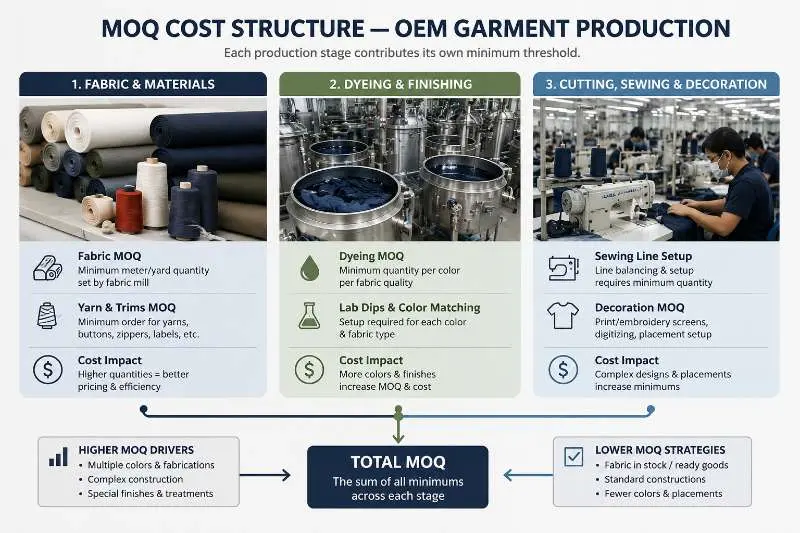
Of all the variables that affect clothing MOQ, two are most directly within a brand's control before they place a single order: how many colors they request, and which fabric they choose.
Each new color in a production run triggers a separate preparation sequence. For dyed fabrics, that means a new dye vat setup, which includes cleaning the equipment from the previous run, mixing the new colorway, and testing for batch consistency before the fabric goes into production. This is not trivial. A factory running three colorways is running three of these sequences, not one.
From the factory's perspective, a brand ordering one style in five colors is five separate mini-runs, not one efficient bulk run. The per-unit cost at low quantities can be disproportionately high, and the factory's MOQ threshold per color reflects that reality.
For brands early in their ordering relationship with a factory, limiting the initial order to two or three colorways — even if the eventual product line will carry more — allows the brand to meet MOQ thresholds without overextending their inventory commitment.
Standard, in-stock fabrics reduce MOQ pressure significantly. When a factory already has suitable fabric on the shelf — common GSM cotton jersey used in private-label T-shirt collections, standard fleece used for custom hoodie programs, or widely-used nylon-spandex blends for performance activewear lines — there is no mill minimum to navigate for that material. The order can proceed at the factory's normal production minimum without waiting on fabric procurement.
Custom fabric specifications change the calculation. A brand requesting a specific GSM outside the factory's stocked range, a custom fiber blend, or a particular finish (brushed interior, enzyme-washed surface) triggers external procurement. That external sourcing typically carries its own minimums from the mill, which the factory passes on to the brand either directly or embedded in a higher MOQ requirement.
Runtang operates with an in-house knitting mill and dyeing facility in Foshan. For brands working within our standard fabric range, the starting MOQ is 100 pieces per style, per color. For custom fabric development — specific GSM ranges, non-standard fiber compositions — we advise brands to discuss fabric procurement timelines and minimums during the inquiry stage before committing to a sampling plan.
Most guidance on clothing MOQ frames it as a barrier to overcome through negotiation — asking the factory to lower the number, promising future volume, or splitting an order across multiple products to hit a total minimum. These tactics exist, but they are secondary to a more effective approach: structuring the order so the MOQ works in the brand's favor from the start.
A few planning decisions that affect how MOQ requirements land in practice:
The brands that run into difficulty with MOQ are often those who approach it as a standalone number to challenge, rather than as an output of how their order is structured. MOQ should also be evaluated alongside broader production budgeting, since fabric sourcing, trims, and decoration methods all influence the final manufacturing expense. Brands unfamiliar with these variables can benefit from understanding how OEM clothing costs are structured before requesting quotations. When the order is designed with production economics in mind — fewer SKUs, standard materials, a realistic size curve — the minimum quantity becomes a natural fit rather than an obstacle.
Factories that offer genuine production flexibility, as opposed to low-MOQ claims that actually mean longer lead times or higher per-unit costs, typically have control over their own material supply. Vertically integrated operations — where knitting, dyeing, and garment assembly happen under one roof — can offer brands more consistent minimums across order cycles because there are fewer external dependencies to manage. MOQ is only one part of supplier selection. Brands should also review communication processes, production capabilities, and sourcing transparency when evaluating apparel manufacturing partners in China.
It depends on how the factory defines it — and this varies. Most OEM factories in China apply MOQ per style per color, meaning each style-and-color combination must independently meet the minimum. Some factories offer a total-order MOQ, where the minimum applies to the combined unit count across all styles. Always confirm the definition before submitting a purchase order, as it significantly affects how you structure your SKU plan.
Yes, in most cases. The MOQ per style per color is typically met by the total units across all sizes in that combination. A factory with a 100-piece minimum might accept a run of 10 XS, 30 S, 40 M, 15 L, and 5 XL — totaling 100 — rather than requiring 100 units in each size. Confirm the size distribution approach during the sampling stage, as some factories set minimum quantities per size for complex constructions.
Generally, no. Sample orders are priced and managed separately from bulk production. They serve to confirm fit, fabric, and construction before committing to the full MOQ. Some factories may credit part of the sample cost toward a future bulk order, depending on their commercial policy. Samples are not a mechanism to bypass MOQ; they are the step that makes the MOQ decision more reliable.
If you have a style direction in mind but are unsure how your color and SKU plan will land against factory minimums, share it with us. We can review the production structure and let you know where the starting quantity sits before you commit to sampling.
 T-shirts Related
The Charm of T-shirts Factory Custom Printing: A Good Helper for Brands
READ MORE Private Label & Brand Building
Starting a Clothing Brand with OEM Manufacturing: A Production Roadmap for Brand Founders
READ MORE T-shirts Related
How to Choose the Right T-shirt Garment Manufacturers to Create High-Quality Clothing
READ MORE Garment Material Insights
Corduroy Fabric Characteristics and Application
READ MORE Hoodies Related
How to Find a Hoodie Manufacturer for Your Clothing Brand
READ MORE