World Class Textile Producer with Impeccable Quality

World Class Textile Producer with Impeccable Quality

Key Sourcing Takeaways
Vintage acid wash T-shirts are one of the most consistently requested styles in streetwear and vintage-inspired brand development. They are also one of the categories most likely to produce a gap between what a brand approves in sampling and what arrives in bulk.
That gap rarely comes from poor factory execution. It comes from the nature of the process itself. Acid wash is a finishing technique applied after garment construction, and its outcome depends on a combination of fabric variables that most brands do not fully lock down before sampling begins. When those variables shift — even slightly — between the sample and the bulk run, the wash result shifts with them.
This guide covers what actually controls acid wash outcomes in OEM production, how to communicate wash expectations in a way a factory can act on, and what confirmation steps matter most for this specific category. The goal is to help brands enter production with a clear set of aligned expectations rather than discovering the gap at goods receipt.
Most garment categories in OEM production can be locked down through a design file or a tech pack. Once a silhouette, construction spec, and print artwork are approved in sampling, the factory has a clear reference to execute against at scale.
Acid wash does not work that way.
The visual result of an acid wash program is not determined by the design file — it is determined by the fabric itself. Specifically, by how the fabric's dye reacts to chemical treatment during post-production washing. A factory following the exact same wash procedure on two different fabric batches — even from the same supplier, even at the same GSM — can produce noticeably different results if the dye lot, yarn count, or finishing treatment varies between those batches.
This has a direct implication for brands: the fabric specification is not a secondary decision to be made after the style is confirmed. For acid wash programs, it is a primary decision that must be made before sampling, and it must be locked before bulk.
The other difference is that acid wash has no digital reference point. When a brand approves a screen print graphic, the factory has a file with exact colours and dimensions. When a brand approves an acid wash effect, the reference is a physical sample — and physical samples can drift between what was produced on a small sample run and what is achievable at batch scale. Understanding why this drift happens is the starting point for managing it.
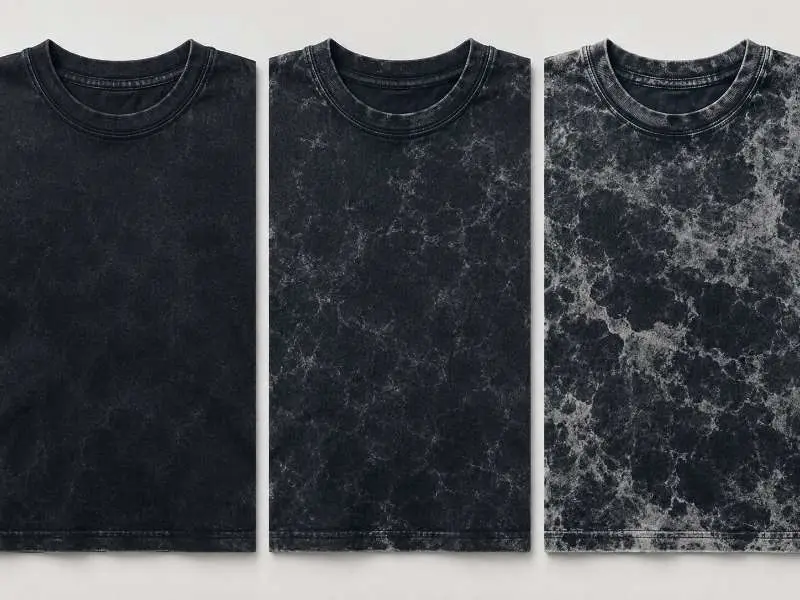
Acid wash outcomes in production are shaped by three interconnected variables. Each one needs to be understood and specified before a brand enters sampling, because changing any of them after a wash effect has been approved means the approval itself is no longer valid.
100% cotton vs cotton-polyester blends: For many classic vintage acid wash t-shirt references, 100% cotton is the safest starting point because the wash effect reads more clearly on cotton-rich fabric. Cotton-polyester blends can still be developed, but the factory should test the wash first because the cotton and polyester portions may react differently. If a blend is required for cost, hand feel, or performance reasons, confirm the achievable wash effect before approving the fabric for bulk.
Combed vs carded cotton: Combed cotton has a more uniform fibre alignment and a smoother surface. Acid wash on combed cotton produces a cleaner, more even fade with softer tonal gradients. Carded cotton has a coarser, more irregular surface, and acid wash produces a rougher, more pronounced texture with greater visual contrast — a stronger "distressed" character. Neither is better; they produce a different end result, and brands should be aware of which direction their reference sample was produced in.
What this means for your brand: Fabric composition must be specified in the tech pack before sampling begins. If the sampling team selects a fabric independently and the brand later requests a change — for cost, feel, or availability reasons — the wash result will change. Do not treat fabric selection as a background procurement decision on acid wash styles.
GSM determines how acid wash chemistry penetrates the fabric and how the finished garment holds up after treatment. It also affects which wash procedures are practical at a given weight.
The ranges below are directional starting points, not fixed production standards. Final GSM should be confirmed with the selected yarn count, knit structure, dye process and wash sample.
| GSM Range | Fabric Character | Typical Wash Result | Best Fit For |
|---|---|---|---|
| 160–200 gsm | Light to medium; chemical penetrates quickly | High contrast, aggressive fade; fabric more prone to surface damage under heavy treatment | Lighter streetwear drops; single-wash programs; brands wanting a clean, uniform fade rather than heavy distressing |
| 220–280 gsm | Medium-heavy; the most common range for vintage tees | Controlled fade, visible cloud patterning, strong hand-feel after wash | Streetwear and vintage brands; a common starting point for many acid wash OEM programs |
| 300 gsm+ | Heavyweight; requires longer wash cycles | Richer layered tones, pronounced texture, pronounced distressing | Premium heavyweight vintage lines; boxy or oversized silhouettes where fabric body is part of the brand identity |
The GSM range you select directly affects which wash procedures are feasible and what the end result will look like. A change in GSM after wash approval requires re-running the wash sample.
What this means for your brand: GSM is not just a fabric weight decision — it is a wash result decision. Brands that specify a GSM in their tech pack and then request a heavier or lighter option after sampling will need to treat that as a new wash program, not a minor adjustment. The cost and lead time of an additional wash sample should be factored into the development timeline from the start.
Reactive dye: Reactive dyes form a chemical bond with the cotton fibre. Acid wash treatment breaks down this bond selectively, creating the high-contrast cloud patterning that defines classic acid wash. This is the standard dye process for producing the look most brands associate with vintage acid wash T-shirts.
Pigment dye: Pigment dyes sit on the surface of the fibre rather than bonding with it. When this type of fabric goes through an acid wash or garment wash process, the result is a different kind of fade — more even, less contrasted, closer to what is often described as a "sun-faded" or "garment-dyed" effect. This is a legitimate aesthetic, but it is not what buyers usually mean when they ask for acid wash. Brands should know which dye process their reference sample was built on, because specifying the wrong one will produce a result that looks nothing like the reference.
What this means for your brand: When submitting a wash reference to a factory, confirm the dye process used in that reference. If you do not know, ask. If the factory cannot confirm, request fabric content details before proceeding to sampling.
For broader context on textile dyeing and finishing processes, brands can also review Textile World’s Dyeing Printing & Finishing coverage before discussing wash references with a factory.
One of the most consistent problems in acid wash OEM development is that brands rely on descriptions that seem clear but give the factory very little to work with. Understanding what does and does not constitute a workable reference is the difference between a first-sample hit and three rounds of revisions.
1. A physical wash reference sample (strongest option). A garment or swatch that shows the target wash effect. This gives the factory a direct visual and tactile reference. Even an approximate reference — a garment that is close to the direction, annotated to indicate what should be adjusted — is more useful than an image alone.
2. Wash depth instruction. Specify where on the spectrum the target effect sits. A working framework is: light wash (most original colour preserved, subtle fade, faint cloud pattern); medium wash (clear cloud patterning, significant colour reduction, moderate contrast); heavy wash (high contrast, large-scale bleaching, pronounced marbling effect). This gives the factory a wash intensity target even without a physical reference.
3. Distribution pattern instruction. Specify whether the wash effect should be uniform across the garment, concentrated in specific areas (chest, sleeve edges, hem), or randomly distributed. These are different wash procedures, and an instruction to produce one will not automatically produce another.
4. Full fabric specification. Composition (100% combed cotton), GSM, and dye process — all stated explicitly in the tech pack. This locks the substrate for the wash program.
5. Post-wash measurements. All measurement points should be taken and specified after the wash process is complete. Acid wash causes shrinkage — typically a few percentage points depending on fabric weight and wash intensity — and tech pack dimensions must reflect finished (post-wash) garment size, not pre-wash cut size.
Brands sourcing acid wash T-shirts for the first time often approach consistency the same way they approach print consistency: expect the bulk to match the approved sample exactly, and treat deviation as a quality failure.
This expectation is reasonable for printed garments. It is not a realistic expectation for acid wash, and entering a production relationship with it will cause problems that would have been avoidable with a different framework upfront.
Acid wash depends on a chemical reaction between a treatment solution and a dyed fabric. The variables in that reaction — wash cycle duration, water temperature, chemical concentration, machine load, and the specific characteristics of the fabric batch — are all controlled to specification, but they are never perfectly identical from one batch to the next.
The fabric itself is the largest source of variation. Even fabrics from the same supplier, same colour, same GSM, and same order will have natural lot-to-lot variation in dye uptake. That variation expresses differently once acid wash treatment is applied.
This is not a sign of a poorly run factory. It is the nature of a process that involves chemistry, natural fibres, and mechanical equipment. A factory operating with disciplined wash controls will produce consistent results within a reasonable tolerance range. Expecting results outside that range — either far better or far worse — misunderstands what the process can deliver.
The correct approach is to agree on a tolerance range with the factory before bulk begins — not to discover that a tolerance gap exists after goods arrive.
Formalising this in writing before bulk begins — even in an email exchange confirming the wash approval — gives both parties a shared reference point and removes ambiguity at goods receipt.
In standard garment production, a pre-production sample confirms that the factory can replicate the approved style at bulk scale. For most garment categories, this confirms construction quality, fit, and finishing.
For acid wash programs, the PP sample carries additional weight. It should be produced using the actual bulk fabric batch — same fabric lot, same dye batch, same GSM as what will be cut for production. This is important because the bulk fabric and the sampling fabric, even when ordered from the same supplier, may come from different dye lots. A PP sample produced on the sampling fabric batch does not confirm what the wash will look like on the bulk fabric batch.
If your team is still deciding whether the base fabric should be cotton, polyester, or a blend, review our cotton vs polyester t-shirt sourcing guide before confirming the wash sample. Acid wash development works best when the fiber decision is locked before the first garment wash test.
The following is a practical checklist for brands entering an acid wash t-shirt program. It is structured around the three stages where most problems originate: before sampling begins, during the sampling phase, and immediately before bulk is released.
These are two distinct confirmation steps. Treating a fit sample that happens to have been washed as the wash approval standard creates risk: if the silhouette is adjusted in a subsequent sample round, the wash will be re-run, and the result may shift.
The 220–280 gsm range is often a practical starting point for vintage acid wash t-shirts because it balances wash visibility, fabric body and durability. Lighter fabrics can create a cleaner fade but need tighter wash control. Heavier fabrics can show deeper texture, but they usually require more sampling to confirm wash depth and shrinkage.
Not exactly — but consistently within a defined tolerance range, yes. Acid wash outcomes depend on fabric dye lots, machine variables, and chemical reactions that cannot be perfectly replicated from run to run. What a well-run factory can deliver is a result that falls within the agreed reference range across batches. The key is establishing that range clearly before bulk begins, using a retained wash approval sample as the physical benchmark, and confirming each new batch against it. Brands entering a multi-season program with the same fabric and wash spec will typically see tighter consistency over time as the factory builds institutional knowledge of the program.
100% cotton is strongly recommended for programs where the target is classic acid wash cloud patterning. Cotton-polyester blends respond unevenly to acid wash chemistry — the cotton component bleaches while the polyester does not, producing a patchy result that most vintage-oriented brands do not want. Some blends can work with garment dye or enzyme wash approaches that produce a softer, more even fade, but these are different processes producing different results. If a brand has a specific blend requirement — for stretch, weight, or cost reasons — this should be discussed with the factory before sampling to understand what wash effects are actually achievable on that substrate.
A wash approval sample is a production-stage sample made specifically to confirm the wash direction before bulk fabric is cut. It differs from a fit sample in that its purpose is to establish the wash result — depth, distribution, character — as the agreed standard for bulk. Once approved, the factory retains the original as the production benchmark. Bulk garments are compared against this retained sample at QC. For acid wash programs, skipping the wash approval step — or conflating it with the fit approval — removes the shared physical reference that protects both parties if the bulk result is disputed. It is the most important confirmation step specific to this category.
Runtang supports custom washed tees from fabric selection through wash approval and bulk QC. For brands also developing acid-washed hoodies, the same approval logic applies: fabric weight, dye method, wash depth and batch repeatability should be confirmed before bulk. Our vintage hoodies wholesale guide explains how these wash-effect controls transfer from T-shirts to hoodie production. For brands building an initial one-stop OEM production, Runtang can support fabric selection, sampling, wash approval and bulk QC from one workflow.
 Pajamas Related
What Makes Custom Pajama Sets the Ideal Gift | Personalized Sleepwear Guide
READ MORE Garment Material Insights
Nylon vs Polyester Activewear: A Fabric Decision Guide for Apparel Brands
READ MORE Garment Material Insights
Corduroy Fabric Characteristics and Application
READ MORE Top Clothing Manufacturer Recommend
Top 8 Activewear Manufacturers in China
READ MORE Top Clothing Manufacturer Recommend
Top 8 Clothing Manufacturers Around the World
READ MORE