World Class Textile Producer with Impeccable Quality

World Class Textile Producer with Impeccable Quality
Key Sourcing Takeaways
Clubs sourcing gymnastics competition leotards in bulk need to confirm fabric, decoration, sizing, and production timing before sampling starts. A design that looks strong on screen can still fail in production if the fabric base, crystal layout, logo placement, and size grading are not locked early — these are the same checkpoints Runtang's production team walks through before cutting starts on any club-branded order. This guide explains what club buyers should prepare before placing a custom OEM leotard order, especially when youth, junior, and adult sizes must match across one team lineup.
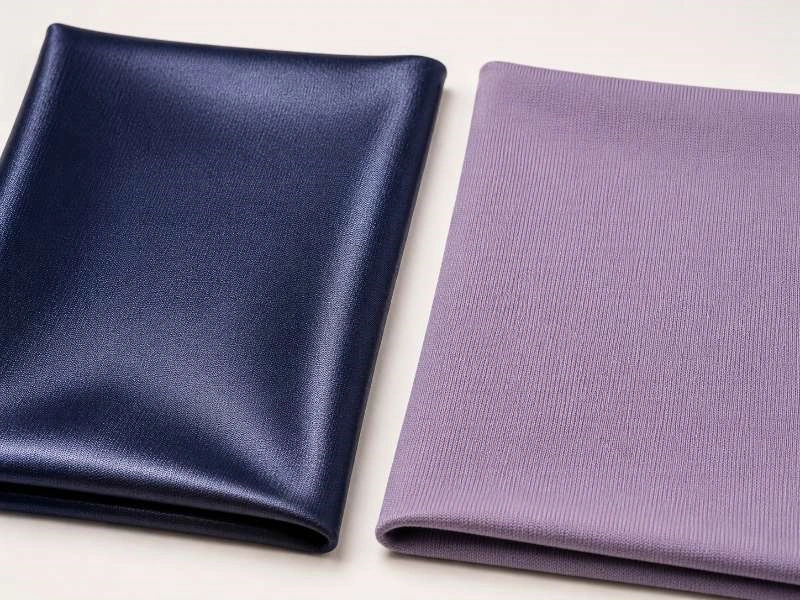
Fabric choice for gymnastics competition leotards comes down to a trade-off between visual performance under stage lighting and per-unit cost. Velocity-style high-sheen knits are often selected for competition pieces because they create a brighter surface under arena lighting and can support a more polished visual finish than basic nylon-spandex blends. Standard nylon-spandex blends remain a reasonable choice for training-to-competition crossover orders where budget matters more than maximum visual impact. Both fabric directions sit on the same nylon vs polyester activewear fabric tradeoffs that apply across performance categories beyond leotards.
Where the design uses full sublimation, clubs should confirm a polyester-spandex base before artwork is approved; nylon-spandex is better suited to solid-color styles, contrast panels, logo placement, or crystal-heavy decoration rather than all-over sublimated graphics.
| Fabric Type | Best Suited For | Stretch & Recovery | Cost Direction |
|---|---|---|---|
| Velocity/high-sheen knit | Competition leotards performed under stage or arena lighting | Usually selected when a stronger visual structure and surface sheen are required | Higher cost per unit due to specialty knit construction |
| Standard nylon-spandex blend | Training leotards and budget-driven competition orders | Good stretch; recovery may decline faster with heavy wash and wear cycles | Lower cost, widely available across MOQ tiers |
For teams competing under stage lighting where visual sheen affects how a routine reads to judges, velocity-style fabric is the stronger choice despite the cost premium. Budget-driven orders that crossover between training and lower-stakes competitions can stay with standard nylon-spandex blends without a major performance trade-off.
Clubs comparing fabric direction in more depth before finalizing a Tech Pack can review our leotard fabric guide for brand buyers for a closer look at stretch performance across leotard-specific fabric categories. Most of this fabric range is produced through our custom leotards line, where teams can match fabric selection to their competition schedule.
Most competition leotard designs combine more than one decoration method rather than relying on a single technique for the entire garment. Sublimation printing handles all-over color and gradient transitions because the dye becomes part of the polyester fiber rather than sitting on top of it. Rhinestone heat-transfer and hand-placed crystals add the sparkle that stands out under arena lighting — this is especially true for rhythmic gymnastics leotards, where crystal coverage and movement under lighting are part of how a routine reads to judges — and silicone logos give club branding a durable, peel-resistant finish on flexible fabric.
| Decoration Method | Best Use Case | Durability Direction | Note |
|---|---|---|---|
| Sublimation printing | All-over color and gradient designs across the full leotard | High color is part of the fiber and does not peel | Requires a polyester-based fabric base |
| Rhinestone heat-transfer | Accent placement for stage visibility | Moderate — bonding depends on the application method and wash care | Typically layered on top of a sublimated base, not used standalone |
| Silicone logo | Club name or logo placement | High — resists peeling on stretch fabric | Limited to smaller logo areas, not full-coverage designs |
For club competition orders, decoration should be approved as a layered system: sublimation first for the shared team artwork, then rhinestones for stage visibility, and finally silicone logos or numbers only where they do not conflict with seams, stretch zones, or crystal placement. This keeps the same design readable across youth, junior, and adult sizes instead of treating each decoration method as a separate decision.
Decoration materials such as rhinestone adhesives and transfer films should be reviewed against chemical restriction guidance, such as the AAFA Restricted Substances List (RSL).
Because sublimation, rhinestone placement, silicone logos, and packaging all affect unit cost, clubs should review the pricing breakdown before finalizing decoration layers.
A complete Tech Pack prevents the most common rework cycle in club leotard orders: discovering a logo placement or color mismatch after the first sample arrives. Five elements need confirmation before cutting starts.
This sequence mirrors the broader process covered in our custom leotards OEM ordering guide, and the same Tech Pack discipline applies across the broader OEM production workflow for other activewear categories.
Clubs ordering the same leotard design across youth, junior, and adult divisions face a grading risk that single-size orders don't: a pattern grade that fits the adult size chart correctly can distort proportions — neckline depth, leg cut angle, crystal spacing — when scaled down for youth sizing without separate grading checks. With 15-plus years of garment production experience, Runtang treats youth, junior, and adult competition leotards as separate grading groups rather than one pattern scaled up or down. If your team has past fit complaints — for example, neckline pull, leg opening pressure, or crystal placement shifting on smaller sizes — include that feedback in the Tech Pack before size-set sampling.
Sampling and bulk production timing should be confirmed before the club locks its competition calendar. As a working rule, buyers should allow time for design confirmation, sample review, crystal placement approval, size-set checks, and bulk production instead of assuming a rush order can be added close to the meet date.
Use this approval sequence before confirming a meet-date delivery plan:
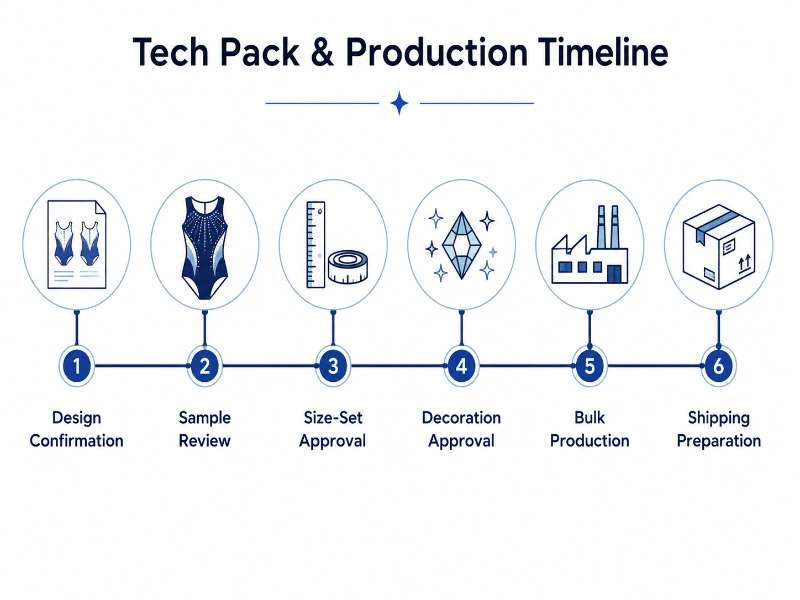
Before submitting a bulk order for gymnastics competition leotards, confirm these five points to avoid the most common delays and mismatches in club orders.
For Runtang custom leotard orders, the regular MOQ starts from 100 pieces per style/color. A simple team design is easier to arrange at this level, while rhinestone-heavy layouts, multiple size groups, or several colorways may need a separate MOQ review before sampling.
Yes. A sample should be arranged after the color codes, fabric direction, logo placement, and the crystal placement diagram are confirmed, so the club can approve the design before bulk cutting starts.
Yes. Club leotard orders can include woven labels, size labels, hang tags, and branded poly bags. For team distribution, confirm whether packaging should be grouped by athlete name, size division, or style/color before bulk packing starts.
Treat rush production as the exception rather than the plan: capacity for rush requests varies week to week at the factory, so competition-season orders are safer when backward-planned from the meet date instead of booked at the last minute. If a rush need does come up, your production partner can confirm that week's capacity on a case-by-case basis.
Have a club design in mind? Share your tech pack or a rough sketch — including team colors, crystal placement, and your size breakdown — and we'll get back to you with a sample timeline that fits your competition date. You can also reach our team directly through our contact page.
 Leggings Related
A Must-Read for Professional Sportswear Brands: How to Customize the Best Fleece Lined Leggings
READ MORE Leotard Related
Gymnastics Competition Leotards: Custom Design, Print and Bulk OEM Guide for Clubs
READ MORE Pajamas Related
How Social Media Is Driving Christmas Pajama Sales
READ MORE Sourcing & Supplier Guide
China Clothing Suppliers: How Apparel Brands Should Evaluate and Start an OEM Partnership
READ MORE Top Clothing Manufacturer Recommend
Top 8 Activewear Manufacturers in China
READ MORE