World Class Textile Producer with Impeccable Quality

World Class Textile Producer with Impeccable Quality

Key Sourcing Takeaways
Picking the wrong base fabric for a dance leotard order shows up fast — competition leotards that go sheer under stage lights, sublimated designs with poor color reliability after washing, or training styles that lose their stretch after a season of practice. For brand buyers and dance studios planning bulk OEM production, the fabric decision needs to match the leotard's actual use case — competition, printed design, or daily training — rather than defaulting to whichever blend a supplier has in stock. This guide breaks down which fabric works for each application, with the GSM and fiber ratios apparel buyers should be specifying on their tech pack.
Cotton dance leotards and their stretch-blend counterparts are all built on a similar gusset-and-shoulder-strap pattern, but the fabric underneath does very different jobs depending on where the leotard gets worn.
A leotard headed for a competition floor needs opacity under lighting and a snap-back stretch that survives splits and leaps. A leotard carrying a full sublimated print needs a base fiber that actually holds dye rather than letting it sit on the surface. A leotard worn three times a week in a studio needs to stay comfortable against the skin for hours at a time without the dancer overheating.
Treating these as a single fabric decision is where bulk orders go wrong — specifying the same nylon-spandex across a sublimated team order can create color reliability problems in bulk production, because polyester-based fabric is the safer base for reliable sublimation results. The fabric call should follow the leotard's job, not the other way around, and it is worth locking in before the first sample is cut. For brands still finalizing construction details such as lining, gusset reinforcement and back opening support, Runtang's custom leotard ordering guide covers the structure decisions that should be confirmed before bulk production.
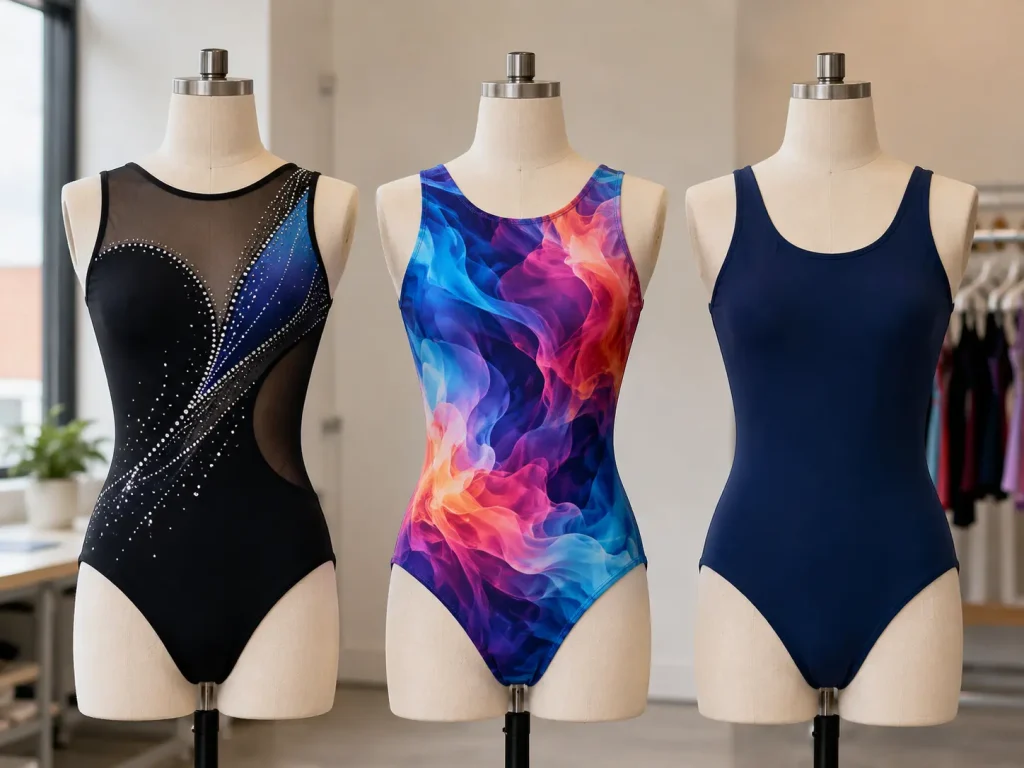
For competition, recital and most performance leotards, nylon-spandex is the standard base fabric, typically built at 180–210 GSM. Within that weight range, the fiber ratio shifts the trade-off.
80/20 nylon-spandex carries the highest spandex content of the common ratios and gives the most four-way stretch and recovery, which is why it shows up most often in gymnastics and competitive dance leotards that need to survive splits, leaps and tumbling without bagging out over a season of use.
82/18 sits in the middle and is a common general-purpose ratio for studio recital leotards that need solid stretch without the extra cost of higher spandex content.
85/15 nylon-spandex carries the least spandex of the three and the most structure, which makes it the better choice for skirted or fully lined competition styles where the bodice needs to hold its shape under embellishment rather than stretch as freely as a plain leotard. Brands ordering at bulk should confirm which ratio their factory is cutting against on the tech pack, since the difference shows up directly in how the leotard fits after repeated stretching, washing and stage use.
This nylon-versus-polyester call for leotards is driven by opacity and sublimation fixation — a different decision factor from the compression, opacity and recovery checks used in gym leggings production.
Any leotard order built around an all-over sublimated design should start with a polyester-spandex base. Dye sublimation performs best when the ink can bond into polyester fibers under heat, so higher polyester content normally gives more reliable color depth and wash durability. For nylon-spandex leotards, treat sublimation as unsuitable for bulk production unless the factory has already tested and approved that exact fabric, heat setting and print workflow before sampling.
The exact spandex percentage in these print-ready blends varies by supplier and should be confirmed on the tech pack, but the trade-off direction holds either way: polyester-spandex leotards may give up some stretch range compared with nylon-spandex in exchange for a printed design with more reliable color performance after washing and stage use.
Cotton dance leotards built on a cotton-spandex base are a better fit for daily class wear, warm-up styles and entry-level kids' leotards when brands prioritize softer hand feel and lower-impact studio use over maximum stretch recovery.
For training styles, the main reason to keep cotton-spandex on the option list is not performance stretch, but sample-tested comfort, hand feel and fabric behavior after washing. The final comfort level still needs to be checked by fabric sample, because yarn quality, knit structure, GSM, dyeing and finishing all affect how the garment feels against the skin. For technical background, Cotton Incorporated Fiber Processing Research is a better source for cotton raw material properties, yarn quality and processing research than for a direct leotard-specific breathability ranking.
The trade-off is stretch recovery: cotton-spandex typically loses its snap-back faster than nylon-spandex or polyester-spandex after repeated washing and stretching, so it is not the right base fabric for competition or performance styles that need to hold shape through high-impact movement season after season.
For younger or sensitive-skin dancers specifically, full-lining and spandex-ratio decisions get more involved than a standard training leotard — that is, a separate construction question covered in depth in Runtang's toddler gymnastics leotard fabric guide.
The table below summarizes the three application paths and their typical fabric specs side by side.
| Application | Typical GSM & Ratio | Key Advantage | Watch For |
|---|---|---|---|
| Competition & Performance | Nylon-Spandex, 80/20–85/15, 180–210 GSM | Highest stretch recovery and opacity under stage lighting | Higher spandex ratio (80/20) costs more and is less structured for skirted styles |
| Sublimation-Printed | Polyester-Spandex ratio confirmed by tech pack | Most reliable base for all-over sublimation printing | Slightly less stretch range than nylon-spandex |
| Training, Kids & Daily Wear | Cotton-Spandex | Softer hand feel for lower-impact training programs | Stretch recovery degrades faster; not suited to competition-grade construction |
For most bulk orders, the GSM and fiber ratio should be locked to the leotard's primary use case first — competition, print, or training — rather than chosen by cost alone, since switching base fabric after sampling typically means re-cutting the whole order from scratch.
Nylon-spandex at 180–210 GSM is the standard base for competition leotards, typically in an 80/20 or 82/18 ratio for maximum stretch and recovery. 85/15 nylon-spandex is a better fit when the design includes a skirt or heavy embellishment that needs more structure than stretch.
For bulk all-over sublimation, polyester-spandex should be used as the base fabric. Nylon-spandex should only be considered if the factory has tested and approved the exact fabric, heat setting and print workflow before sampling.
Basic cotton-spandex training styles can follow the 100 pieces per style per color baseline. Embellished or sublimated competition styles may require a higher MOQ when print, rhinestone or decoration setup is handled separately.
Yes, but each fabric based on the same order is usually treated as a separate production setup. A team ordering both sublimated competition leotards and plain cotton-spandex training leotards should confirm the MOQ for each fabric base separately, rather than combining both into one threshold.
Have a tech pack ready, or just a rough sketch of your next leotard line? Share your design and the application it is built for — competition, print, or training — and we will confirm the right fabric base before you sample. Explore Runtang's custom leotard manufacturing capabilities to get started.
 Pajamas Related
How to Quickly Lay Out the Christmas Pajama Market
READ MORE Sourcing & Supplier Guide
China Clothing Suppliers: How Apparel Brands Should Evaluate and Start an OEM Partnership
READ MORE Top Clothing Manufacturer Recommend
Top 8 Clothing Manufacturers Around the World
READ MORE Hoodies Related
How to Choose the Best Fleece Hoodie: A Complete Guide for Hoodie Fleece Fabric
READ MORE Customization & Craft Guide
Garment Print Methods Compared: Screen Print, DTG, Heat Transfer and Sublimation
READ MORE