World Class Textile Producer with Impeccable Quality

World Class Textile Producer with Impeccable Quality

Key Sourcing Takeaways
Polo shirts look straightforward on the surface. But when you start building a custom line — whether that's a corporate uniform program, a golf range collection, or a brand's sportswear launch — the fabric construction underneath becomes one of the most consequential decisions you'll make before sampling.
Three knit structures dominate polo shirt production: piqué, interlock, and jersey. They share similar weight ranges on paper, but deliver completely different results in terms of logo performance, drape, durability, and how they behave at scale. Brands that spec the wrong construction often find themselves back at square one after the first sample — or, worse, after bulk delivery.
This guide walks through each fabric type from a production standpoint, so you can align your polo specification with your decoration method and brand positioning before the tech pack goes to the factory.
All three major polo constructions are knitted fabrics — meaning they're built from interlocked loops of yarn rather than woven threads. That's what gives polo shirts their stretch, recovery, and comfort. But the way those loops are constructed changes everything about how the finished garment looks, feels, and performs under decoration.
The table below summarises the key production-level differences across piqué, interlock and jersey:
| Fabric | Knit Structure | Weight Direction | Surface Texture | Primary Polo Use |
|---|---|---|---|---|
| Piqué | Textured knit with raised surface | Usually midweight, factory to confirm | Waffle/honeycomb texture | Corporate, golf, sport |
| Interlock | Double-knit with smooth faces | Usually mid-to-heavier direction | Smooth both sides | Premium/fashion brand |
| Jersey | Single-knit, flat face | Usually light-to-midweight | Smooth face, textured back | Casual/high-volume |
Weight direction should be confirmed during fabric development based on yarn count, fibre blend, collar structure and decoration method.
Piqué is the polo shirt fabric most buyers picture when they place an order. Its honeycomb or waffle surface isn't just a visual signature — it's a structural feature that affects how the garment performs across the entire product lifecycle.
For brands, the practical advantages come down to three things:
The main consideration when speccing piqué is the fibre blend. Cotton piqué is the most common request, but polyester-cotton blends (typically 65/35 or 50/50) are widely used in performance and workwear applications for moisture management. For brands building a custom polo shirt line for uniform or sport use, confirming the blend ratio upfront avoids a late-stage resample when the hand feel doesn't match expectation.
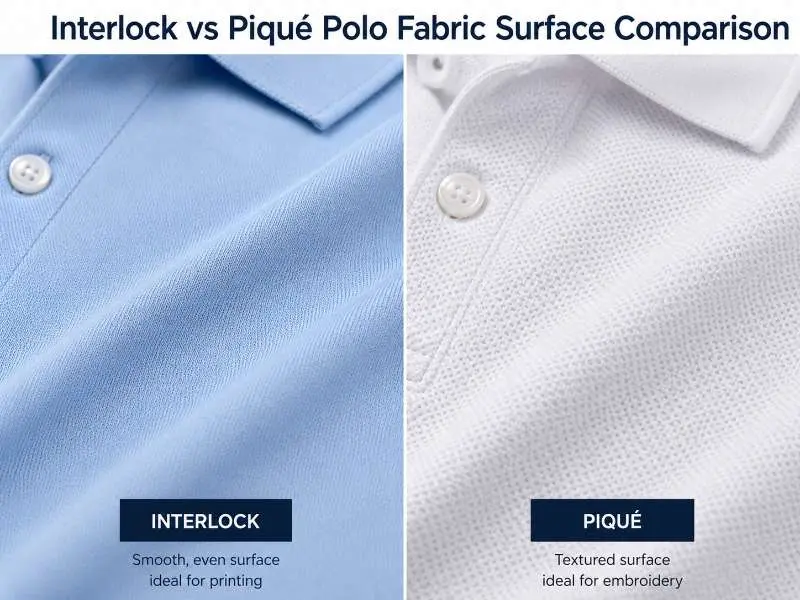
Interlock is sometimes confused with piqué because both are double-knit constructions. The difference is in the surface: interlock produces two smooth, identical faces by interlocking two separate rows of stitches on a circular knit machine. There is no raised texture.
For polo shirt production, this changes the decoration equation:
The practical trade-off is cost. Interlock typically carries a higher fabric price than jersey at similar weight, and the double-knit construction means slightly longer knitting time in production. For brands planning a smaller MOQ entry order, this is worth factoring into the initial budget.
Brands evaluating interlock alongside other premium knit categories, such as custom hoodies in French terry or fleece, should treat fabric density as part of the price-positioning decision. A smoother, more stable knit can support a higher-end product line, but the added fabric cost needs to fit the brand's target margin before sampling begins.
Jersey is the same single-knit construction used in most T-shirts. In polo shirt form, it produces the lightest, most affordable option of the three — and the most print-friendly surface for large-format graphics.
For brands, the key use cases are:
The technical consideration that often gets missed is collar and placket construction. Piqué and interlock usually hold collar shape more easily, while jersey needs a clearer rib specification and placket interfacing note in the tech pack. Brands already sourcing jersey knit apparel at scale, such as T-shirts, can use jersey polo shirts as an extension of their existing fabric programme, but they should expect extra collar sampling before bulk sign-off.
The right fabric construction depends less on personal preference and more on three sourcing-level factors: how you're decorating the garment, where it sits in your brand's price architecture, and what your production volume looks like at launch.
If you are still defining collar shape, placket style, logo placement and overall garment details, it is better to design polo shirts before locking the fabric construction.
The decision table below maps these factors to the most appropriate construction:
| Your Priority | Piqué | Interlock | Jersey |
|---|---|---|---|
| Embroidery logo (chest/sleeve) | Best choice | Works well | Collar needs extra spec |
| Screen print/heat transfer | Texture may affect ink bond | Best choice | Works well |
| DTG/large-format graphic | Not recommended | Works well | Best choice |
| Premium/elevated positioning | Standard premium | Best choice | Risk of T-shirt read |
| High volume, cost-sensitive | Mid-range cost | Higher fabric cost | Most cost-efficient |
| Corporate uniform/workwear | Industry standard | Premium alternative | Collar stability risk |
Use this as a starting framework — the final construction choice should be validated at the sampling stage, where collar drape, embroidery density and logo placement can be tested on a physical garment.
If you are also comparing factory options, sourcing timelines and sampling steps, this separate guide to polo shirts from China can help you plan the next stage after fabric selection.
One more practical note: when submitting a tech pack to a factory, specify the construction — not just the fibre content. "100% cotton polo" tells a production team very little. "100% combed cotton piqué, factory-confirmed GSM" gives them an actual starting point. The same applies to polyester-cotton blends, where the ratio affects both the hand feel and the decoration method compatibility.
For technical terminology, the Cotton Incorporated textile glossary is a useful reference when aligning fabric construction language in an RFQ, especially for knitting, circular knitting and construction-related terms.
Both are double-knit constructions, but piqué has a raised, textured surface while interlock is smooth on both sides. Piqué is the standard for embroidered corporate and sport polo shirts; interlock is better suited to print decoration and premium brand positioning.
Piqué is usually the safest choice for embroidery logos because its textured surface supports stitch definition and helps reduce visible puckering. Interlock can also work well, especially at a stable midweight. Jersey requires more careful stitch-density testing because the lighter single-knit base is more prone to distortion.
GSM depends on the fabric construction, yarn count, fibre blend and end use. Piqué and interlock polo shirts usually need enough weight to support the collar and placket, while jersey polo shirts can stay lighter for casual or promotional programs. Confirm the GSM with the factory during sampling rather than copying a generic range from another product.
Yes, but the collar and placket specification in the tech pack needs more detail than for piqué or interlock. Jersey is a single-knit fabric with less inherent structure, so the rib specification, interfacing, and placket construction all require explicit instruction to achieve a collar that reads as a polo rather than a T-shirt neckline.
If you're developing a polo shirt line and haven't locked in the fabric construction yet, that's the right stage to involve your production partner. Share your decoration method, target positioning, and any reference samples — and the factory team can advise on the most appropriate knit construction before the tech pack is finalised. Get in touch to discuss your polo shirt spec.
 Hoodies Related
Hoodie Materials Compared: Which Hoodie Fabric Suits You Best?
READ MORE Top Clothing Manufacturer Recommend
Top 8 Clothing Manufacturers in China
READ MORE Private Label & Brand Building
Starting a Clothing Brand with OEM Manufacturing: A Production Roadmap for Brand Founders
READ MORE Pajamas Related
Halloween Family Pajamas 2025: Checker Bats, Candy-Stripe Bones & Retro Ghosts
READ MORE Garment Material Insights
Hoodie Fabric Guide for Apparel Brands: French Terry, Fleece and Cotton Compared
READ MORE