World Class Textile Producer with Impeccable Quality
World Class Textile Producer with Impeccable Quality

Fit errors are one of the most expensive problems in bulk apparel production — and most of them start before the factory cuts a single piece of fabric. When a brand's size specifications are incomplete or inconsistent, the factory interprets the gaps, the pre-production samples come back wrong, and the back-and-forth begins. By the time the issue surfaces in bulk, the cost in time, shipping, and remake fees is high.
The root cause, in most cases, is not a manufacturing error. It is an incomplete or misread size submission. This guide covers what brands need to prepare on the sizing and grading side before placing an OEM order — what to include, how to verify it at the sample stage, and where the common mistakes happen.
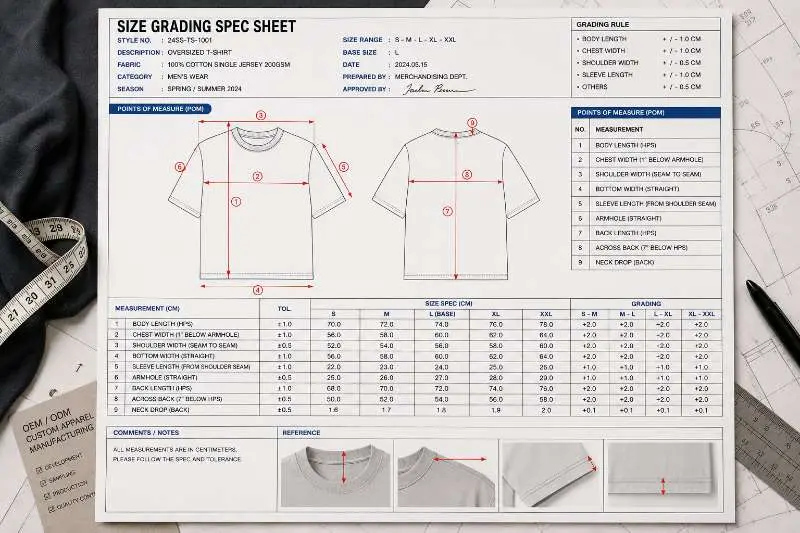
Size grading is the process of adjusting a base pattern up and down across your full size range. It is not a uniform scale-up — each point of measure (POM) on the garment follows its own increment rule, and those rules are set by the brand, not the factory.
In OEM production, grading becomes a practical handoff document. The factory receives your base size sample and your graded spec sheet, then produces all other sizes by following the increment rules you have defined. If those rules are missing, unclear, or inconsistent across measurement points, the factory will either ask for clarification (which adds lead time) or make a judgment call (which adds risk).
The base size is typically the size from which your first sample is developed — most commonly a Medium for adult tops, or whatever size your fit model represents. All other sizes in your range are derived from this base. Confirming the base size explicitly in your tech pack prevents a common source of confusion when factories assume a different starting point.
ASTM publishes standardized sizing tables for various apparel categories, and some factories default to these when a brand does not provide its own grade rules. However, ASTM standards are developed for broad market reference, not for any individual brand's fit intent. Relying on factory defaults often produces a size run that is technically proportional but does not match your brand's fit positioning — especially for categories like activewear or fitted silhouettes where small measurement differences have a visible effect on how the garment performs.
For reference on standardized measurement categories, see ASTM Textile Standards — though your brand's own grade rules should always take precedence in OEM submissions.
A consumer-facing size chart — the kind that shows body measurements alongside size labels — is not what a factory needs. What the factory needs is a garment measurement specification: the actual dimensions of the finished garment at each point of measure, across every size in your range.
These two documents serve different purposes, and submitting the wrong one is one of the most common errors brands make in their first OEM engagement.
| Element | What to Include | Common Gap |
|---|---|---|
| POM List | Every measurement point labelled consistently (e.g., chest at 1" below armhole) | Vague labels like 'chest' without measurement position |
| Measurement Method | Flat or circumference; half or full — stated explicitly for each POM | Inconsistent method between POMs causes factory confusion |
| Grade Increments | The size-to-size increment for each POM across the full size run | Missing increments; factory defaults to uniform grade |
| Tolerances | Acceptable + / - deviation per POM (e.g., ±0.5 cm on chest) | No tolerance stated — factory cannot know what is acceptable |
| Base Size Label | Clearly mark which size is the base (the sample size) | Factory assumes a different base and grades from the wrong starting point |
The table above covers the minimum required components. Any POM that appears in your spec without a grade increment or tolerance will be filled in by the factory's judgment — which may or may not match your brand's intent.
Your size spec is not a standalone document — it is a core section of your tech pack. Factories that work with proper OEM workflows expect to receive size specifications as part of a complete tech pack submission, not as a separate spreadsheet sent after sampling has begun.
For a full breakdown of what a tech pack should contain before submission, see clothing tech pack requirements for OEM production.
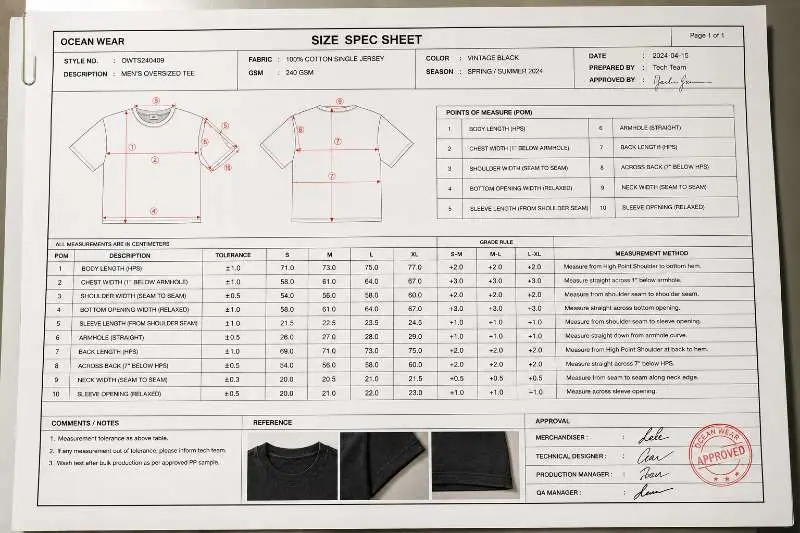
Approving a single sample in your base size does not confirm that grading has been applied correctly. Grading errors only become visible when you measure across the size range — and if you catch them at the pre-production sample stage, corrections are still straightforward. Catching them after bulk cutting is a different situation entirely.
A size set sample is a pre-production run that includes one unit from each size in your range, produced using the graded spec. Requesting a size set before approving bulk production is a recommended checkpoint for brands ordering across more than two sizes. Reviewing only the base size sample tells you whether the fit is correct in that one size — it tells you nothing about whether the grading increments have been correctly applied to the rest of the range.
For brands ordering custom t-shirts or similar cut-and-sew pieces, the size set review should focus on chest, body length, and sleeve length as the three highest-impact POMs. For stretch categories such as gym leggings or activewear bottoms, waist relaxed and stretched, hip circumference, and inseam length require particular attention because stretch fabrics behave differently when graded — a nominal increment may produce a different functional fit depending on the fabric's recovery properties.
See Runtang's custom t-shirt production capabilities and gym leggings OEM options for category-specific production context.
When reviewing size set samples, measure against your spec sheet and record the actual measurement alongside the specified measurement for each POM. Any deviation outside your stated tolerance should be flagged in writing, with the actual measurement, the specified measurement, and the tolerance range noted for each affected point.
Verbal feedback on fit — "the chest feels tight" or "the length seems short" — is not actionable for a factory. A numbered measurement chart with deviations marked is. The clearer your written feedback, the fewer rounds of correction are needed before bulk approval.
Most fit-related bulk production problems trace back to a small set of repeatable errors in how brands submit their size grading information. Understanding these patterns helps brands catch the problem upstream, before a bulk run is cut.
If chest increases by 1 inch per size but side seam length stays fixed across all sizes, the garment proportions shift as the size goes up. For brands ordering woven tops or structured outerwear, this kind of inconsistency tends to produce correct fit in the base size and increasingly poor fit in the extremes. Each POM should have a defined increment, and those increments should reflect how the garment is meant to fit across the full range — not just how a single measurement scales.
Stretch fabric grades differently from woven fabric. A brand ordering seamless leggings or compression activewear that applies woven-fabric grade rules will typically see progressively worse fit as sizes increase. For stretch categories, the grade increment on key POMs like waist and hip should account for the fabric's stretch percentage and intended compression level. This is best confirmed during the size set sample stage, not assumed from the spec alone. The specific adjustments depend on fabric construction and are best discussed with the production team during the sampling stage.
Approving a bulk order based on one size sample — even a well-fitting one — does not confirm grading accuracy. The sample confirms fit at the base size. It does not confirm that the factory has correctly applied grade rules across the other sizes. Requesting a size set for review before bulk approval is the standard checkpoint that catches grading errors while corrections are still practical.
A body measurement chart shows what body dimensions correspond to each size label. A garment spec shows the actual finished measurements of the garment. Factories work from garment specs — they cannot reverse-engineer your intended ease, fit preference, or silhouette from body measurements alone. Submitting body measurements in place of a garment spec is one of the most consistent causes of first-sample errors in new OEM relationships.
| Mistake | What Happens | How to Avoid |
|---|---|---|
| Inconsistent grade increments | Fit degrades in larger/smaller sizes | Define a grade increment for every POM |
| No stretch adjustment | Compression/fit varies unpredictably by size | Discuss stretch-specific grading with factory during sampling |
| Approving from one size sample | Bulk has correct base size fit, other sizes untested | Always request a size set before bulk approval |
| Body chart vs garment spec | Factory cannot determine intended garment dimensions | Submit finished garment measurements, not body reference |
Each of the four mistakes above is correctable at the pre-production stage. The same errors found after bulk cutting are not.
POM stands for point of measure — a specific location on a garment where a measurement is taken. Common examples include chest width (measured a set distance below the armhole), body length (from the high point shoulder to the hem), and sleeve length (from the shoulder seam to the cuff). Each POM in a spec sheet should include the exact position and measurement method so the factory measures consistently across all production units.
Yes. A Chinese OEM factory can follow your grade rules when they are clearly provided in the tech pack. If they are missing, the factory may ask for clarification or apply an internal reference rule. Providing your own grade rules as part of your tech pack submission is the most reliable way to ensure your size run fits the way you intend.
For a first order, many early-stage brands choose a focused three- to five-size range to control SKU complexity before the fit is fully validated. The more practical question is whether to request a size set sample for all sizes before bulk approval. For a three-size run, reviewing all three at the pre-production stage is straightforward. For a wider range, reviewing at minimum the base size, the smallest, and the largest will surface any grading issues that affect the extremes.
Not sure whether your size spec is factory-ready? Share your tech pack or a rough measurement chart — we'll review what's there and let you know what needs to be confirmed before sampling.
 Top Clothing Manufacturer Recommend
Top 8 Hoodie Manufacturers in China
READ MORE T-shirts Related
Cotton vs Polyester T-Shirt: Which Fabric Works Better for Bulk Brand Orders
READ MORE Leotard Related
Custom Dance Costumes OEM: How Studios and Brands Order in Bulk from China
READ MORE T-shirts Related
How to Choose the Right T-shirt Garment Manufacturers to Create High-Quality Clothing
READ MORE Top Clothing Manufacturer Recommend
Top 8 Clothing Manufacturers in China
READ MORE