World Class Textile Producer with Impeccable Quality

World Class Textile Producer with Impeccable Quality

Key Sourcing Takeaways
Most brand buyers finalize their garment designs, fabrics, and colorways before giving labels a second thought. By the time bulk production is ready to start, labels are still being proofed — and that gap can cost weeks. Beyond timing, labels carry real compliance and retail-readiness value: getting fiber content, care details, or country-of-origin declarations wrong can lead to relabeling, retailer rejection, or extra review before shipment.
This guide walks through every layer of a complete OEM label and packaging setup — from the types of labels your brand needs, to compliance requirements across key markets, to what file formats your factory actually needs and when to send them.
A finished garment leaving a factory for retail typically carries more than one label. Each serves a different function — some are legally required, others are brand choices. Understanding which is which helps brands budget correctly and avoid late-stage surprises.
Here is the standard label set for an OEM apparel order:
| Label Type | Function | Typical Position | Legally Required? |
|---|---|---|---|
| Brand / Neck Label | Displays brand name and logo | Inside neck, center back | No — brand choice |
| Care Label | Washing, drying, ironing, and dry-clean instructions | Side seam or center back below brand label | Required in U.S. and Australia; EU requirements vary by market/retailer |
| Fiber Content Label | Lists material composition by percentage | Same label as care, or separate | Required in U.S. and EU; check AU retailer/category requirements |
| Country of Origin | Declares where the garment was manufactured | Permanent, visible label | Required for U.S. textile products; check EU/AU destination and retailer rules |
| Size Label | Indicates garment size (XS–3XL or numeric) | Neck or side seam | Required by some retailers; no universal law |
| Hang Tag | Displays price, barcode, brand story, QR code | Attached externally, removed before wearing | No — retail/brand choice |
| Manufacturer Identity | Brand name, importer name, or FTC RN number | On care label or separate | Yes — U.S. (FTC), recommended elsewhere |
For most OEM orders, care, fiber, origin, and company identity details are planned together so the factory can sew or print them consistently during bulk production.
The care label, fiber content, country of origin, and manufacturer identity are the four non-negotiable fields for the U.S. market. Most brands combine these onto a single printed satin or woven label to minimize sewing steps in production.
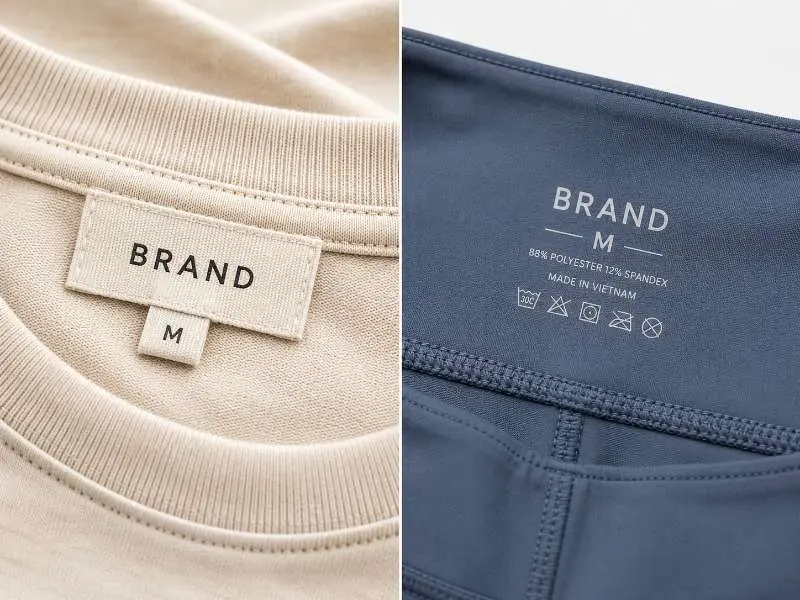
The two main production methods for sewn-in garment labels are woven and printed. Each has distinct strengths, and the right choice depends on what the label needs to do and which garment type it will be sewn into.
| Factor | Woven Label | Printed Label (Satin / Heat Transfer / TPU) |
|---|---|---|
| Durability | High — the design is woven into the fabric and usually holds up well through repeated wear and washing | Depends on method: satin printed is washfast; heat transfer can crack over time on stretchy fabrics |
| Color reproduction | Limited thread colors; not suitable for gradients or photographic detail | Supports more colors than woven labels, including gradients, photos, and fine text depending on print method |
| Comfort | Can feel stiff on thin or sheer fabrics | Heat transfer and TPU labels are soft and tagless — important for activewear and childrenswear |
| Best for | Brand neck labels, logo tabs, hem labels, woven patches | Care labels, size labels, allergy-friendly tagless labels for athleticwear or babywear |
| Cost direction | Higher unit cost; durable for the life of the garment | Lower unit cost; heat transfer setup involves a one-time screen or plate fee |
| MOQ tendency | Depends on label supplier, material, size, and artwork complexity | Often lower; some printed options available in smaller runs |
Most brands use woven labels for visible brand identity and printed or heat-transfer labels for care, size, and comfort-sensitive placements.
A typical OEM label set for a mid-range fashion brand combines both: a woven damask label at the neck for brand identity, and a satin-printed or heat-transfer label at the side seam carrying care, fiber, and country information.
Within woven labels, material choice matters:
Within printed labels:
Labeling requirements vary by destination market, retailer channel, and product category. The table below gives brand buyers a practical starting point, but final label artwork should be checked against the market where the garments will be sold.
| Requirement | United States (FTC) | European Union (EU 1007/2011 + GPSR) | Australia (ACCC) |
|---|---|---|---|
| Fiber content | Required — list all fibers ≥5% by weight in descending order using generic fiber names | Required — fibre composition under Regulation (EU) 1007/2011 | Check retailer and category requirements |
| Country of origin | Required — permanent label, e.g. 'Made in China' | Not covered by EU textile fibre labelling rules; check national/import rules | If origin is claimed, it must not be false or misleading |
| Care instructions | Required — washing or dry-cleaning instructions (FTC Care Labeling Rule 16 CFR Part 423) | Not harmonised under EU textile fibre labelling rules; often requested by retailers | Required under care labelling mandatory standard |
| Care symbol standard | ASTM symbols only (ISO symbols not yet accepted by FTC) | ISO 3758 commonly used where care symbols are provided | English instructions or 5 internationally recognised care symbols |
| Manufacturer identity | Required — brand name, importer name, or FTC-registered RN number | Check GPSR/responsible economic operator requirements for EU sale | Check importer/retailer requirements |
| Language requirement | English required | Language of destination market may apply | English or accepted care symbols |
| Special national requirements | State flammability laws (e.g. CA Prop 65) may apply to certain product types | France and other EU markets may have additional sorting, recycling, or retailer requirements | None beyond federal standard |
This table should be treated as a planning checklist, not a substitute for market-specific legal review before final label approval.
A few practical notes on the above:
For U.S. textile label requirements, use the FTC’s dedicated textile labeling guide as the primary reference: FTC: Threading Your Way Through the Labeling Requirements Under the Textile and Wool Acts.
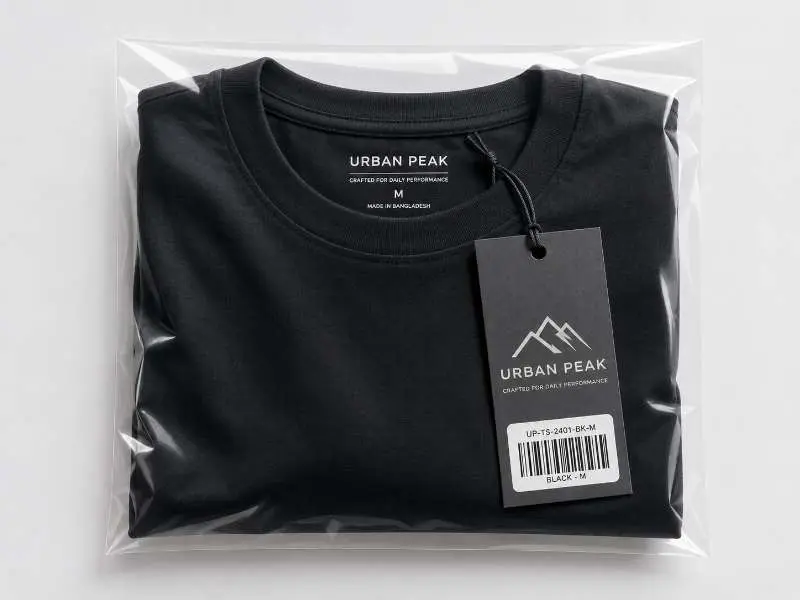
Hang tags are brand-facing rather than compliance-facing, but they sit at the intersection of retail requirements and brand presentation. For brands supplying to wholesale accounts or retail chains, tag specifications are often dictated by the retailer, not the brand.
Barcode format by market:
| Barcode Type | Digits | Primary Market | Notes |
|---|---|---|---|
| UPC-A | 12 | United States / Canada | Common for North American retail; retailer requirements should be confirmed before printing |
| EAN-13 | 13 | Europe / International | Common for Europe and many international retail channels |
| QR Code | Variable | All markets (supplementary) | Can carry product URLs, care guides, or sustainability info; does not replace UPC/EAN for POS scanning |
Barcode selection should follow the retailer's market and POS requirements before hang tags are printed.
For retail barcodes, brands should plan GS1 GTINs early. Each style, color, and size variation usually needs its own unique code, so barcode planning should happen before hang tags are printed.
Hang tag design elements to prepare:
Retail packaging options:
For some DDP (Delivered Duty Paid) orders, factories may help with barcode sticker application and carton labeling before shipment. This can reduce destination-side handling, but the exact scope should be confirmed in the order terms and packing requirements.
The most common cause of label-related production delays is not compliance gaps — it is late or incorrectly formatted file submissions. Factories can only proceed with label sourcing once artwork is finalized and approved. Here is what needs to happen, and in what order.
Step 1 — Prepare artwork files
Step 2 — Confirm label dimensions
| Label Type | Planning Size Reference (mm) | Notes |
|---|---|---|
| Neck / brand label (center fold) | 20×60 or 25×80 | Width × height before folding |
| Care label (end fold) | 25×75 or 30×100 | Depends on content volume — more text requires taller label |
| Size tab | 15×25 or 20×30 | Typically a separate small label sewn under the main neck label |
| Hang tag | 50×80 or 60×90 | Coated paper standard; die-cut shapes add cost and lead time |
These are planning references only; final dimensions should be confirmed after artwork, fold type, content volume, and label supplier sampling.
Step 3 — Timing: when to send label files to your factory
Labels need to be physically produced and delivered to the factory before bulk sewing begins. The typical production chain looks like this:
The time from artwork submission to labels arriving at the factory is often several weeks, depending on label type, supplier location, proofing rounds, and physical sample approval. As a safer rule, label files should be prepared with the tech pack rather than left until after sample approval.
Brands that treat labels as an afterthought are more likely to create approval delays, extra courier steps, or last-minute packing changes.
Step 4 — Approval checkpoints
Label requirements are not identical across all garment categories. Placement standards, attachment methods, and the comfort sensitivity of the end product vary by product type. Here is how label configuration typically differs across Runtang's main product lines.
| Product Category | Recommended Label Types | Key Considerations |
|---|---|---|
| T-Shirts | Woven neck label (or heat-transfer for tagless); satin-printed care label at side seam | Heat-transfer is increasingly preferred for next-to-skin comfort; tagless setup requires no physical label sewing step |
| Hoodies | Woven neck label; printed care/size label at side seam; optional woven patch at chest or sleeve | Drawstring, patch, and neck-label placement should be confirmed in the tech pack, especially for retail or EU-bound orders. |
| Leggings / Activewear | Heat-transfer or TPU inner waistband label; side seam care label | Stretch fabrics require labels that move with the garment — woven labels can cause discomfort or distortion; heat-transfer or laser-cut TPU are preferred |
| Pajama Sets | Woven neck label; printed care label; outer hang tag; gift box or individual polybag | Children's pajama orders may require additional safety and labelling checks, including market-specific sleepwear rules. |
| Polo Shirts | Woven neck label; care label at side seam; optional brand tab at hem | Corporate polo buyers often require specific placement of company logo vs brand identity label — confirm in tech pack |
| Sweatshirts | Woven neck label; printed care label; optional woven patch | Similar to hoodies; heavy fleece garments may require larger label formats for readability |
At Runtang, label position and attachment method can be confirmed during the pre-production sample stage. Before bulk sewing begins, brands should review label placement on a sample garment so issues with positioning, fold, or legibility can be caught before QC inspection.
Brands sourcing across multiple product lines — for example, a brand building a full collection of custom hoodies, t-shirts, and pajama sets — benefit from establishing a master label spec sheet early. For brands building a broader private label clothing setup, the label spec sheet should connect with hang tags, packaging format, SKU barcodes, and carton labeling from the start.
For most U.S. textile apparel, labels should cover fiber content, country of origin, and the identity of the manufacturer, importer, or another responsible business. Clothing also needs care instructions under the FTC Care Labeling Rule. Many brands combine these fields on one sewn-in care label for production efficiency.
Woven labels integrate the design into the fabric using threads, making them durable for long-term brand identity use. Printed labels apply design onto fabric via ink. Woven labels are preferred for brand identity elements that should last the life of the garment; printed labels (especially heat-transfer) are preferred for care and size information on activewear or childrenswear where softness and comfort matter.
Label artwork should be submitted at the same time as the tech pack — not after sample approval. The timeline depends on label type, supplier location, proofing rounds, and whether a physical sample is required. A safer approach is to prepare label artwork with the tech pack so labels can be approved before bulk sewing begins.
Yes. Each unique style, color, and size variation normally needs its own GTIN. For retail barcode planning, a t-shirt in three colors and five sizes would normally require fifteen unique codes. Brands should confirm barcode requirements with GS1 and the retailer before hang tags are printed.
Yes. Runtang can coordinate label sourcing from supplier networks based on brand-approved artwork. This is common in full-package orders. The brand provides final artwork and approval; the factory manages production timing and quality check against the approved sample. This reduces the number of vendors brands need to manage directly.
Standard options include individual polybags (most common for wholesale), hanger packaging, folded flat with belly band, and gift box. Gift box packaging is standard for pajama sets and couple-matching items sold as gifting products. Packaging format should be confirmed at the sampling stage as it affects final carton dimensions, weight, and freight cost.
EU fibre composition information should be understandable in the market of sale. Care symbols can reduce translation needs when they are accepted by the retailer or market. For France, confirm Triman and sorting-information requirements before final label or packaging artwork approval.
Labels and packaging are often the final step that makes a collection retail-ready, and they are easy to underestimate during OEM planning. If you are building out your label specification alongside an OEM production order, our team can walk you through the process from artwork requirements to placement confirmation during sampling.
Working on a new collection? Share your tech pack or label requirements with us, and we will advise on what needs to be prepared at each stage of production. You can review our full-package OEM clothing production support or send the requirements directly for a factory-side check.
 T-shirts Related
How to Make Tie Dye Personalized T-Shirts: Full Step-By-Step Process to Customize Tie Dye T-shirts
READ MORE Pajamas Related
Winter Night Essentials for the Family: A Guide to Choosing Comfortable Family Christmas Pajamas
READ MORE Customization & Craft Guide
Lab Dip and Bulk Color Approval for Custom Apparel Orders: A Brand Buyer’s Guide
READ MORE Garment Material Insights
Corduroy Fabric Characteristics and Application
READ MORE T-shirts Related
Sourcing Oversized T-Shirts Wholesale: What Drop Shoulder Spec and GSM Tell Your Factory
READ MORE